


Physicians' attitudes towards patients with substance-related disorders predict training needs in addiction medicine: challenges and opportunities for strengthening the global addiction medicine workforce
- PMID: 40598317
- PMCID: PMC12211938
- DOI: 10.1186/s12909-024-05109-7
Physicians' attitudes towards patients with substance-related disorders predict training needs in addiction medicine: challenges and opportunities for strengthening the global addiction medicine workforce
Abstract
Background: Substance use disorders (SUD) prevalence rises. Barriers to the expansion of global addiction workforce are a lack of qualified addiction physicians and healthcare providers' negative attitudes/stigmatization towards patients with SUD (PWSUD), negative impacting treatment outcomes. Attitudes towards PWSUD and professional competence are associated. In order to confirm this association and to develop a stigma-focused model for strengthening global addiction services, this study explores the relationship between professional attitudes towards PWSUD and perceived competence.
Methods: The MCRS, measuring professionals' attitudes towards patients with SUD, and the AM-TNA, measuring perceived training needs and competence gaps, were used to study the association between attitudes and competence. We used Pearson correlation, multiple regression, and PROCESS path analysis in a cross-sectional study design in a convenience sample of addiction physicians trained in The Netherlands (Dutch) (N = 70) and in Lithuanian (Lithuania) (N = 75) to explore this association and a possible moderation effect of the Gender and Country of Origin variables among addiction caregivers.
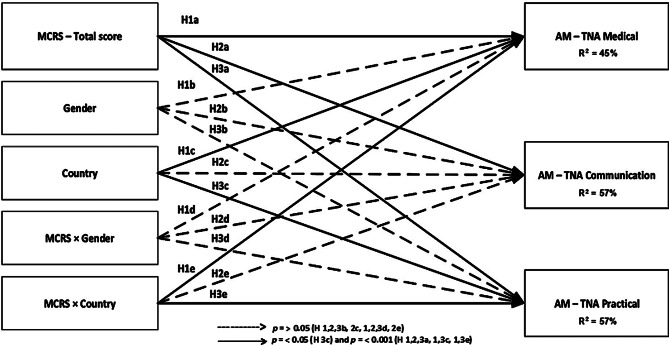
Results: We found a significant positive correlation between the total score of both scales: R = 0.537, p < 0.001. The MCRS predicted the three AM-TNA subscales significantly p < 0.001, and Gender did not influence the association between the two scales. The Country of Origin variable and its combination with the MCRS total score did strengthen the association between the MCRS and two AM-TNA subscales: medical- (p < 0.001) and practical aspects of perceived addiction competence (p < 0.05).
Conclusions: Knowledge and skills influence attitudes, while attitudes predict these: they are intertwined and mutually reinforcing, meaning that addiction physicians with positive attitudes are likelier to have and want better-developed addiction knowledge and skills. To improve addiction services and reduce stigma, combining the MCRS and the AM-TNA could reveal specific SUD competence gaps and offers an opportunity to model the design of an integrated, stigma-focused, addiction training or intervention approach. Future research should focus on the longitudinal use of the combined scales, assess individual professionals' progress, and compare and combine self-reported competencies and attitudes with validated external assessments of learning, attitudes, self-efficacy and cognitive dissonance.
Keywords: Addiction medicine; Attitudes; Global addiction workforce; SUD competencies; Self-assessment; Training needs.
© 2025. The Author(s).
Conflict of interest statement
Declarations. Ethics approval and consent to participate: The research was conducted ethically following the World Medical Association Declaration of Helsinki. Study approval: the study protocol was reviewed and approved by the Kaunas Lithuanian University of Health Sciences Ethics Committee: approval number Nr-BC-LSMU-121 and in The Netherlands by the Radboud University (ECSW 2015-2508-33). Written informed consent was obtained from all participants. Consent for publication: Not applicable. Competing interests: The authors declare no competing interests.
Figures

References
-
- World Health Organization. Atlas on substance use: resources for the prevention and treatment of substance use disorders. World Health Organization. 2017. https://www.who.int/substance_abuse/activities/fadab/msb_adab_2017_atlas.... Accessed October 17, 2022.
-
- Degenhardt L, Hall W. Extent of illicit drug use and dependence, and their contribution to the global burden of disease. Lancet. 2012;379(9810):55–70. - PubMed
-
- Degenhardt L, Charlson F, Ferrari A, Santomauro D, Erskine H, Mantilla-Herrara A, Whiteford H, Leung J, Naghavi M, Griswold M, Rehm J. The global burden of disease attributable to alcohol and drug use in 195 countries and territories, 1990–2016: a systematic analysis for the global burden of Disease Study 2016. Lancet Psychiatry. 2018;5(12):987–1012. - PMC - PubMed
-
- UNODC. United Nations office on drugs and crime. Global drug use is rising, while COVID-19 has far-reaching Impacts on global drug markets Press Release. 2020. https://www.unodc.org/unodc/press/releases/2020/June/media-advisory---gl.... Accessed November 26, 2023.
MeSH terms
LinkOut - more resources
Full Text Sources
Medical
