


Association between the dietary index for gut microbiota and constipation in American adults
- PMID: 40598518
- PMCID: PMC12210596
- DOI: 10.1186/s12937-025-01164-y
Association between the dietary index for gut microbiota and constipation in American adults
Abstract
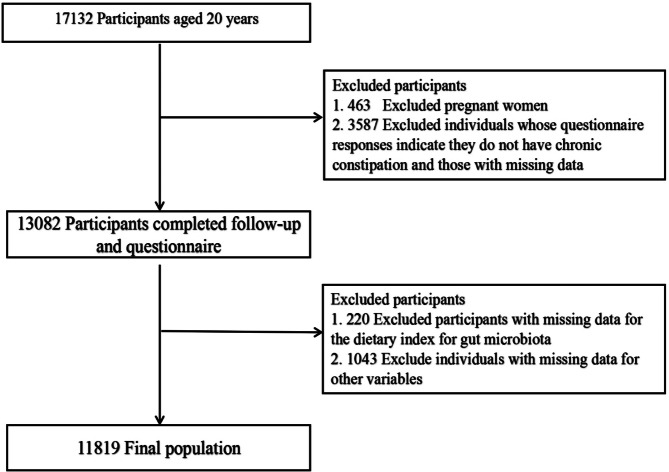
Constipation, a common gastrointestinal disorder, significantly impacts quality of life.Its association with gut microbiota has garnered attention.Dietary factors play a crucial role in the development and management of constipation.The recently introduced dietary index for gut microbiota (DI-GM), a measure of gut microbiota diversity, offers insights into this connection.The association between dietary gut microbiota index and constipation is a critical public health issue.This study investigated the association between DI-GM and constipation prevalence in the American population using data from 11,819 individuals from the National Health and Nutrition Examination Survey (NHANES) between 2005 and 2010.Constipation was defined using Bristol stool form scale types 1 and 2.Dietary recall information was used to determine the DI-GM score, indicating the dietary influence on the gut microbiome. Multivariate weighted logistic regression, adjusted for confounders, was performed to analyze the association between DI-GM scores and constipation prevalence.Further analyses included a subgroup analysis and restricted cubic splines to explore this association [restricted cubic spline(RCS)].An increased DI-GM index, indicating a healthier gut microbiome, was related to a decreased risk of constipation.A similar association was observed with a more favorable score for beneficial gut microbiota.Non-linear associations between DI-GM scores and constipation were identified through RCS analysis.Subgroup and interaction analyses confirmed the consistency of these findings across strata, suggesting no significant heterogeneity.These findings suggest that dietary adjustments may be an important method for preventing constipation.
Keywords: Constipation; Dietary index for gut microbiota (DI-GM); General population; NHANES.
© 2025. The Author(s).
Conflict of interest statement
Declarations. Ethics approval and consent to participate: The institutional review board approved the NHANES protocol of the Centers for Disease Control and Prevention (CDC), and each participant provided written informed consent.The authors of this study thank the participants of the NHANES and the NHANES staff. Consent for publication: Not applicable. Competing interests: The authors declare no competing interests.
Figures


References
-
- Huang L, Zhu Q, Qu X, Qin H. Microbial treatment in chronic constipation. Sci China Life Sci. 2018;61(7):744–52. 10.1007/s11427-017-9220-7. (2018). - PubMed
-
- Barberio B, Judge C, Savarino EV, Ford AC. Global prevalence of functional constipation according to the Rome criteria: a systematic review and meta-analysis. Lancet Gastroenterol Hepatol. 2021;6(8):638–648.10.1016/S2468-1253(21)00111-4(2021). - PubMed
-
- Camilleri M, Ford AC, Mawe GM, Dinning PG, Rao SS, Chey WD, Simrén M, Lembo A, Young-Fadok TM, Chang L. Chronic constipation. Nat Rev Dis Primers. 2017;3:17095.10.1038/nrdp.2017.95(2017). - PubMed
-
- Sethi S, Mikami S, Leclair J, Park R, Jones M, Wadhwa V, Sethi N, Cheng V, Friedlander E, Bollom A, Lembo A. Inpatient burden of constipation in the united states: an analysis of National trends in the united States from 1997 to 2010. Am J Gastroenterol. 2014;109(2):250–6. 10.1038/ajg.2013.423. (2014). - PubMed
-
- Suares NC, Ford AC. Prevalence of, and risk factors for, chronic idiopathic constipation in the community: systematic review and meta-analysis. Am J Gastroenterol. 2011;106(9):1582-91; quiz 1581, 1592.10.1038/ajg.2011.164(2011). - PubMed
MeSH terms
LinkOut - more resources
Full Text Sources
Medical
