


Knowledge, Attitude, Practice, and Determinants of Community Health Workers' Involvement Toward NCD Prevention and Control in Northern Tanzania: A Cross-Sectional Study
- PMID: 40599415
- PMCID: PMC12208910
- DOI: 10.1002/hsr2.70978
Knowledge, Attitude, Practice, and Determinants of Community Health Workers' Involvement Toward NCD Prevention and Control in Northern Tanzania: A Cross-Sectional Study
Abstract
Background and aim: Globally, non-communicable diseases (NCDs) are the leading cause of preventable morbidity and premature mortality. In sub-Saharan Africa, NCDs will be the leading cause of mortality by 2030. In 2018, WHO reported that NCDs accounted for about 33% of all deaths in Tanzania. Community health workers (CHWs) are among the key stakeholders in prevention and control of NCDs. In developing countries like Tanzania, CHWs play an extensive role in prevention and control of communicable diseases, however, their simultaneous involvement toward NCDs is limited. This study aimed to determine knowledge, attitude, practice, and determinants toward CHWs' involvement in NCDs prevention and control in northern Tanzania.
Methods: This was a community-based analytical cross-sectional study in northern Tanzania enrolling 191 CHWs. Frequencies and percentages, χ 2, and logistic regression tests were used to summarize categorical variables and determinants of CHWs' involvement toward NCDs prevention and control, respectively, using SPSS.
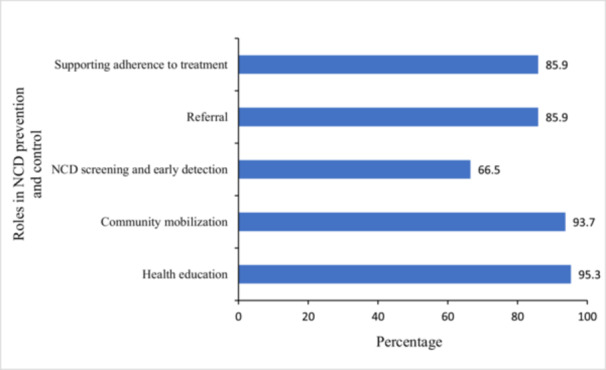
Results: Majority of participants had good knowledge (92.1%) and favorable attitude (100%). More than half (63.4%) were involved in NCD prevention and control programs of which only 26.7% and 41.4% reported to have involved in NCDs screening and community mobilization programs, respectively. Only 36.1% and 46.1% reported to have access to NCDs screening tools and to have ever attended either formal NCD seminar or training, respectively. Professional training to practice as CHW, frequency of home visits per week, involvement confidence, attendance of formal seminar or training on NCDs, and accessibility of tools for NCDs screening were determinants of CHWs' involvement in NCDs prevention and control.
Conclusion: Despite the vital role of CHWs toward NCDs prevention and control, their engagement in NCDs screening and community mobilization is still low in northern Tanzania. Professional training among in-service and newly enrolled CHWs, encouragement of weekly home visits, and NCDs' capacity-building programs in terms of skills and accessibility of screening tools should be implemented among CHWs to enhance their involvement in NCDs prevention and control.
Keywords: NCD prevention and control; community healthcare workers; non‐communicable diseases; public health.
© 2025 The Author(s). Health Science Reports published by Wiley Periodicals LLC.
Conflict of interest statement
The authors declare no conflicts of interest.
Figures
References
-
- “Non‐Communicable Disease: What Is It and How Does It Work?,” accessed July 24, 2022, https://www.webmd.com/a-to-z-guides/what-is-non-communicable-disease.
-
- “Definition of Premature Death,” – NCI Dictionary of Cancer Terms – NCI, accessed July 24, 2022, https://www.cancer.gov/publications/dictionaries/cancer-terms/def/premat....
-
- Robinson H. M. and Hort K., “Non‐Communicable Diseases and Health Systems Reform in Low‐and‐Middle‐Income Countries,” Pacific Health Dialog 18, no. 1 (2012): 179–190, https://pubmed.ncbi.nlm.nih.gov/23240355/. - PubMed
-
- WHO, Noncommunicable Diseases (WHO, 2023), https://www.who.int/news-room/fact-sheets/detail/noncommunicable-diseases.
LinkOut - more resources
Full Text Sources
