


Assessment of Functional Recovery and Complications in Adult Diaphyseal Femur Fractures Treated With Closed Intramedullary Interlocking Nailing
- PMID: 40599521
- PMCID: PMC12208812
- DOI: 10.7759/cureus.85120
Assessment of Functional Recovery and Complications in Adult Diaphyseal Femur Fractures Treated With Closed Intramedullary Interlocking Nailing
Abstract
Background: Adults often sustain high-energy injuries called diaphyseal fractures of the femur, which are typically treated surgically for the greatest cure.
Objective: This study evaluated the functional and radiological outcomes of adult diaphyseal femur fractures treated with closed intramedullary interlocking nailing over a 12-month follow-up using standardized clinical tools.
Methodology: This prospective observational study was conducted at the Department of Orthopedic Surgery, Bacha Khan Medical College, from January 2022 to December 2023. This study included 96 adult patients who had solitary diaphyseal femur fractures treated with closed intramedullary interlocking nailing. We gathered information on recovery parameters, fracture characteristics, and demographics. The Harris hip score and visual analog scale (VAS) were used to measure functional outcomes at six weeks, three months, six months, and one year. Data analysis was done using Statistical Package for the Social Sciences version 25.0 (IBM Corp., Armonk, NY).
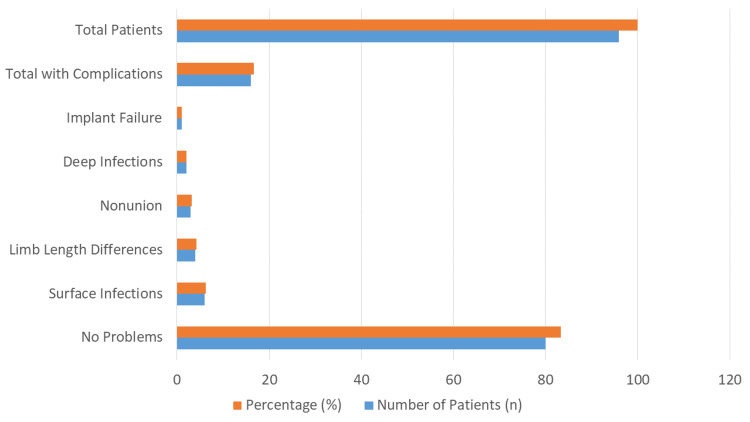
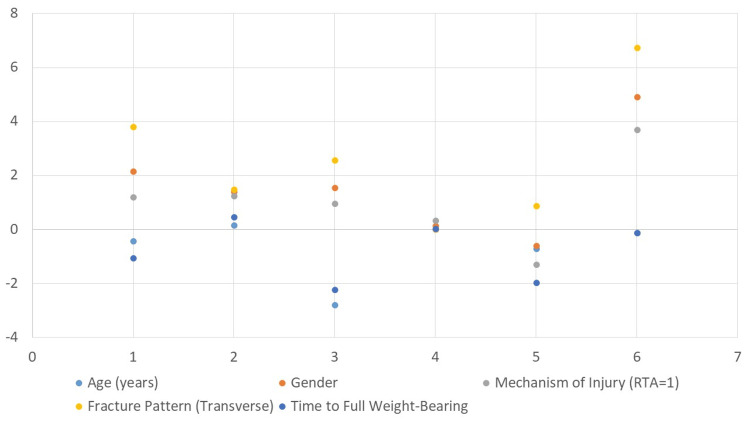
Results: The average time to reach radiological union was 14.83 ± 3.12 weeks, and the time to full weight-bearing was 10.42 ± 2.65 weeks. The average range of motion was 122.3° ± 11.8° for the knee and 116.7° ± 10.5° for the hip. At one year, the mean Harris hip score increased from 71.45 ± 13.21 at six weeks to 85.27 ± 8.46, with 39.58% of patients having outstanding scores. The mean pain decreased from 5.27 ± 1.82 to 2.17 ± 1.35, indicating a substantial fall in VAS ratings as well. Sixteen patients (16.67%) had complications, with superficial infections accounting for most cases (n = 6; 6.25%). Transverse fractures (p = 0.035) and early weight-bearing (p = 0.038) were linked to better functional results.
Conclusion: Closed intramedullary interlocking nailing is an effective treatment for diaphyseal femur fractures, promoting early recovery with favorable functional outcomes and minimal complications.
Keywords: femoral shaft fractures; functional outcome; harris hip score; interlocking nailing; orthopedic surgery; visual analog scale.
Copyright © 2025, Ahmad et al.
Conflict of interest statement
Human subjects: Consent for treatment and open access publication was obtained or waived by all participants in this study. Medical Teaching Institution, Bacha Khan Medical College issued approval 1132/BKMC. Animal subjects: All authors have confirmed that this study did not involve animal subjects or tissue. Conflicts of interest: In compliance with the ICMJE uniform disclosure form, all authors declare the following: Payment/services info: All authors have declared that no financial support was received from any organization for the submitted work. Financial relationships: All authors have declared that they have no financial relationships at present or within the previous three years with any organizations that might have an interest in the submitted work. Other relationships: All authors have declared that there are no other relationships or activities that could appear to have influenced the submitted work.
Figures
References
-
- Incidence of traumatic long-bone fractures requiring in-hospital management: a prospective age- and gender-specific analysis of 4890 fractures. Meling T, Harboe K, Søreide K. Injury. 2009;40:1212–1219. - PubMed
-
- The etiology and pattern distribution of closed long bone diaphyseal fractures: a prospective survey in a regional trauma center Enugu, Nigeria. Iyidobi EC, Anijunsi LP, Enweani U, Ekwunife RT, Agbo EO, Ozioko US. https://www.researchgate.net/publication/359598782_The_etiology_and_patt... Ann Clin Biomed Res. 2022;3
-
- Distal femur fractures. Surgical techniques and a review of the literature. Ehlinger M, Ducrot G, Adam P, Bonnomet F. Orthop Traumatol Surg Res. 2013;99:353–360. - PubMed
LinkOut - more resources
Full Text Sources