


A comparative analysis of clinical outcomes in hematological patients afflicted with bacteremia attributable to carbapenem-resistant Klebsiella pneumoniae versus Escherichia coli
- PMID: 40599648
- PMCID: PMC12209189
- DOI: 10.3389/fcimb.2025.1600746
A comparative analysis of clinical outcomes in hematological patients afflicted with bacteremia attributable to carbapenem-resistant Klebsiella pneumoniae versus Escherichia coli
Abstract
Introduction: Carbapenem-resistant Enterobacterales (CRE) bloodstream infections (BSI) represent a frequent and grave complication among hematological patients, whose prevailing culprits are Carbapenem-Resistant Klebsiella pneumoniae (CRKP) and Escherichia coli bacteremia (EC). Nevertheless, there is a paucity of studies that have undertaken a comparative analysis of clinical outcomes in patients afflicted with CRKP and EC.
Methods: This study was conducted with the aim of identifying the microbiological and clinical characteristics of hematological patients suffering from bacteremia caused by CRKP and CREC.
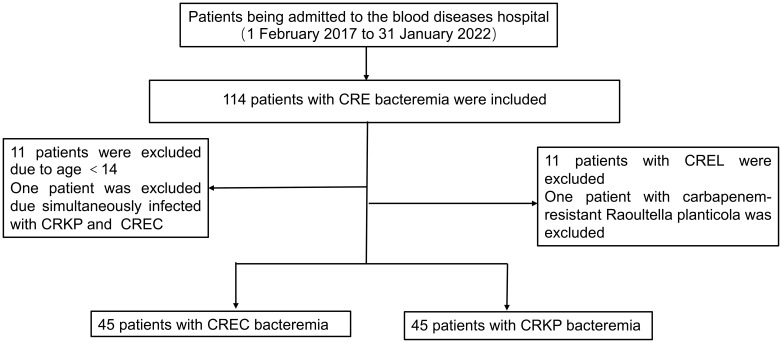
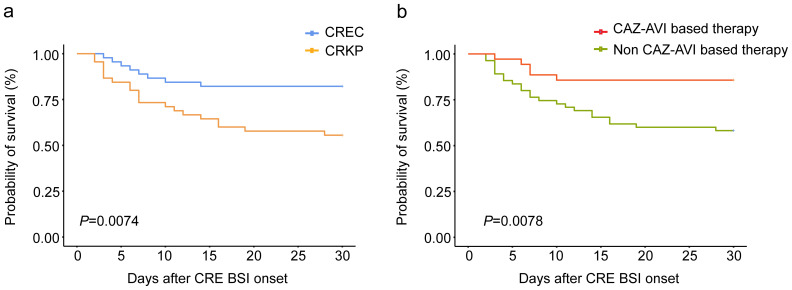
Results: The cohort included 90 patients with equal proportions of CRKP BSI and CREC BSI from 2017 to 2022. Among the tested CRE strains (n = 45) for carbapenemase (CP) genes, the KPC gene was most commonly found in CP-CRKP isolates (12/21), while the NDM gene predominated among CP-CREC strains (18/24). A comparison of drug susceptibility showed that CREC was significantly more susceptible to tigecycline than CRKP (97.73% vs. 64.86%, P = 0.018). Patients treated with tigecycline-based therapy had a higher survival rate in the CREC group (18/24,75%) compared to the CRKP group (8/14,57.1%). The CRKP group had a significantly lower rate of prior cephalosporin use within 30 days compared to the CREC group (27% vs. 49%, P = 0.03) and a higher incidence of multi-site infections before BSI (44% vs. 8.9%, P<0.001). Multivariate analysis showed that BSI caused by CRKP was an independent risk factor for survival (P = 0.029), while CAZ-AVI-based therapy emerged as an independent factor improving patient prognosis (P =0.013).
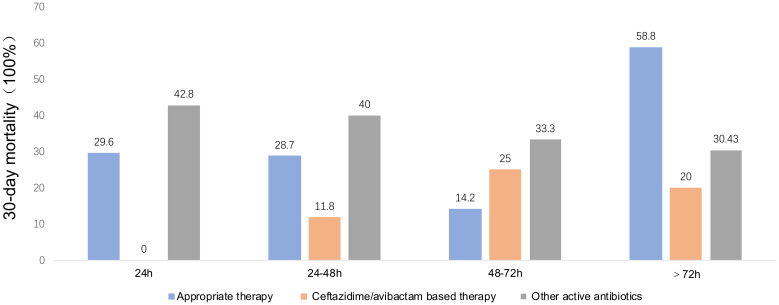
Conclusions: Our results found that bacteremia instigated by CRKP was associated with a less favorable prognosis when compared to cases induced by CREC. Moreover, treatment regimens incorporating CAZ-AVI have the potential to enhance the prognosis of patients grappling with CRE BSI.
Keywords: bacteremia; carbapenem resistant Escherichia coli; carbapenem-resistant Klebsiella pneumoniae; clinical outcomes; hematological patients.
Copyright © 2025 Wang, Liu, Lin, Zhang, Zheng, Xiao, Wang, Pang, He, Jiang, Feng, Han and Zhai.
Conflict of interest statement
The authors declare that the research was conducted in the absence of any commercial or financial relationships that could be construed as a potential conflict of interest.
Figures
References
-
- Adeolu M., Alnajar S., Naushad S., Gupta R. S. (2016). Genome-based phylogeny and taxonomy of the 'Enterobacteriales': proposal for Enterobacterales ord. nov. divided into the families Enterobacteriaceae, Erwiniaceae fam. nov., Pectobacteriaceae fam. nov., Yersiniaceae fam. nov., Hafniaceae fam. nov., Morganellaceae fam. nov., and Budviciaceae fam. nov. Int. J. Syst. Evol. Microbiol. 66, 5575–5599. doi: 10.1099/ijsem.0.001485 - DOI - PubMed
-
- Chen J., Xiang Q., Wu J. Y., Huang X. B., Wang C., Wei D. Q., et al. (2022). Different Effects of Antibiotics on Klebsiella pneumoniae and Escherichia coli Resistance Induced by Antibiotics: A Retrospective Study from China. Microb. Drug Resist. 28, 660–669. doi: 10.1089/mdr.2021.0326 - DOI - PMC - PubMed
-
- Davido B., Fellous L., Lawrence C., Maxime V., Rottman M., Dinh A. (2017). Ceftazidime-avibactam and aztreonam, an interesting strategy to overcome β-lactam resistance conferred by metallo-β-lactamases in enterobacteriaceae and pseudomonas aeruginosa. Antimicrob. Agents Chemother. 61. doi: 10.1128/aac.01008-17 - DOI - PMC - PubMed
Publication types
MeSH terms
Substances
LinkOut - more resources
Full Text Sources
Medical
Miscellaneous
