


Describing Diet of Imperiled Sierra Nevada Red Foxes and a Carnivoran Competitor Using DNA Metabarcoding
- PMID: 40599880
- PMCID: PMC12209344
- DOI: 10.1002/ece3.71605
Describing Diet of Imperiled Sierra Nevada Red Foxes and a Carnivoran Competitor Using DNA Metabarcoding
Abstract
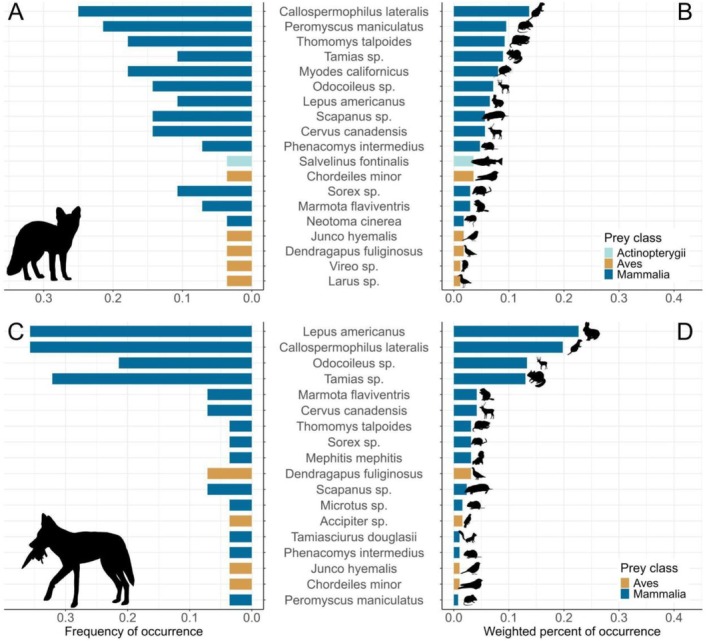
Montane red foxes (Vulpes vulpes ssp.) native to western North America are of broad conservation interest, occupying a narrow ecological niche and typically restricted to small, isolated populations. However, many aspects of montane red fox ecology are poorly understood due to their rarity. We examined Sierra Nevada red fox (V. v. necator) diet in an unstudied portion of their range, then evaluated dietary overlap with coyote (Canis latrans), a presumably dominant carnivore expected to exhibit future distributional increases. We collected Sierra Nevada red fox and coyote scats via detection dog team surveys during 2017-2018 in Oregon, USA and used DNA metabarcoding to determine scat composition. Sierra Nevada red fox and coyote diets differed with respect to the most frequently occurring prey species and prey species that comprised the largest proportions of their diets (red fox - golden-mantled ground squirrel [Callospermophilus lateralis]; coyote - snowshoe hare [Lepus americanus]). Despite some differences, Sierra Nevada red fox and coyote diets exhibited similar taxonomic richness and their dietary overlap was high (Pianka's index = 0.74 via weighted percent occurrence, 0.69 via frequency of occurrence), with golden-mantled ground squirrel appearing to be an important prey item for both species. High dietary overlap suggests potential for competition between Sierra Nevada red foxes and coyotes where the two species occur sympatrically, which could be consequential for foxes in the future if spatial overlap increases and results in niche compression. Our work addresses an aspect of data insufficiency for an imperiled species that can inform conservation strategies and species management.
© 2025 The Author(s). Ecology and Evolution published by British Ecological Society and John Wiley & Sons Ltd.
Conflict of interest statement
The authors declare no conflicts of interest.
Figures


References
-
- Akins, J. R. 2017. “Distribution, Genetic Structure, and Conservation Status of the Cascade Red Fox in Southern Washington.” PhD diss., University of California, Davis, California, USA.
-
- Aubry, K. B. 1983. “The Cascade Red Fox: Distribution, Morphology, Zoogeography and Ecology (Washington, Oregon, British Columbia).” PhD diss., University of Washington, Seattle, Washington, USA.
-
- Aubry, K. B. , Statham M. J., Sacks B. N., Perrine J. D., and Wisely S. M.. 2009. “Phylogeography of the North American Red Fox: Vicariance in Pleistocene Forest Refugia.” Molecular Ecology 18, no. 12: 2668–2686. - PubMed
-
- Bekoff, M. 1977. “Canis latrans.” Mammalian Species 79: 1–9.
-
- Beniston, M. 2005. “Mountain Climates and Climatic Change: An Overview of Processes Focusing on the European Alps.” Pure and Applied Geophysics 162: 1587–1606.
LinkOut - more resources
Full Text Sources
Miscellaneous
