. 2025 Apr 25;7(3):fcaf159.
doi: 10.1093/braincomms/fcaf159. eCollection 2025.

An artificial intelligence-derived metabolic network predicts psychosis in Alzheimer's disease

Affiliations

An artificial intelligence-derived metabolic network predicts psychosis in Alzheimer's disease

Nha Nguyen et al. Brain Commun. .

Abstract

The delusions and hallucinations that characterize Alzheimer's disease psychosis (AD + P) are associated with violence towards caregivers and an accelerated cognitive and functional decline whose management relies on the utilization of medications developed for young people with schizophrenia. The development of novel therapies requires biomarkers that distinguish AD + P from non-psychotic Alzheimer's disease. We investigated whether there might exist a brain metabolic network that distinguishes AD + P from non-psychotic Alzheimer's disease that could be used as a biomarker to predict and track the course of AD + P for use in clinical trials. Utilizing F-18 fluorodeoxyglucose positron emission tomography scans from cohorts of cognitively healthy elderly (N = 174), those with Alzheimer's disease without psychosis (N = 174) and those with AD + P (N = 88) participating in the Alzheimer's Disease Neuroimaging Initiative study, we employed a convolutional neural network to identify and validate the Alzheimer's Psychosis Network. We analysed network progression, clinical correlations and psychosis prediction using expression scores and network organization using graph theory. The Alzheimer's Psychosis Network accurately distinguishes AD + P from controls (97%), with increasing scores correlating with cognitive decline. The Alzheimer's Psychosis Network-based approach predicts psychosis in Alzheimer's disease with 77% accuracy and identifies specific brain regions and connections associated with psychosis. Alzheimer's Psychosis Network expression was found to be associated with increased cognitive and functional decline that characterizes AD + P. The increased metabolic connectivity between motor and language/social cognition regions in AD + P may drive delusions and agitated behaviour. Alzheimer's Psychosis Network holds promise as a biomarker for AD + P, aiding in treatment development and patient stratification.

Keywords: Alzheimer’s disease psychosis; biomarker; convolutional neural network; explainable AI; metabolic brain networks.


Conflict of interest statement

The authors report no competing interests.

Figures

Graphical Abstract
Graphical Abstract
Figure 1
Figure 1
Flowchart of the study design. We developed a 3D residual neural network to characterize the Alzheimer’s disease psychosis network using FDG PET scans obtained from the ADNI database. After the training phase, we employed an explainable deep learning technique to generate explainable maps and expression scores for each scan. The AD + P expression scores were then utilized to assess the rate of network progression through longitudinal scans, evaluate correlations with clinical measures and predict psychosis in AD. Additionally, metabolic network analysis was conducted within the ADPN space to identify differences in network organization among the groups. ADNI, Alzheimer’s Disease Neuroimaging Initiative.
Figure 2
Figure 2
Alzheimer’s disease psychosis network (ADPN). The ADPN was identified from 142 AD + P and 142 HEC FDG PET scans and subsequently validated on a dataset consisting of 32 AD + P and 32 HEC scans. (A) Explainable map for the AD + P group (N = 87), computed by averaging the explainable maps of AD + P subjects. (B) The ADPN expression score at baseline exhibited an elevation in AD + P compared with the HEC subjects [training set: T(210) = 19.2, P < 10−45; testing set: T(47) = 5.6, P < 10−5). Student’s t-test was used to examine the difference in expression scores between the two groups. AD + P, AD with psychosis; AMY, amygdala; CAU, caudate; FF, fusiform; Grad-CAM, gradient-weighted class activation; HEC, healthy elderly controls; HES, Heschl; HIP, hippocampus; IFop, inferior frontal operculum; IFtri, inferior frontal triangularis; INS, insula; IT, inferior temporal; L, left; LING, lingual; MF, middle frontal; MT, middle temporal; ORBinf, inferior frontal orbital; PAL, pallidum; PH, parahippocampal; PoC, postcentral; PreC, precentral; PUT, putamen; R, right; ROL, rolandic operculum; SF, superior frontal; SMA, supplementary motor area; SMG, supramarginal; ST, superior temporal; THAL, thalamus; TPOmid, middle temporal pole; TPOsup, superior temporal pole.
Figure 3
Figure 3
Longitudinal changes in the ADPN expression scores. (A) In AD + P patients, expression scores increased significantly over time [F(3, 48) = 5.8, P = 0.002, N = 17]. Post hoc Bonferroni tests revealed a significant increase at 24 months compared with baseline (P = 0.001, N = 29), but not at 6 or 12 months. (B) In contrast, ADPN expression scores in healthy controls did not change significantly over time [F(3, 162) = 0.69, P = 0.56, N = 55]. Group differences and changes in expression scores during the follow-up period (6, 12 and 24 months) were assessed using a general linear model, with post hoc Bonferroni tests for pairwise comparisons of time points relative to baseline. AD + P, AD with psychosis; ADPN, Alzheimer’s disease psychosis network; HEC, healthy elderly controls.
Figure 4
Figure 4
Clinical-AD psychosis network correlations. In AD + P patients, the ADPN-based prediction scores significantly correlated with (A) Clinical dementia rating scale sum of boxes (CDRSB) (N = 87, training and testing), and (B) Mini-mental state examination (MMSE) (N = 87, testing). Pearson’s correlations were used to evaluate the associations between ADPN prediction scores and clinical measures (CDRSB and MMSE). Each data point represents the true and predicted scores for each subject scanned at baseline. AD + P, AD with psychosis; ADPN, Alzheimer’s disease psychosis network.
Figure 5
Figure 5
Differences between AD + P and AD−P in the ADPN at baseline. (A) The AD + P group (N = 87) showed a significantly higher ADPN score compared with AD−P (N = 174) (T(259) = 2.6, P = 0.009). (B) Difference in group explainable maps between AD + P (N = 87) and AD−P (N = 174). When compared with the AD−P patients, the AD + P exhibited brain regions with significantly higher expression scores (P < 0.05, Student’s t-test, Bonferroni correction; see Supplementary Table 5), including (i) the prefrontal cortex, (ii) the inferior parietal cortex, angular and supramarginal gyrus, (iii) the primary auditory cortex inclusive of Hesch’s gyri and the superior temporal cortex, (iv) the anterior and middle cingulate gyrus, (v) the insula and (vi) the supplemental motor area, the primary motor (M1) and somatosensory (S1) cortex. (C) The average expression score across these regions exhibited a significant elevation [T(259) = 4.4, P < 0.00002) in AD + P (N = 87)] compared with the AD−P (N = 174). Student’s t-test was used to examine the difference in expression scores between the two groups in A and C. AC, anterior cingulum; AD + P, AD with psychosis; AD−P, AD without psychosis; ADPN, Alzheimer’s disease psychosis network; ANG, angular; Grad-CAM, gradient-weighted class activation; HES, Heschl; IFop, inferior frontal operculum; INS, insula; IP, inferior parietal; L, left; MC, middle cingulum; MF, middle frontal; MT, middle temporal; PCL, paracentral lobule; PoC, postcentral; PreC, precentral; R, right; ROL, rolandic operculum; SF, superior frontal; SFmed, medial superior frontal; SMA, supplementary motor area; SMG, supramarginal; ST, superior temporal.
Figure 6
Figure 6
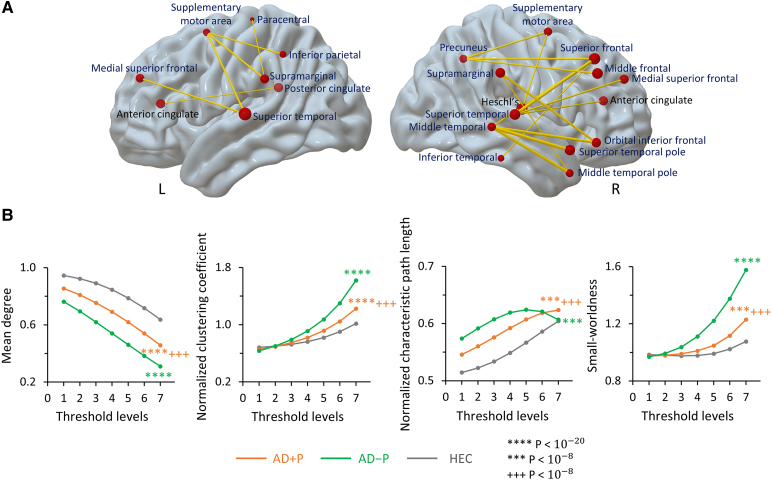
Alternations in the ADPN network organization. (A) Enhanced connections in AD + P (N = 87) relative to AD−P (N = 174). Changes in metabolic connectivity between the two groups were validated using bootstrapped data (N = 100 per group) and a Student’s t-test [T(198) > 21.7, P < 2.3×10−54), followed by post hoc Bonferroni corrections. (B) Network metrics including mean degree centrality, clustering coefficient, characteristic path length and small-worldness. These metrics were computed at thresholds ranged from r = 0.3 to 0.6, at 0.05 increments. A general linear model for bootstrapped data (N = 100 per group) across graph thresholds, followed by post hoc Bonferroni tests, was used to evaluate group differences in each network metric. Average network metric of 100 bootstraps were displayed for each group. ****P < 10−20, ***P < 10−8 relative to HEC, +++ P < 10−8 relative to AD−P. AD + P, AD with psychosis; AD−P, AD without psychosis; ADPN, Alzheimer’s disease psychosis network; HEC, healthy elderly controls.

References

    1. Koppel J, Koppel J, Greenwald BS. Optimal treatment of Alzheimer’s disease psychosis: Challenges and solutions. Neuropsychiatr Dis Treat. 2014;10:2253–2262. - PMC - PubMed
    1. Cummings J, Pinto LC, Cruz M, et al. Criteria for psychosis in Major and mild neurocognitive disorders: International psychogeriatric association (IPA) consensus clinical and research definition. Am J Geriatr Psychiatry. 2020;28(12):1256–1269. - PMC - PubMed
    1. Stern Y, Mayeux R, Sano M, Hauser WA, Bush T. Predictors of disease course in patients with probable Alzheimer’s disease. Neurology. 1987;37(10):1649–1653. - PubMed
    1. Stern Y, Albert M, Brandt J, et al. Utility of extrapyramidal signs and psychosis as predictors of cognitive and functional decline, nursing home admission, and death in Alzheimer’s disease. Neurology. 1994;44(12):2300–2300. - PubMed
    1. Wilson RS, Gilley DW, Bennett DA, Beckett LA, Evans DA. Hallucinations, delusions, and cognitive decline in Alzheimer’s disease. J Neurol Neurosurg Psychiatry. 2000;69(2):172–177. - PMC - PubMed

LinkOut - more resources