


Use of systemic hormonal contraception and risk of depression: a registry-based study from Finland
- PMID: 40601246
- PMCID: PMC12374907
- DOI: 10.1007/s10654-025-01267-0
Use of systemic hormonal contraception and risk of depression: a registry-based study from Finland
Abstract
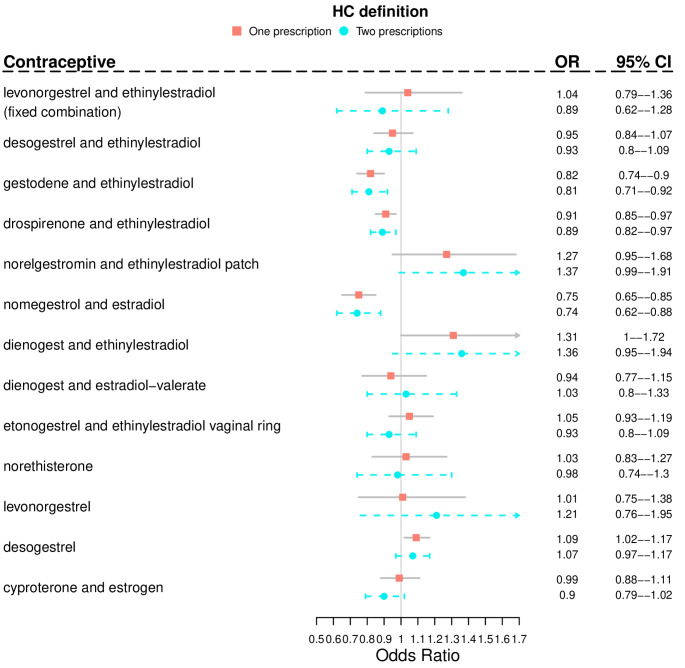
Earlier findings on the relationship between use of hormonal contraception (HC) and depressive symptoms and disorders are contradictory. Thus, we assessed the associations of use of different types of systemic hormonal contraceptives in the six preceding months with the risk of depression in women aged 15-49 years. Data were obtained from national registers in Finland. All cases of depression in the years 2018-2019 were identified in a population-based cohort of women. We used a nested case-control design with 1:4 ratio (n = 117,360 cases) and applied multivariable conditional logistic regression models. During the follow-up a total of 23,480 new cases with the diagnosis of depression were observed (incidence rate: 21.7, 95% confidence interval = 21.5-22.0 per 1000 person-years). Use of HC in the six preceding months, specifically that of combined hormonal contraceptives (containing gestodene and ethinylestradiol, drospirenone and ethinylestradiol, and nomegestrol and estradiol), was significantly associated with a lower risk of depression compared to non-use when controlling for marital status, socioeconomic status, education, recent delivery, recent psychiatric hospitalization, chronic diseases, use of psychiatric medications (excluding antidepressants) and former use of HC (odds ratio: 0.90, 95% confidence interval = 0.85-0.95; 0.86, 95% confidence interval = 0.81-0.91, respectively). Current use of progestogen-only preparations (norethisterone, levonorgestrel, desogestrel) was not associated with depression. This pattern was evident in all age groups, including adolescent girls. HC use appeared not associated with an increased risk of depression in fertile-aged women and across all age groups, including adolescent girls.
Keywords: Adolescents; Combined hormonal contraceptives; Contraceptive; Fertile-age; Girls; Women.
© 2025. The Author(s).
Conflict of interest statement
Declarations. Conflict of Interest: O.H. serves occasionally on advisory boards for Bayer AG and Gedeon Richter and has designed and lectured at educational events of these companies. The other authors report no financial relationships with commercial interests. Ethics approval: This study was performed in line with the principles of the Declaration of Helsinki. The study was reviewed by the Ethics Committee of the Faculty of Medicine, University of Helsinki (3/2018). Because this is a register-based study, no individual consent is needed.
Figures

References
-
- United Nations Data Portal Population Division. (https://population.un.org/dataportal/). Accessed 24 April 2025.
-
- United Nations, Department of Economic and Social Affairs, Population division. Contraceptive use by method 2019: data booklet. ST/ESA/SER; 2019.A/435.
MeSH terms
Substances
LinkOut - more resources
Full Text Sources
Medical
