


Association between atherogenic index of plasma and depression in premenopausal and postmenopausal women: A cross-sectional study
- PMID: 40601570
- PMCID: PMC12221011
- DOI: 10.1371/journal.pone.0327103
Association between atherogenic index of plasma and depression in premenopausal and postmenopausal women: A cross-sectional study
Abstract
Aim: This study is the first to investigate the association between the Atherogenic Index of Plasma (AIP) and depression in women, stratified by menopausal status.
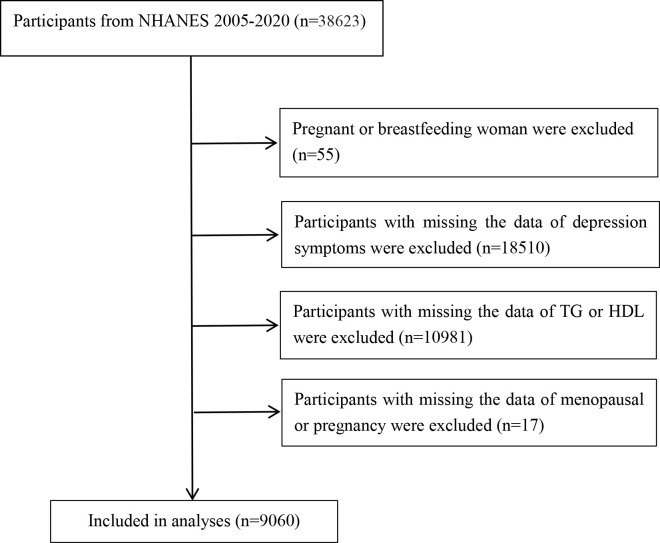
Methods: A total of 9,060 subjects were enrolled from the National Health and Nutrition Examination Survey (NHANES) conducted from 2005 to 2020. AIP was computed by Log10 (triglycerides/high-density lipoprotein cholesterol). Depression was assessed using the Patient Health Questionnaire (PHQ-9), with a score of ≥10 indicating a diagnosis of depression. Multivariate logistic regression, restricted cubic splines (RCS), and subgroup analysis were employed to explore the associations between AIP and depression.
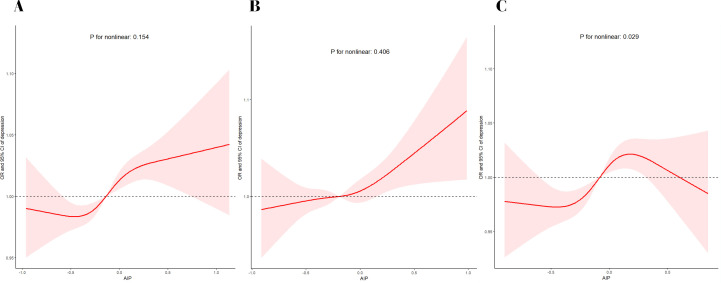
Results: In comparison to quartile 1, Multivariate logistic regression revealed that AIP in quartiles 2-4 yielded odd ratios (ORs) (95% confidence interval, 95% CI) of premenopausal women of 1.14 (0.87, 1.50), 1.06 (0.79, 1.42), and 1.49 (1.11, 2.00), and postmenopausal women of 0.88 (0.64, 1.22), 1.03 (0.76, 1.41) and 1.40 (1.04, 1.89), respectively. RCS showed a linear correlation between AIP and depression in premenopausal women and a nonlinear correlation between AIP and depression in postmenopausal women. When AIP > 0.60, premenopausal women had an increased risk of depression, while postmenopausal women had a decreased risk of depression.
Conclusions: This study demonstrates that elevated AIP levels are significantly associated with an increased risk of depression in both premenopausal and postmenopausal women. However, the strength and direction of these associations varied between the two groups, suggesting that menopausal status may play a critical role in modulating the impact of lipid metabolism on mental health outcomes.
Copyright: © 2025 Deng et al. This is an open access article distributed under the terms of the Creative Commons Attribution License, which permits unrestricted use, distribution, and reproduction in any medium, provided the original author and source are credited.
Conflict of interest statement
The authors have declared that no competing interests exist.
Figures
References
-
- GBD 2019 Mental Disorders Collaborators. Global, regional, and national burden of 12 mental disorders in 204 countries and territories, 1990-2019: a systematic analysis for the Global Burden of Disease Study 2019. Lancet Psychiatry. 2022;9(2):137–50. doi: 10.1016/S2215-0366(21)00395-3 - DOI - PMC - PubMed
MeSH terms
Substances
LinkOut - more resources
Full Text Sources
Medical
Miscellaneous
