


Trends in the use of video consultation in general practice during COVID-19: impact of practice and country characteristics based on the international, cross-sectional PRICOV-19 study
- PMID: 40604477
- PMCID: PMC12220306
- DOI: 10.1186/s12875-025-02892-0
Trends in the use of video consultation in general practice during COVID-19: impact of practice and country characteristics based on the international, cross-sectional PRICOV-19 study
Abstract
Background: The COVID-19 pandemic accelerated the use of telemedicine, specifically video consultations as they provide healthcare access in challenging situations where face-to-face encounters are not possible. Nevertheless, it remains largely unknown to what extent the organisation of general practice and national digital infrastructures have impacted the uptake and use of video consultations.
Objective: This study examined the variation in use of video consultations in general practice across Europe during the COVID-19 pandemic and explored associations with practice- and country-level characteristics.
Methods: This study is part of the international PRICOV-19 project, using data from an online survey and additional questions from national leads. First, we conducted a rapid literature search to support an evidence-based selection of the PRICOV-19 main survey items and additional questions aligned with our aims. Then, we included five practice-level and nine country-level characteristics, as well as COVID-19 intensity characteristics, as independent variables in the analysis. Finally, we conducted a linear mixed model analysis at the country-level, examining five models incrementally within a one-level random intercept regression model.
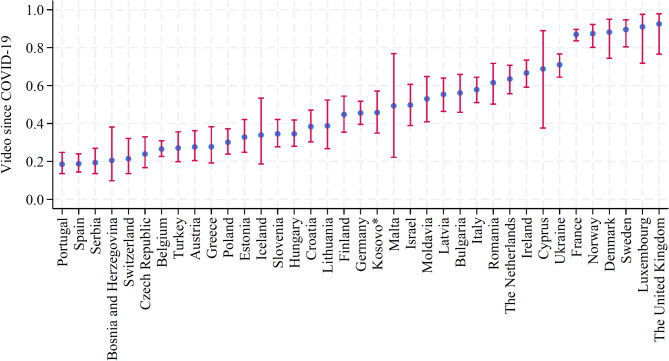
Results: Data from 5,065 general practices in 38 countries revealed that fewer than half (47.5%) utilized video consultations during the COVID-19 pandemic. Usage was highest in the United Kingdom, Luxembourg, Scandinavia, and France (82.6-94.4%) and the lowest in Portugal, Spain, Serbia, Bosnia and Herzegovina, Switzerland, and the Czech Republic (11.1-23.1%). At practice-level, key factors associated with higher usage included having more patients than average with a history of migration and difficulty speaking the local language, being a self-employed general practitioner, having a higher number of registered patients, and being urban-based. At country level, only accessible and affordable internet was statistically significantly associated with use of video consultations.
Conclusions: The study corroborates some established trends in telemedicine adoption while also providing new insights into specific practice-level factors that facilitated the use of video consultations in general practice across European countries during COVID-19. While some factors are universally influential, particularly internet access and affordability, others are more context-dependent.
Trial registration: Not applicable.
Keywords: COVID-19, general practice, equity; Telemedicine; Video consultation.
© 2025. The Author(s).
Conflict of interest statement
Declarations. Ethics approval and consent to participate: The Research Ethics Committee of Ghent University Hospital approved the protocol of the PRICOV-19 study (BC-07617), which was conducted in accordance with the guidelines of the Declaration of Helsinki. Additional approval was obtained from local Research Ethics Committees in partner countries where required. Informed consent was obtained from all participants on the first page of the online questionnaire. All data were anonymised, and any raw data that could potentially identify respondents were permanently removed. Consent for publication: Not applicable. Competing interests: The authors declare no competing interests. Note: *All references to Kosovo in this project, whether to the territory, institutions, or population, shall be understood in full compliance with the United Nations Security Council Resolution 1244 and the ICJ Opinion on the Kosovo’s Declaration of independence, without prejudice to the status of Kosovo.
Figures
References
-
- OECD. The COVID-19 pandemic and the future of telemedicine. OECD health policy studies. Paris: OECD Publishing; 2023. 10.1787/ac8b0a27-en
-
- Monteleone G, Terzulli G, Cefaloni F, Bonini M, Richeldi L. The impact of telemedicine during severe acute respiratory syndrome coronavirus 2 pandemic and future perspectives: A systematic review. Respiration. 2023;102(10):879–90. Epub 2023 Sep 22. PMID: 37742627. 10.1159/000533621 - PubMed
MeSH terms
Grants and funding
LinkOut - more resources
Full Text Sources
Medical