


Cross-cultural adaptation and validation of the Sinhala version of SarQoL® for assessing quality of life in older women with sarcopenia
- PMID: 40604484
- PMCID: PMC12220569
- DOI: 10.1186/s12877-025-06137-8
Cross-cultural adaptation and validation of the Sinhala version of SarQoL® for assessing quality of life in older women with sarcopenia
Abstract
Introduction: Sarcopenia, characterized by the loss of muscle strength, mass, and function, significantly impacts the quality of life (QoL) in older adults. The Sarcopenia Quality of Life (SarQoL®) questionnaire is a disease-specific tool designed to evaluate QoL in individuals with sarcopenia. It has been cross-culturally adapted and validated in various languages worldwide. However, no validated tool existed in Sinhala, limiting the ability to assess QoL among Sri Lankan older adults with sarcopenia. This study aimed to cross-culturally adapt the SarQoL® into Sinhala and evaluate its psychometric properties.
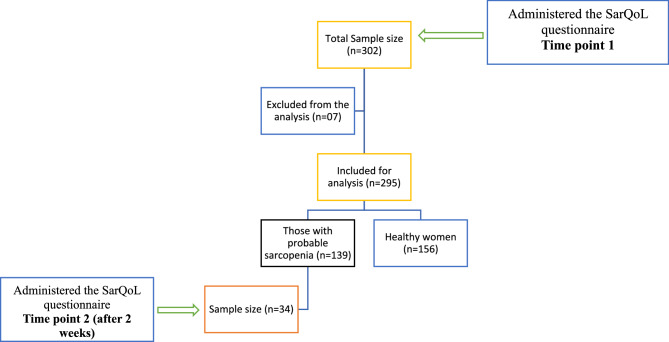
Methods: The standard protocol for cross-cultural adaptation was followed, including forward translation, synthesis, backward translation, expert committee review, and pre-testing. The finalized Sinhala version of SarQoL® was administered to a randomly selected sample of 295 older women (≥ 65 years) who regularly attended medical clinics at a tertiary care hospital in Sri Lanka. The validated Short Form 36 survey (SF-36) was used for concurrent validation. Probable sarcopenia was identified using handgrip strength (HGS) based on local cutoff values. SarQoL® was re-administered via phone after two weeks to 34 women with probable sarcopenia to assess test-retest reliability. Psychometric properties, including internal consistency, reliability, construct validity, discriminant validity, and floor and ceiling effects, were evaluated.
Results: The mean age of participants was 72.1 ± 4.8 years, with 139 (47.1%) identified as having probable sarcopenia. The questionnaire demonstrated strong internal consistency (Cronbach's alpha = 0.82) and excellent test-retest reliability (Intraclass Correlation Coefficient; ICC = 0.90; 95% CI: 0.81-0.96). Significant correlations between SarQoL® scores and SF-36 dimensions (r range: 0.24-0.75, p < 0.001) confirmed concurrent validity. Total SarQoL® scores were significantly lower in sarcopenic women compared to non-sarcopenic women (54.24 ± 14.52 vs. 62.10 ± 15.31, p < 0.001), confirming discriminant validity. No floor or ceiling effects were observed.
Conclusions: The Sinhala version of SarQoL® is a reliable and valid tool for assessing QoL in older adults with sarcopenia. It can be effectively used in both clinical practice and research to evaluate QoL and guide interventions targeting sarcopenia in Sri Lanka.
Trial registration: Not applicable.
Keywords: Quality of life; Questionnaire; Sarcopenia; Sinhala version; Validation.
© 2025. The Author(s).
Conflict of interest statement
Declarations. Ethics approval and consent to participate: Ethics approval for this study was granted by the Ethics Review Committee, Faculty of Medicine, University of Ruhuna, Sri Lanka (Ref no: 2021.P.016: 17.02.2021). All participants provided informed consent to participate, collected via an information sheet and consent form. The study was conducted according to the principles of the Declaration of Helsinki. Consent for publication: Not applicable. Competing interests: The authors declare no competing interests.
Figures
References
-
- Beaudart C, Reginster J-Y, Geerinck A, Locquet M, Bruyère O. Current review of the SarQoL®: a health-related quality of life questionnaire specific to sarcopenia. Expert Rev PharmacoEcon Outcomes Res. 2017;17(4):335–41. - PubMed
Publication types
MeSH terms
LinkOut - more resources
Full Text Sources
