Randomized Controlled Trial
. 2025 Jul 2;25(1):981.
doi: 10.1186/s12903-025-06405-4.

Oral microbiome diversity and composition before and after chemotherapy treatment in pediatric oncology patients

Affiliations
Randomized Controlled Trial

Oral microbiome diversity and composition before and after chemotherapy treatment in pediatric oncology patients

Egle Immonen et al. BMC Oral Health. .

Abstract

Objective: This study investigated the impact of anticancer treatment on the oral microbiome in pediatric patients and its association with oral mucositis (OM).

Materials and methods: A double-blind, randomized trial involving 34 pediatric cancer patients (ages 2-17.99) with solid or hematological malignancies. Mucosal swab samples were collected before and after chemotherapy. Patients underwent two 7-day rinse cycles-one with Caphosol and one with saline-in a randomized order. Bacterial DNA from 110 mucosal swabs was analyzed using 16S rRNA sequencing.

Results: Chemotherapy altered bacterial composition. No life-threatening OM cases (WHO grade 4) were observed, but mild to severe OM (grades 1-3) occurred in three patients. In patients without oral lesions, Bergeyella genus was more abundant prior to treatment while Alloprevotella was more abundant in the post-treatment samples, compared to patients with lesions. OM was linked to distinct microbiome profiles, including Stenotrophomonas, Leptotrichia sp., Serratia sp.,Capnocytophaga sputigena, Sphingomonas sp., Parapusillimonas sp., Staphylococcus sp., and Turicibacter genera. Additionally, Burkholderia-Caballeronia-Paraburkholderia (p = 0.013) were more prevalent in the Caphosol group compared to the saline group.

Conclusions: These findings indicate that chemotherapy-induced microbiome shifts associate with OM risk, highlighting the potential for microbial markers to predict high-risk patients and support protective strategies.

Trial registration: The trial titled "Supersaturated Calcium Phosphate Oral Rinse (Caphosol®) for the Prevention of Oral Mucositis in Children Undergoing Chemotherapeutic Treatments" was registered on ClinicalTrials.gov (ID NCT02807337), with the first submission date 2016-06-07.

Keywords: Chemotherapy; Diversity; Mucositis; Oral microbiome; Pediatric; Randomized.


Conflict of interest statement

Declarations. Ethics approval and consent to participate: The study was approved by the Regional Ethics Committee of Tampere University Hospital in accordance with the principles of the Declaration of Helsinki. All patients and/or their parents provided written informed consent prior to participation. Every subject was given a study code number, and analyses were carried out without personal identification data. Consent for publication: Not applicable. Competing interests: The authors declare no competing interests.

Figures
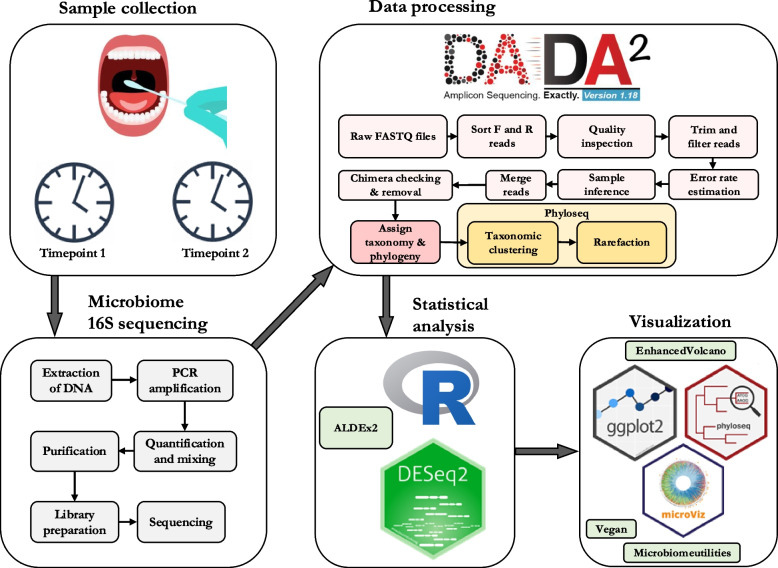
Fig. 1
Fig. 1
Workflow diagram illustrating the study process, divided into three main stages: sampling and laboratory work, data processing, and statistical analysis and visualization. Each stage is distinguished by a consistent color scheme for clarity. R packages utilized during data processing, analysis and visualization are written in subtitles with the version number of each package
Fig. 2
Fig. 2
Diversity plots for the oral microbiota of pediatric cancer patients are presented. a Plots of inverse Simpson, Shannon diversity, Simpson diversity, and species richness are shown for all patients included in the study, with samples categorized by pre-treatment and post-treatment phases and further divided based on mucosal status (no lesions vs. lesions). No statistically significant differences were observed among any of the groups. b The NMDS1 plot illustrates samples grouped by mucosal status and sampling time (pre-treatment vs. post-treatment), revealing no statistically significant clusters
Fig. 3
Fig. 3
Mean relative abundance of phyla. The data is grouped by the lesion status and the sampling time. Phyla are ordered in decreasing order based on total read count
Fig. 4
Fig. 4
The microbial composition of individual samples is represented in the figure as a proportion of the total reads observed. Samples from patients without oral lesions are displayed at the top, while those with observed oral lesions are positioned at the bottom. Samples collected prior to the treatment regimen are shown on the left, and those collected post-treatment are on the right. Each row corresponds to a single sample, identified by patient ID. The 35 most abundant genus-level taxa are highlighted in color. Adjusted p-values from the differential abundance analysis are presented in a table, where each column corresponds to a specific pairwise comparison
Fig. 5
Fig. 5
In this panel, taxa are illustrated in a volcano plot, which compares two groups of samples. The x-axis represents the fold change, while the y-axis displays significance as the negative logarithm to the base 10 of the p-value. a Depicts the differences in taxon abundance between pre-treatment samples with lesions and those without. b Shows the lesion status comparison in post-treatment samples (c) Illustrates the differences in taxon abundance between the saline solution and Caphosol oral rinse groups within post-treatment samples (d) Compares pre-treatment and post-treatment samples

References

    1. Caselli E, Fabbri Ch, D’Accolti M, Soffritti I, Bassi C, Mazzacane S, Franchi M. Defining the oral microbiome by wholegenome sequencing and resistome analysis: the complexity of the healthy picture. BMC Microbiol. 2020;20(1):120. 10.1186/s12866-020-01801-y. - PMC - PubMed
    1. Hamady M, Knight R. Microbial community profiling for human microbiome projects: Tools, techniques, and challenges. Genome Res. 2009;19:1141–52. 10.1101/gr.085464.108. - PMC - PubMed
    1. Lazarevic V, Whiteson K, Huse S, Hernandez D, Farinelli L, Østerås M, Schrenzel S, François P. Metagenomic study of the oral microbiota by Illumina high-throughput sequencing. J Microbiol Methods. 2009;79(3):266–71. 10.1016/j.mimet.2009.09.012. - PMC - PubMed
    1. Li W, Liang H, Lin X, et al. A catalog of bacterial reference genomes from cultivated human oral bacteria. NPJ Biofilms Microb. 2023;9:45. 10.1038/s41522-023-00414-3. - PMC - PubMed
    1. Human Microbiome Project Consortium. Structure, function and diversity of the healthy human microbiome. Nature. 2012;486(7402):207–14. 10.1038/nature11234. - PMC - PubMed

Publication types

Associated data
