


Effects of a multi-modal static and dynamic balance and hand function training program on multi-dimensional balance ability, hand function, and life-space mobility in rural older adults: protocol for a randomized controlled trial
- PMID: 40604859
- PMCID: PMC12219521
- DOI: 10.1186/s13102-025-01214-2
Effects of a multi-modal static and dynamic balance and hand function training program on multi-dimensional balance ability, hand function, and life-space mobility in rural older adults: protocol for a randomized controlled trial
Abstract
Background: Rural older adults face an increasing number of health challenges. While balance training is beneficial, it is often included as part of broader exercise programs. However, comprehensive studies specifically combining balance training with hand function training for rural older adults remain scarce.
Objective: This study aims to investigate whether a combined balance and hand training program can provide programmatic references and empirical evidence for improving functional outcomes in rural older adults.
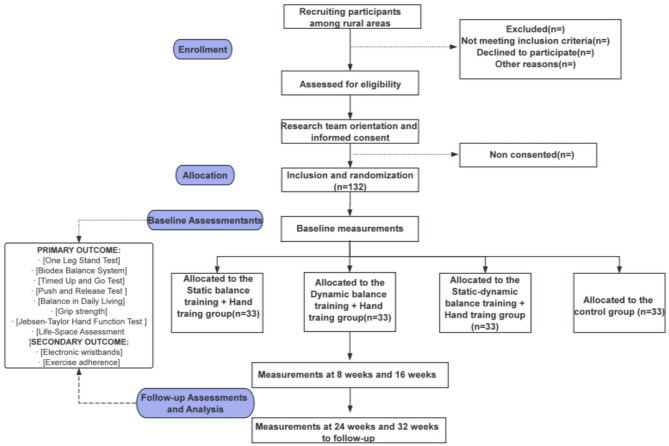
Methods: A single-blind, four-group parallel, multicenter randomized controlled trial was used. Four rural communities in Huzhou, Zhejiang Province, were included in the study, with an estimated total sample size of 132 individuals. During the 16-week intervention period, the comprehensive exercise program consisted of two balance training programs and one hand training session provided by a multidisciplinary team including physiotherapists, sports professionals, nurses and community health workers. The four rural communities were randomly divided into four experimental groups in the ratio of 1:1:1:1 (a) static balance training combined with hand training; (b) dynamic balance training combined with a hand training program; (c) multi-modal static-dynamic balance and hand function training (M-mBHF) program; and (d) a Daily activity group. The multidimensional balance ability, hand function, and life-space mobility of the four parallel groups will be assessed at baseline (T0), 8 weeks of intervention (T1), 16 weeks of intervention (T2), and at 24 (T3) and 32 weeks (T4) follow-up.
Conclusion: This study protocol proposes a M-mBHF program hypothesized to improve multi-dimensional balance ability, hand function, and life-space mobility in rural older adults. The anticipated outcomes aim to provide empirical evidence for future interventions targeting this population.
Trial registration: Registered in the Chinese Clinical Trial Registry on 02/17/2025 (ChiCTR2500097310).
Keywords: Aging-related mobility improvement; Balance ability; Exercise program evaluation; Health intervention.
© 2025. The Author(s).
Conflict of interest statement
Declarations. Ethics approval and consent to participate: All work was conducted in accordance with the provisions of the Helsinki Declaration. Our study adheres to CONSORT guidelines. It has been approved by the Medical Ethics Committee of Huzhou University (approval number: 202412-05) and registered in the Chinese Clinical Trial Register on 02/17/2025 (number: ChiCTR2500097310). All participants will sign informedconsents prior to their participation. Consent for publication: Not applicable. Competing interests: The authors declare no competing interests.
References
-
- World Health Organization Ageing and health. 2022. https://www.who.int/news-room/fact-sheets/detail/ageing-and-healthAvailable
-
- National Bureau of Statistics of China. 2025. https://www.stats.gov.cn/xxgk/sjfb/zxfb2020/202501/t20250117_1958332.htm...
Grants and funding
LinkOut - more resources
Full Text Sources
