


The adverse effects of metabolic disorder on left ventricular myocardial mechano-energetic efficiency and dysfunction in ischemic cardiomyopathy: insight from a cardiac MRI study
- PMID: 40604995
- PMCID: PMC12224664
- DOI: 10.1186/s12933-025-02817-2
The adverse effects of metabolic disorder on left ventricular myocardial mechano-energetic efficiency and dysfunction in ischemic cardiomyopathy: insight from a cardiac MRI study
Abstract
Purpose: Metabolic risk factors (MetF) have emerged as the leading drivers of ischemic cardiomyopathy (ICM) worldwide. However, in patients who have already experienced myocardial ischemia/infarction, whether and in what pattern the MetF act on the heart needs to be further elucidated. This study aims to determine the adverse effects of MetF on left ventricular (LV) indexed myocardial mechano-energetic efficiency (MEEi) and dysfunction in patients with ICM, and further clarify which MetF classification is more clinically significant.
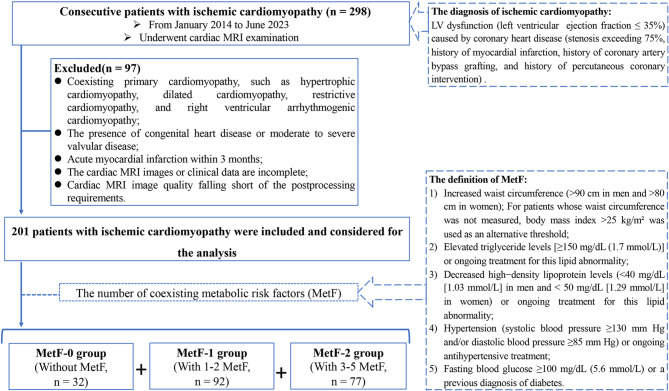
Materials and methods: This study retrospectively included 201 patients with ICM who underwent cardiac magnetic resonance imaging (MRI) examinations, and further divided them into the following three groups according to the number of coexisting MetF: The groups with no MetF (MetF-0 group, n = 32), with 1-2 MetF (MetF-1, n = 92) and with 3-5 MetF (MetF-2, n = 77). The clinical variables and MRI-derived parameters were measured and compared among the three groups. Multivariate linear regression analysis was performed to determine independent correlation of MetF on LV MEEi and strain in ICM patients.
Results: LV global circumferential peak strain (PS) gradually decreased from MetF-0 group, through MetF-1 group, to MetF-2 group (- 9.52 ± 2.70% vs. - 7.62 ± 2.73% vs. - 6.50 ± 2.70%, P < 0.001). MetF-1 and MetF-2 groups both showed lower MEEi, lower LV global radial and longitudinal PS than MetF-0 group (Both P < 0.001), while there was no statistically significant difference between MetF-1 and MetF-2 groups (P > 0.05). Multivariate analyses indicated that the coexisting any MetF was independently associated with decreased LV MEEi (β = - 0.093, P = 0.018) and PS (Radial, β = - 0.232, P < 0.001; Circumferential, β = 0.156, P = 0.002; Longitudinal, β = 0.192, P = 0.008), and the increase in the number of coexisting MetF was only related to the reduction of circumferential PS (β = 0.238, P = 0.006).
Conclusions: Our results revealed whether coexisting any MetF, rather than coexisting a greater number of MetF, is associated with the reduction of LV myocardial mechano-energetic efficiency and dysfunction in patients with ICM, suggesting that clinicians should promptly identify and treat any coexisting MetF in the management of ICM patients.
© 2025. The Author(s).
Conflict of interest statement
Declarations. Ethics approval and consent to participate: The Biomedical Research Ethics Committee of our hospital approved this study, with the requirement for written informed consent being waived due to the retrospective nature of this study. Consent for publication: Not applicable. Competing interests: The authors declare that there are no conflicts of interest.
Figures


References
-
- Li S, Liu Z, Joseph P, Hu B, Yin L, Tse LA, et al. Modifiable risk factors associated with cardiovascular disease and mortality in china: a PURE substudy. Eur Heart J. 2022;43(30):2852–63. - PubMed
-
- Crea F. The burden of cardiovascular risk factors: a global perspective. Eur Heart J. 2022;43(30):2817–20. - PubMed
-
- Wang W, Hu M, Liu H, Zhang X, Li H, Zhou F, et al. Global burden of disease study 2019 suggests that metabolic risk factors are the leading drivers of the burden of ischemic heart disease. Cell Metab. 2021;33(10):1943–e19562. - PubMed
MeSH terms
Grants and funding
- 82202115/National Natural Science Foundation of China
- 82120108015/National Natural Science Foundation of China
- 82371925/National Natural Science Foundation of China
- 2023NSFSC1725/Sichuan Provincial Science and Technology Support Program
- 2024YFFK0259/Sichuan Provincial Science and Technology Support Program
LinkOut - more resources
Full Text Sources
Medical
