Review
. 2025 May 30:9:100304.
doi: 10.1016/j.jhlto.2025.100304. eCollection 2025 Aug.

Sizing in lung transplantation: principles, practices and ideas for the future

Affiliations
Review

Sizing in lung transplantation: principles, practices and ideas for the future

Michael Eberlein et al. JHLT Open. .

Abstract

Lung transplantation (LTx) is an important treatment option for many end-stage lung diseases. The goal of LTx is to restore pulmonary physiology (gas exchange and respiratory system mechanics) towards normal, so that LTx recipients can experience an improved quality of life and live significantly longer. An optimized approach to donor-to-recipient size matching is a strategy to increase opportunities for successful transplants and optimize outcomes. In this review we discuss relevant pulmonary gas exchange and respiratory systems mechanics principles as a framework to optimize donor-to-recipient size matching and LTX-recipient management. The predicted total lung capacity (pTLC) is a refined estimate of organ size utilizing regression equations to calculate lung size based on height, sex and age. In general, irrespective of the underlying lung disease the chest cavity is "reverse remolding" back towards normal size in most recipients. The parameter that can reflect the sizing goal to restore physiology towards normal is the recipient pTLC. A pragmatic size matching metric is the donor-to-recipient pTLC-ratio. Significant undersizing based on the pTLC-ratio is a risk factor for complications and lower LTx survival. If significant changes to the LTx candidate's chest cavity size occur (as can occur in severe restrictive lung disease or severe emphysema), or if the chest cavity cannot "reverse remodel" towards normal, it is important to consider additional donor-to-recipient sizing metrics. In addition to the recipient's measured actual total lung capacity imaging-based metrics can be considered. Chest X-ray and computer tomography based volumetric analyses can provide information facilitating a successful LTx.

Keywords: Donor; Lung physiology; Lung transplantation; Matching; Sizing.


Conflict of interest statement

The authors have no conflicts to declare.

Figures

Figure 1
Figure 1
Respiratory system mechanics. (A) Parallel springs representing opposing static forces of the lung and chest wall. (B) Pressure-volume curve of lung, chest wall, and respiratory system. The curve of the respiratory system is the sum of the lung and chest wall curves.
Figure 2
Figure 2
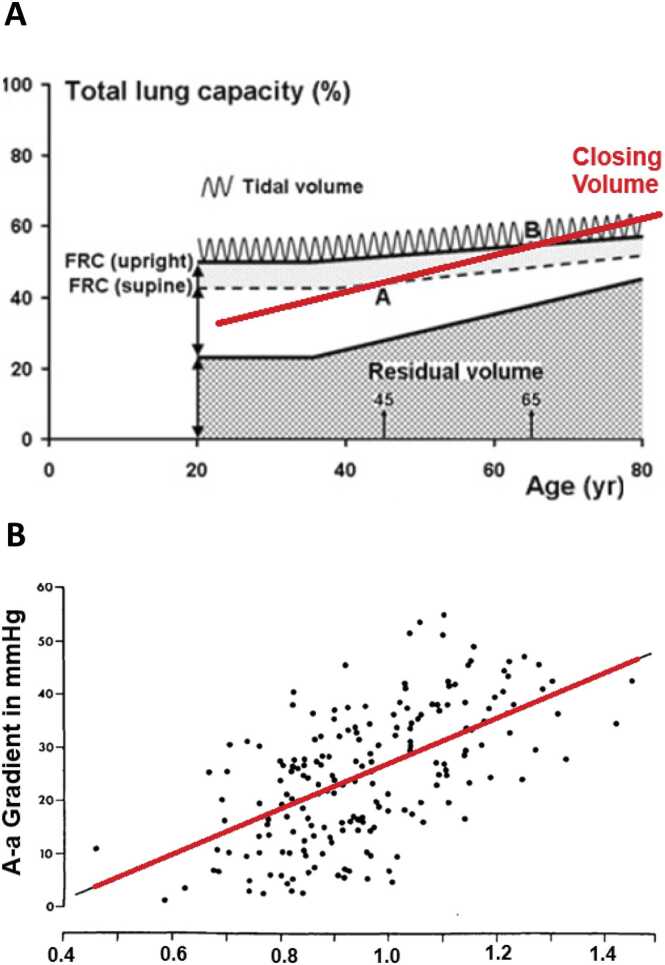
Subdivision of lung volume and closing capacity. (A) Subdivision of lung volume as a function of age. TLC total lung capacity; FRC functional residual capacity; CC closing capacity; RV residual volume. (B) Alveolar to arterial (Aa) gradient of partial pressure of oxygen as a function of CC/FRC.
Figure 3
Figure 3
Chest wall strapping as model of oversizing. The effects of increased chest wall strapping (CWS) pressures on lung volumes and lung elastance. As pressure exerted on the chest wall increases via CWS, lung volumes diminish and lung elastance increases. Inspiratory CT scans show increasing chest strap pressure reduces thoracic size, and basilar atelectasis is seen at 50 mmHg of CWS (50% reduction of total lung capacity).
Figure 4
Figure 4
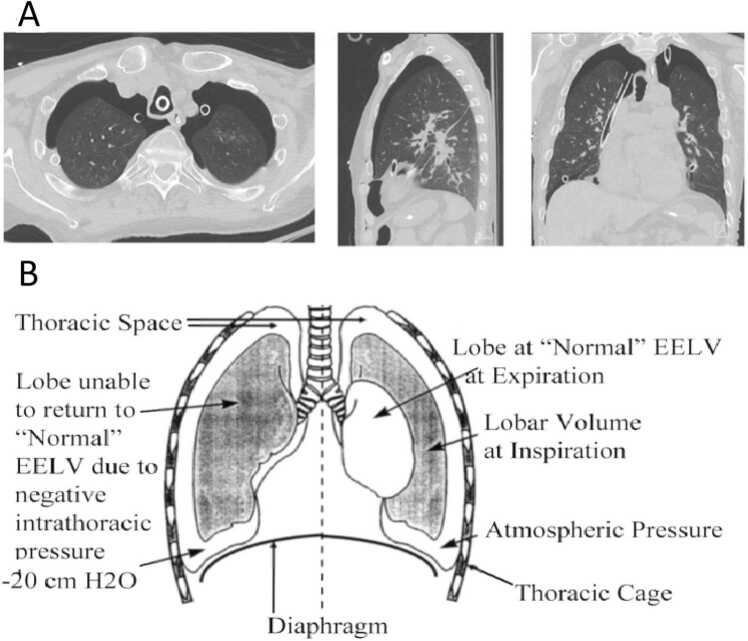
Physiology of undersizing. (A) Computed tomography of the chest. Residual pleural space from a significant size mismatch between a smaller allograft and a larger recipient ‘s chest cavity is shown in axial, sagittal, and coronal view. (B) Comparison of the pulmonary mechanics in a hemithorax at atmospheric pressure, with one under negative intrathoracic pressure, following lobar transplantation. Failure of the lungs to empty due to the negative intrathoracic pressure causes hyperinflation and subsequent hemodynamic deterioration.
Figure 5
Figure 5
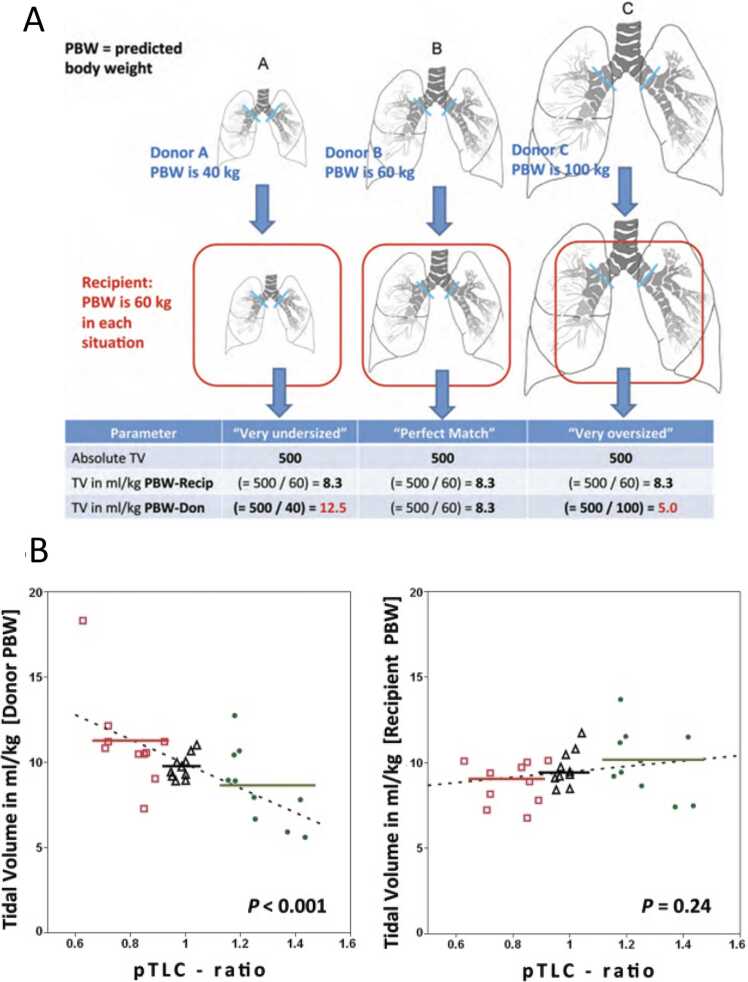
Lung-size mismatch on mechanical ventilation tidal volumes. (A) Conceptual graphic on the possible effect of lung-size mismatch on mechanical ventilation tidal volumes expressed as ml/kg-predicted body weights of the donor. (B) Scatter plot of tidal volumes in ml/kg against predicted total lung capacity (pTLC) ratio. For each patient (n = 30) the mean tidal volume is displayed. On left side tidal volumes are expressed as ml/kg-predicted body weights of the donor (P < 0.001). In (B) tidal volumes are expressed as ml/kg-predicted body weights of the recipient (P = 0.24). Red squares = most-undersized cohort (n = 10). Black triangles = best-matched cohort (n = 10). Green circles = most-oversized cohort (n = 10). Dotted lines represent regression lines. Solid lines represent mean tidal volumes for most-undersized cohort (red), best-matched cohort (black) and most-oversized cohort (green).
Figure 6
Figure 6
Physiology of undersizing. (A) Pulmonary vascular resistance in relation to inflation of the lung. (B) Sparing native upper lobes in living-donor lobar lung transplantation. Right Bi-lobectomy and left lower lobectomy are performed in the recipient, and lower lobar grafts are implanted.
Figure 7
Figure 7
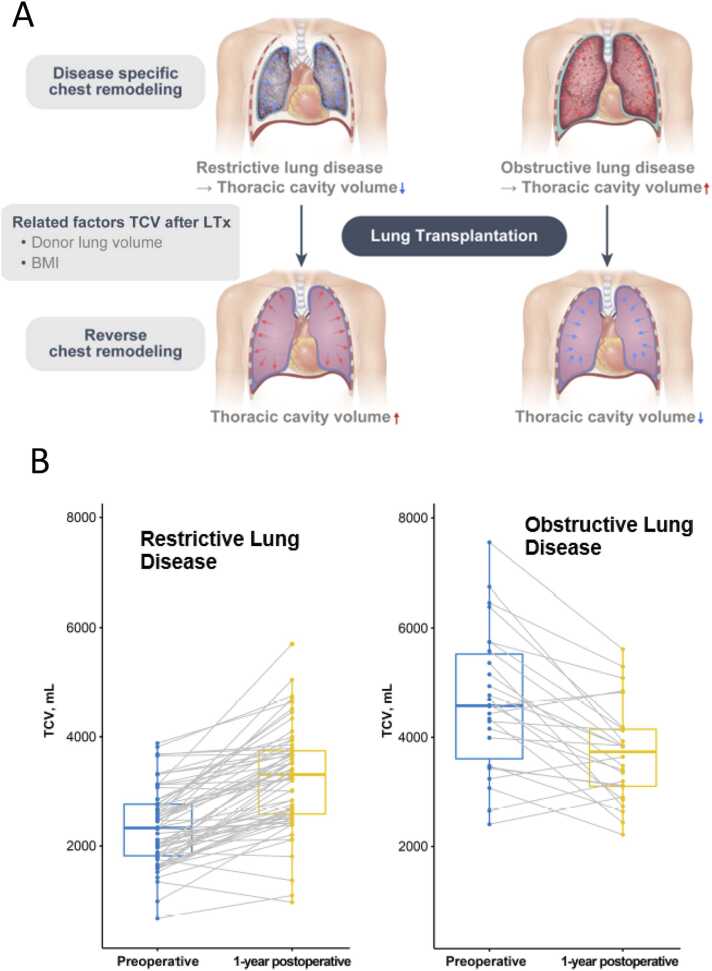
Chest wall and chest cavity reverse remodeling. (A) The disease-specific chest remodeling caused by restriction and hyperinflation is at least, in part, reversible. (Reverse chest remodeling). (B) Preoperative and 1-year postoperative thoracic cavity volume (TCV) measured by CT. On the left in the restrictive group, TCV increased after lung transplantation (LTx). On the right in the obstructive group, TCV decreased after LTx..
Figure 8
Figure 8
The donor to recipient predicted total lung capacity ratio (pTLCratio) and outcomes after lung transplant. (A) pTLCratio and risk for primary graft dysfunction. (B) pTLCratio and risk of death after transplant in a retrospective cohort studie utilizing SRTR dataset. (C) pTLCratio and risk of death in a French cohort study. (D) pTLCratio and chronic lung allograft dysfunction (CLAD), bronchiolitis obliterans syndrome (BOS) risk after lung transplant..
Figure 9
Figure 9
Distribution of differences (in Liters) comparing aTLC versus pTLC by diagnosis. PAH, Pulmonary arterial hypertension; IPF, idiopathic pulmonary fibrosis; aTLC, actual total lung capacity; pTLC, predicted total lung capacity..
Figure 10
Figure 10
(A) Lung height measurements on upright chest X-ray: apex-costophrenic angle (ACPA) distance; apex-middiaphragm (AMD) distance; and intercostophrenic angle (ICPA) distance; (B) artificial intelligence generated CXR size metrics (C) CT Volumetry approach. Segmentation results from 2 representative recipients, with threshold-based software results shown in green overlay in the left column and convolutional neural networks of software results shown in blue and light green overlay in the right column..
Figure 11
Figure 11
Computed Tomography Volumetrics for Size Matching in Lung Transplantation for Restrictive Disease. (A) Cutoffs for sizing groups, defined as follows: undersized (quintile 1), reference (quintiles 2–4), and oversized (quintile 5). On left is sizing per CT volumetry (CTVol) based ratio; on right sizing by pTLCratio. (B) Kaplan-Meier curves of posttransplant survival stratified by sizing groups on the basis of the volumetric sizing ratio (on the left) and the predicted total lung capacity (pTLC) si z ing ratio (on the right). P values are derived from a log-rank test..

References

    1. Christie J.D., Van Raemdonck D., Fisher A.J. Lung transplantation. N Engl J Med. 2024 Nov 14;391(19):1822–1836. doi: 10.1056/NEJMra2401039. - DOI - PubMed
    1. Eberlein M., Reed R.M. Donor to recipient sizing in thoracic organ transplantation. World J Transplant. 2016 Mar 24;6(1):155–164. doi: 10.5500/wjt.v6.i1.155. - DOI - PMC - PubMed
    1. 〈https://optn.transplant.hrsa.gov/media/nwrksrgl/exec_2024–2027-strategi... (accessed 2/12/25).
    1. Reed R.M., Eberlein M. Sizing strategies in heart and lung transplantation: you cannot manage what you do not measure. Future Cardiol. 2014 May;10(3):303–306. doi: 10.2217/fca.14.17. - DOI - PubMed
    1. Eberlein M., Hunsicker L., Reed R.M. Short stature and access to lung transplantation: reducing disparities by changing to a lung size-based allocation mechanism. Am J Respir Crit Care Med. 2016 Sep 1;194(5):642–643. doi: 10.1164/rccm.201604-0673LE. - DOI - PMC - PubMed

LinkOut - more resources