


A framework to evaluate the thermal and energy performance of smart building systems in existing buildings: A case study on automated interior insulating window shades
- PMID: 40606684
- PMCID: PMC12221587
- DOI: 10.1016/j.mex.2025.103378
A framework to evaluate the thermal and energy performance of smart building systems in existing buildings: A case study on automated interior insulating window shades
Abstract
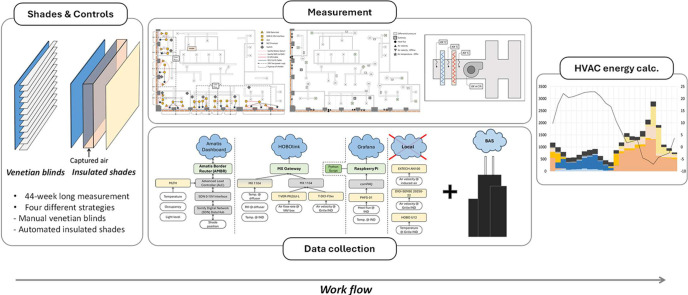
This paper presents a methodological framework for evaluating the thermal and energy performance of smart building systems in existing buildings, with a focus on automated interior insulating window shades as an energy efficiency retrofit measure. The methodology is demonstrated through a case study of a high-rise building in which different shade control strategies were assessed. This paper provides comprehensive descriptions of the (i) development and implementation of the study design, (ii) selection and deployment of measurement instruments, (iii) analysis of various shade control strategies to quantify thermal and energy performance for heating, cooling, and ventilation energy end-uses, and (iv) quantification of the uncertainty associated with the measurements and calculations. This manuscript provides detailed, step-by-step and in-depth guidance to conduct such an evaluation. Overall, this paper:•Highlights the benefits, challenges, and limitations in conducting long-term measurements that capture realistic temporal, seasonal, and operational patterns in an occupied existing building.•Provides practical considerations for such measurements and analysis approaches, upon which future studies can build.•Emphasizes the importance of ensuring that the study design and measurements do not interfere with the building's existing operations.
Keywords: A methodological framework to evaluate the thermal and energy performance of interior insulating window shades in existing buildings; Building science; Energy efficiency measure; Energy performance; Field measurement and validation; Heating ventilation and air conditioning systems.
© 2025 The Authors.
Conflict of interest statement
The authors declare the following financial interests/personal relationships which may be considered as potential competing interests: This work was supported by the Emerging Technologies initiative within the ComEd Energy Efficiency Program. Also, this study was also funded in part by an ASHRAE New Investigator Award to Mohammad Heidarinejad.
Figures


References
-
- Lamberti G., Contrada F., Kindinis A. Exploring adaptive strategies to cope with climate change: the case study of Le Corbusier’s modern architecture retrofitting. Energy Build. 2024;302 doi: 10.1016/j.enbuild.2023.113756. - DOI
-
- Kirimtat A., Koyunbaba B.K., Chatzikonstantinou I., Sariyildiz S. Review of simulation modeling for shading devices in buildings. Renew. Sustain. Energy Rev. 2016;53:23–49. doi: 10.1016/j.rser.2015.08.020. - DOI
-
- Gehbauer C., Lee E.S., Wang T. An evaluation of the demand response potential of integrated dynamic window and HVAC systems. Energy Build. 2023;298 doi: 10.1016/j.enbuild.2023.113481. - DOI
-
- Zhang G., Wu H., Liu J., Liu Y., Ding Y., Huang H. A review on switchable building envelopes for low-energy buildings. Renew. Sustain. Energy Rev. 2024;202 doi: 10.1016/j.rser.2024.114716. - DOI
-
- Bellia L., Marino C., Minichiello F., Pedace A. An overview on solar shading systems for buildings. Energy Procedia. 2014;62:309–317. doi: 10.1016/j.egypro.2014.12.392. - DOI
LinkOut - more resources
Full Text Sources
