


Targeting the P2X7 receptor signaling pathway: Unlocking therapeutic strategies for autism spectrum disorder
- PMID: 40606938
- PMCID: PMC12214281
- DOI: 10.1016/j.bbih.2025.101037
Targeting the P2X7 receptor signaling pathway: Unlocking therapeutic strategies for autism spectrum disorder
Abstract
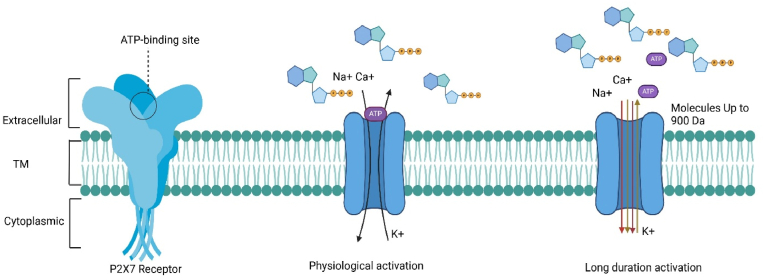
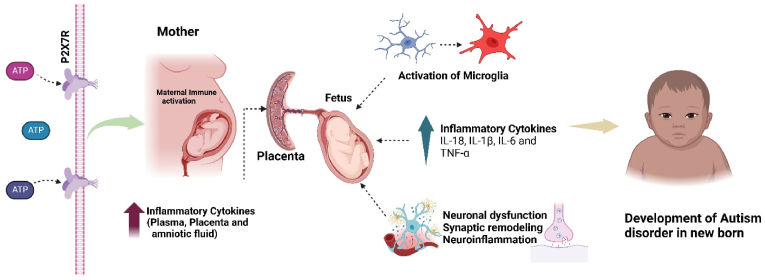
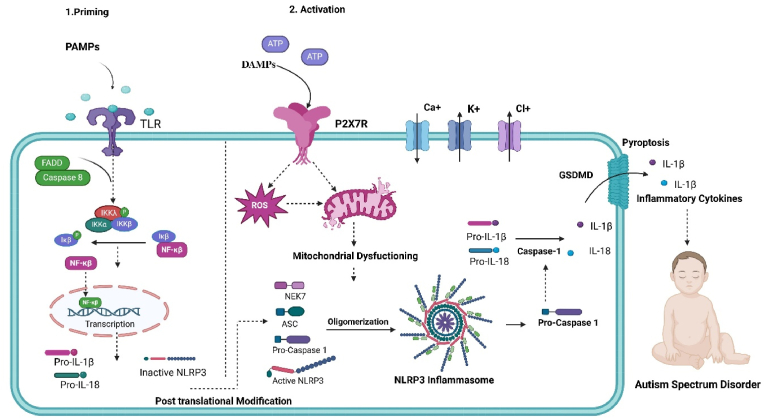
Autism spectrum disorder (ASD) is a common developmental neurological disorder that has a significant genetic predisposition and is marked by an early beginning of impairment of social communication and restricted repetitive behaviors, as well as loss of interest in activities. Though it is a common condition, pathogenetic mechanisms and etiologic foundations are still unclear; diagnostic strategies and treatments remain inadequate and restricted. Hence, there is an ongoing need to develop safer and more effective therapeutic strategies. Recent findings indicate P2X7 receptor upregulation plays a key role in ASD development through multiple pathological mechanisms, including maternal immune activation, mitochondrial dysfunctioning, oxidative stress, and neuroinflammation. When ATP from outside the cell attaches to P2X7 receptors, it opens channels that let sodium, calcium, and potassium flow in and out of the cell. Long-term receptor stimulation generates large pores in the membrane, potentially facilitating apoptotic and inflammatory mechanisms. So, based on studies using drugs that block the P2X7 receptor and genetic methods, stopping the P2X7 receptor appears to improve the harmful effects related to ASD. So, the therapeutic lead is the brain-permeable P2X7 receptor antagonists that deserve more complete clinical validation. This review discusses how the P2X7 receptor is involved in the development of ASD and looks at possible drug strategies to slow down the disease.
Keywords: Autism spectrum disorder; Maternal immune activation; Mitochondrial dysfunctioning; Neuroinflammation; Oxidative stress; P2X7 receptor.
© 2025 The Authors. Published by Elsevier Inc.
Conflict of interest statement
The authors declare that they have no conflict of interest.
Figures
References
-
- Arsenault D., St-Amour I., Cisbani G., Rousseau L.S., Cicchetti F. The different effects of LPS and poly I: C prenatal immune challenges on the behavior, development and inflammatory responses in pregnant mice and their offspring. Brain Behav. Immun. 2014;38:77–90. doi: 10.1016/j.bbi.2013.12.016. - DOI - PubMed
-
- Ashwood P., Krakowiak P., Hertz-Picciotto I., Hansen R., Pessah I., Van de Water J. Elevated plasma cytokines in autism spectrum disorders provide evidence of immune dysfunction and are associated with impaired behavioral outcome. Brain Behav. Immun. 2011;25:40–45. doi: 10.1016/J.BBI.2010.08.003. - DOI - PMC - PubMed
-
- Bhattacharya A., Lord B., Grigoleit J.S., He Y., Fraser I., Campbell S.N., Taylor N., Aluisio L., O'Connor J.C., Papp M., Chrovian C., Carruthers N., Lovenberg T.W., Letavic M.A. Neuropsychopharmacology of JNJ-55308942: evaluation of a clinical candidate targeting P2X7 ion channels in animal models of neuroinflammation and anhedonia. Neuropsychopharmacology. 2018;43:2586–2596. doi: 10.1038/S41386-018-0141-6. - DOI - PMC - PubMed
Publication types
LinkOut - more resources
Full Text Sources
