


Development and validation of hybrid machine learning approach for predicting survival in patients with cervical cancer: a SEER-based population study
- PMID: 40606977
- PMCID: PMC12213391
- DOI: 10.3389/fonc.2025.1605378
Development and validation of hybrid machine learning approach for predicting survival in patients with cervical cancer: a SEER-based population study
Abstract
Background: Accurate survival prediction in cervical cancer is crucial for personalized therapy, particularly in high-risk groups where early intervention might enhance results. The study aims to create a hybrid survival model that integrates Cox Proportional Hazards (CoxPH) with Elastic Net regularization and Random Survival Forest (RSF) to improve prediction accuracy and interpretability.
Methods: Data from the SEER database (2013-2015) were pre-processed through normalization and encoding. RSF recorded non-linear interactions between covariates, while the CoxPH Elastic Net Regularization model provided linear interpretability and identified key variables. Model parameters were optimized using cross-validation, and final performance was assessed on an independent test set using metrics including C-index, Integrated Brier Score (IBS), AUC-ROC, and calibration plots.
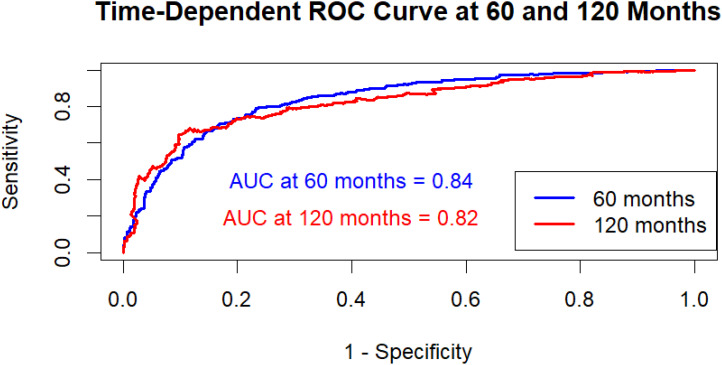
Results: The hybrid model outperformed the individual models with an Integrated Brier Score (IBS) of 0.13 and a concordance index (C-index) of 0.82. With an AUC-ROC of 0.84, the model provided robust calibration and classification performance on the independent test set, effectively separating between individuals at high and low risk.
Conclusion: The hybrid model provides a promising tool for personalized risk stratification in cervical cancer based on survival probability. Further testing in varied clinical categories is recommended to confirm its efficiency in precision oncology.
Keywords: SEER database; cervical cancer; hybrid models; machine learning; survival models.
Copyright © 2025 Kolasseri and B.
Conflict of interest statement
The authors declare that the research was conducted in the absence of any commercial or financial relationships that could be construed as a potential conflict of interest.
Figures
References
-
- Sun P, Yu C, Yin L, Chen Y, Sun Z, Zhang T, et al. Global, regional, and national burden of female cancers in women of child-bearing age, 1990–2021: analysis of data from the global burden of disease study 2021. EClinicalMedicine. (2024) 74:102713. doi: 10.1016/j.eclinm.2024.102713 - DOI - PMC - PubMed
LinkOut - more resources
Full Text Sources
