


Nonlinear relationship between fibrinogen-to-albumin ratio and mortality in critically ill patients with sepsis: a retrospective cohort study
- PMID: 40607037
- PMCID: PMC12213360
- DOI: 10.3389/fnut.2025.1562091
Nonlinear relationship between fibrinogen-to-albumin ratio and mortality in critically ill patients with sepsis: a retrospective cohort study
Abstract
Background: The fibrinogen-albumin ratio (FAR) is recognized as a prognostic biomarker in several diseases, but its role in sepsis remains controversial. To elucidate the relationship between FAR and mortality risk in a large cohort of patients with sepsis.
Methods: In this retrospective cohort study, we analyzed clinical data from the Medical Information Mart for Intensive Care IV Database (version 2.2) to investigate the mortality of sepsis patients. We employed restricted cubic spline curves and Cox regression models to evaluate the effect of FAR on mortality and conducted subgroup analyses to verify the consistency of our primary findings.
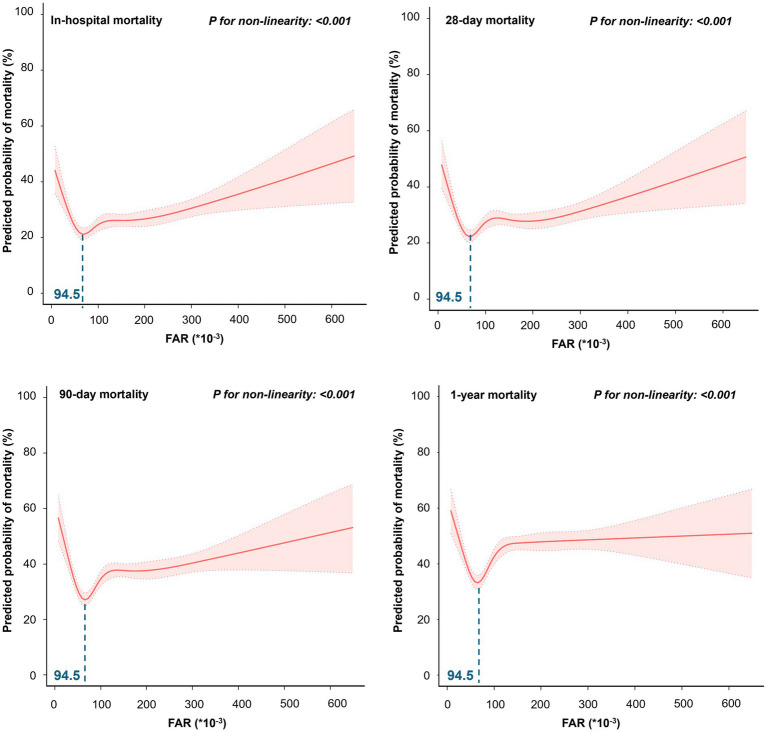
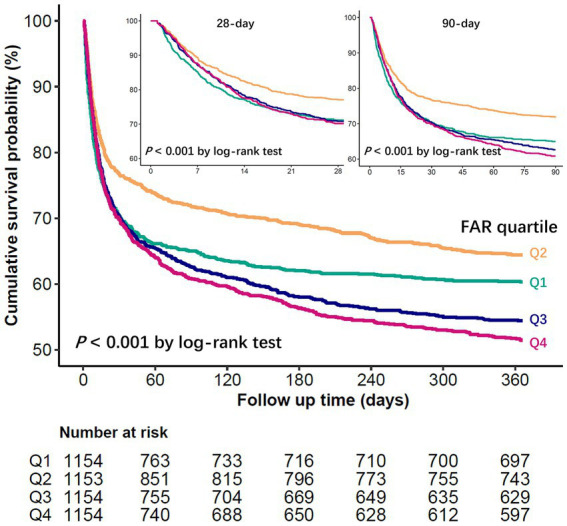
Results: In our analysis of 4,615 sepsis patients, we observed that mortality risk initially decreased with increasing FAR values, reaching a minimum at approximately 94.5*10-3, before rising again. Cox regression analysis revealed differing hazard ratios (HRs) for FAR quartiles relative to the second quartile (Q2). At 28 days, adjusted HRs were 1.23 (95% CI: 1.03-1.46) for Q1, 1.14 (0.96-1.36) for Q3, and 1.11 (0.93-1.33) for Q4. By 90 days, these HRs adjusted to 1.25 (1.07-1.46) for Q1, 1.21 (1.04-1.41) for Q3, and 1.21 (1.03-1.42) for Q4. This pattern persisted at 1-year mortality, with HRs of 1.16 (1.00-1.33) for Q1, 1.22 (1.06-1.39) for Q3, and 1.24 (1.07-1.43) for Q4.
Conclusion: FAR exhibited a nonlinear, U-shaped association with mortality risk at 28 days, 90 days, and 1 year in patients with sepsis. These findings suggest that FAR may serve as a practical prognostic biomarker to support early risk stratification and clinical decision-making in sepsis care.
Keywords: MIMIC database; biomarkers; fibrinogen-to-albumin ratio; mortality; sepsis.
Copyright © 2025 Jiang, Yuan, Shen and Bian.
Conflict of interest statement
The authors declare that the research was conducted in the absence of any commercial or financial relationships that could be construed as a potential conflict of interest.
Figures
Similar articles
-
Stress hyperglycemia ratio as a biomarker for early mortality risk stratification in cardiovascular disease: a propensity-matched analysis.Cardiovasc Diabetol. 2025 Jul 12;24(1):286. doi: 10.1186/s12933-025-02812-7. Cardiovasc Diabetol. 2025. PMID: 40652236 Free PMC article.
-
Serum creatinine-to-albumin ratio as a predictor of 28-day mortality in critically ill patients with ischemic stroke: A retrospective cohort study.J Clin Neurosci. 2025 Jun 28;139:111439. doi: 10.1016/j.jocn.2025.111439. Online ahead of print. J Clin Neurosci. 2025. PMID: 40582197
-
Hemoglobin glycation index and neutrophil percentage as predictors of congestive heart failure among individuals diagnosed with sepsis: A MIMIC-IV cohort study.Sci Rep. 2025 Jul 25;15(1):27099. doi: 10.1038/s41598-025-12453-1. Sci Rep. 2025. PMID: 40715448 Free PMC article.
-
Systemic pharmacological treatments for chronic plaque psoriasis: a network meta-analysis.Cochrane Database Syst Rev. 2021 Apr 19;4(4):CD011535. doi: 10.1002/14651858.CD011535.pub4. Cochrane Database Syst Rev. 2021. Update in: Cochrane Database Syst Rev. 2022 May 23;5:CD011535. doi: 10.1002/14651858.CD011535.pub5. PMID: 33871055 Free PMC article. Updated.
-
Smoking cessation for secondary prevention of cardiovascular disease.Cochrane Database Syst Rev. 2022 Aug 8;8(8):CD014936. doi: 10.1002/14651858.CD014936.pub2. Cochrane Database Syst Rev. 2022. PMID: 35938889 Free PMC article.
References
LinkOut - more resources
Full Text Sources
