


Epidemiology of hand, foot, and mouth disease outbreaks before and during availability of EV-A71 vaccine in China's mainland: analysis of outbreak surveillance data from 2011 to 2023
- PMID: 40607075
- PMCID: PMC12219462
- DOI: 10.1016/j.lanwpc.2025.101603
Epidemiology of hand, foot, and mouth disease outbreaks before and during availability of EV-A71 vaccine in China's mainland: analysis of outbreak surveillance data from 2011 to 2023
Abstract
Background: Hand, foot, and mouth disease is a common contagious illness of childhood that causes a heavy disease burden in China's mainland. There are three enterovirus A71 (EV-A71) vaccines licensed and used in China since 2016. Our study describes changes in epidemiological characteristics of HFMD outbreaks following EV-A71 vaccine introduction.
Methods: Using HFMD outbreak data notified to China CDC during 2011-2023, we compared characteristics of HFMD outbreaks before and after EV-A71 vaccine licensure and availability. We determined risk factors associated with outbreak size with a multivariate regression model and explored county-level patterns of outbreak clusters using local indicators of spatial association (Anselin Local Moran's I).
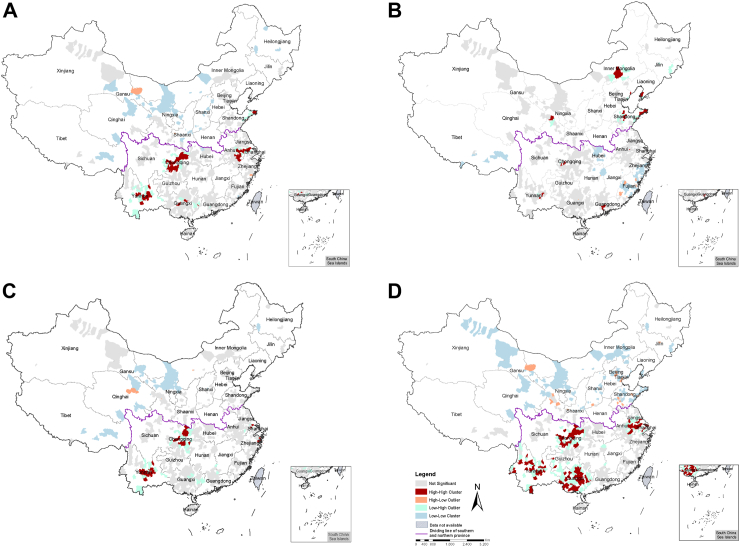
Findings: During 2011-2023, there were 2838 HFMD outbreaks reported with more than ten cases each that were included in our study. There were 53,958 HFMD cases and 17 deaths in the included outbreaks. The median attack rate was 0.07% (IQR = 0.04%-0.13%) and the median outbreak duration was 14 days (IQR = 9-21). Outbreaks began before school seasons started and peaked during weeks 16-25; most (87.95%) occurred in kindergartens, followed by primary or secondary schools (6.69%). Coxsackievirus A16 (CV-A16) caused 54.94% of the HFMD outbreaks, EV-A71 caused 19.77%, CV-A6 caused 8.99%, CV-A10 caused 0.53%, and other enteroviruses caused 15.76%. After EV-A71 vaccine was introduced into the market as a non-National Immunization Program (NIP) vaccine, the proportion of outbreaks caused by EV-A71 declined to 2.93% in the southern provinces and 4.84% in the northern provinces, and CV-A16, CV-A6, CV-A10, and other enteroviruses increased in proportion. Before EV-A71 vaccine availability, high-high clusters occurred in 37 counties of nine provinces, expanding to 117 counties of nine provinces after vaccine introduction, mainly into southern provinces.
Interpretation: After EV-A71 vaccine was introduced to the market in China, fewer HFMD outbreaks were caused by EV-A71 and more were caused by CV-A16, CV-A6, and CV-A10. The changes of spectrum for HFMD and expansion of outbreaks hotspots associated with vaccine introduction calls for multi-enterovirus vaccine development for controlling HFMD outbreaks.
Funding: Key Laboratory of Epidemiology of Major Diseases (Peking University), Ministry of Education; Prevention and Control Mechanisms for Major Infectious Diseases in the Cyber-Physical-Social Tri-Space (2023YFC2308702).
Keywords: Enterovirus A 71 vaccine; Epidemiology; Hand, foot, and mouth disease; Outbreaks.
© 2025 The Authors.
Conflict of interest statement
All authors declare that there are no conflicts of interest.
Figures


References
-
- Solomon T., Lewthwaite P., Perera D., Cardosa M.J., McMinn P., Ooi M.H. Virology, epidemiology, pathogenesis, and control of enterovirus 71. Lancet Infect Dis. 2010;10(11):778–790. - PubMed
-
- Wang B., Li J., Wang Y., et al. Understanding the epidemiological characteristics of EV71 and CVA16 infection to aid the diagnosis and treatment of hand, foot, and mouth disease. J Med Virol. 2019;91(2):201–207. - PubMed
-
- Bian L., Wang Y., Yao X., Mao Q., Xu M., Liang Z. Coxsackievirus A6: a new emerging pathogen causing hand, foot and mouth disease outbreaks worldwide. Expert Rev Anti Infect Ther. 2015;13(9):1061–1071. - PubMed
-
- Bian L., Gao F., Mao Q., et al. Hand, foot, and mouth disease associated with coxsackievirus A10: more serious than it seems. Expert Rev Anti Infect Ther. 2019;17(4):233–242. - PubMed
LinkOut - more resources
Full Text Sources
