


The association between stress hyperglycemia and poor outcome in critically ill children is modulated by hyperlactatemia
- PMID: 40607229
- PMCID: PMC12213459
- DOI: 10.3389/fendo.2025.1518746
The association between stress hyperglycemia and poor outcome in critically ill children is modulated by hyperlactatemia
Abstract
Background: The available evidence on tight glycemic control is conflicting, while the interaction between glucose and lactate in critically ill children remains unclear.
Objective: To explore the potential role of hyperlactatemia (HL) in modulating the relationship between stress hyperglycemia (SHG) and poor outcomes, aiming to establish tailored glucose targets in critically ill children.
Methods: This was a secondary analysis of a prospective observational cohort study conducted in five Pediatric Intensive Care Units (PICU) in southwestern China (ChiCTR2000030846). The interaction effect between glucose and lactate metrics concerning outcomes and subsequent subgroup regression analysis was conducted. SHG was defined as glucose > 150 mg/dL(8.3mmol/L) and HL as lactate > 2 mmol/L.
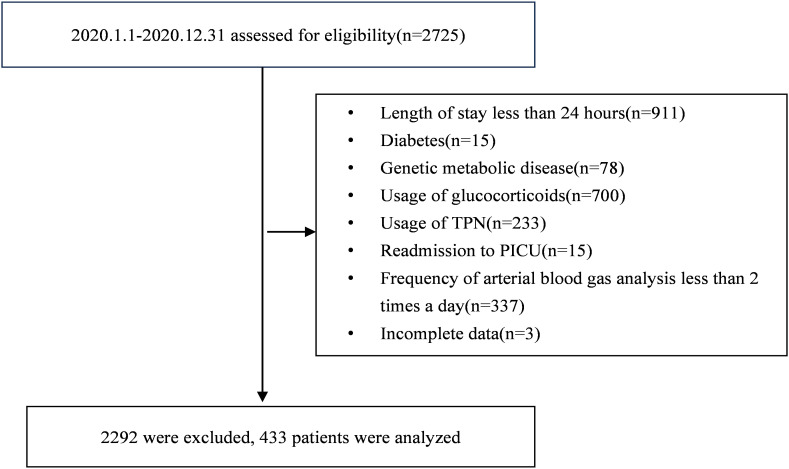
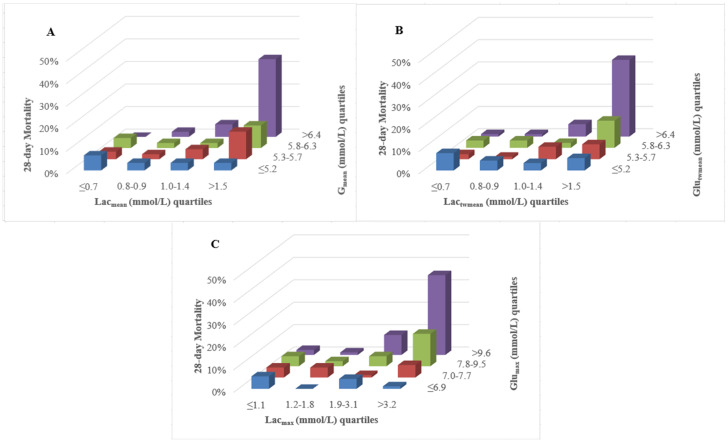
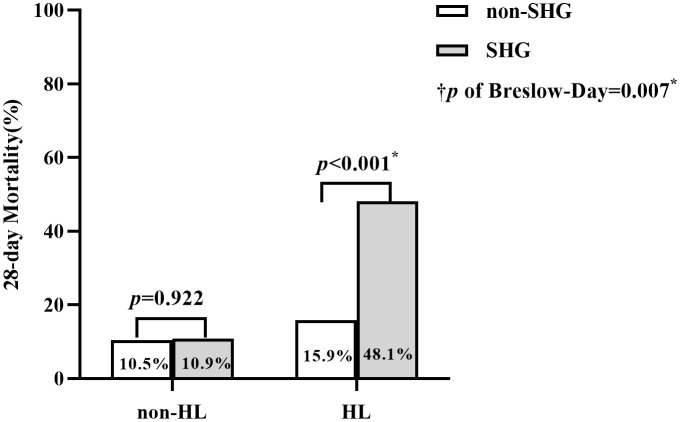
Results: A cohort of 433 pediatric patients with 4885 arterial blood gas measurements were finally enrolled. 90 (20.8%) cases died within 28 days of PICU admission. Significant interaction effects between SHG and HL on outcomes were observed (p < 0.05). In the non-HL group, SHG was not an independent predictor of 28-day mortality (p = 0.656) and was not correlated with either 28-day ventilator-free days (p = 0.916) or 28-day ICU-free days (p = 0.914). In contrast, in the HL group, SHG was independently associated with 28-day mortality (OR 3.55, 95% CI 1.62~7.80, p = 0.002) and correlated with a reduction of 5.04 28-day ventilator-free days (p = 0.003) and 4.10 28-day ICU-free days (p = 0.004).
Conclusions: HL potentially modulates the correlation between SHG and poor outcomes in pediatric critically ill patients. Combined SHG and HL are associated with poor outcomes, whereas SHG without HL is not.
Keywords: children; critically ill; hyperlactatemia; outcome; stress hyperglycemia.
Copyright © 2025 Liu, Dong, Li, Zhang, Chen, Jiang, Duan, Xiong, Huang, Zou, Liu, Fu and Yu.
Conflict of interest statement
The authors declare that the research was conducted in the absence of any commercial or financial relationships that could be construed as a potential conflict of interest.
Figures
References
Publication types
MeSH terms
Substances
LinkOut - more resources
Full Text Sources
Medical
