


The risk of hyperuricemia assessed by estimated glucose disposal rate
- PMID: 40607233
- PMCID: PMC12213406
- DOI: 10.3389/fendo.2025.1567789
The risk of hyperuricemia assessed by estimated glucose disposal rate
Abstract
Purpose: The estimated glucose disposal rate (eGDR) is a simple and noninvasive clinical measure used to assess insulin resistance (IR), yet its potential utility as a marker for hyperuricemia risk had not been systematically evaluated. This study aimed to investigate the relationship between eGDR and hyperuricemia risk among American adults.
Methods: Data for this cross-sectional study were obtained from the 2007-2018 National Health and Nutrition Examination Survey (NHANES). Hyperuricemia was identified as a serum urate (SU) concentration of ≥7 mg/dL in males and ≥6 mg/dL in females. The relationship between eGDR and hyperuricemia risk was assessed using multivariate logistic regression and restricted cubic spline (RCS) methods, with additional subgroup and interaction analyses performed.
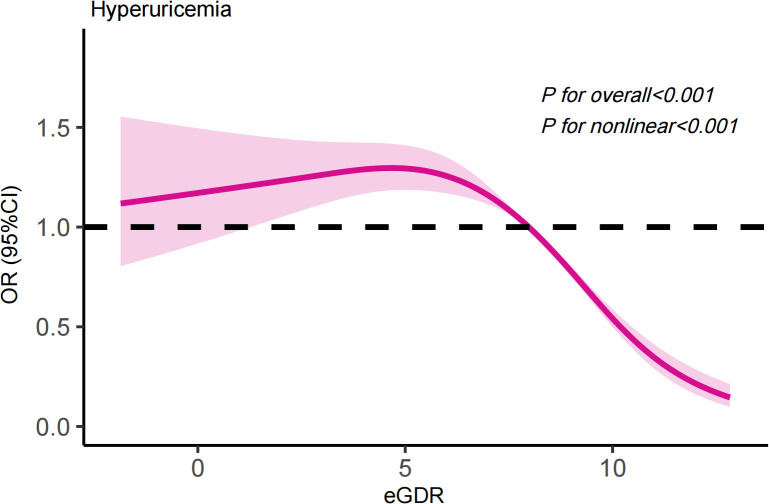
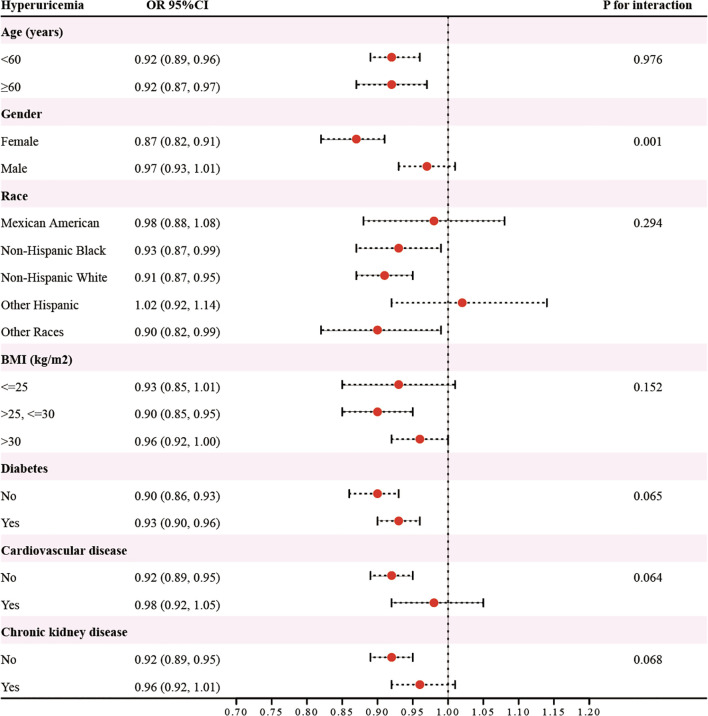
Results: With increasing eGDR values, the prevalence of hyperuricemia decreased significantly (29.93% vs. 19.11% vs. 13.20% vs. 5.03%, P <0.001). Multivariate logistic regression indicated that eGDR was independently associated with the risk of hyperuricemia after controlling for covariates including demographic, lifestyle, and clinical factors (OR=0.93, 95%CI: 0.90-0.96, P <0.001). RCS analysis further revealed a nonlinear relationship, with a turning point at eGDR 7.96 mg/kg/min. Subgroup analysis revealed a stronger inverse association between eGDR and hyperuricemia risk in females.
Conclusions: The eGDR is inversely associated with hyperuricemia and appears to be a promising epidemiological tool for evaluating the impact of IR on the risk of hyperuricemia.
Keywords: NHANES; estimated glucose disposal rate; hyperuricemia; insulin resistance; population-based study.
Copyright © 2025 Wang, Liu, Tang and Shen.
Conflict of interest statement
The authors declare that the research was conducted in the absence of any commercial or financial relationships that could be construed as a potential conflict of interest.
Figures
References
MeSH terms
Substances
LinkOut - more resources
Full Text Sources
Medical
