


Genetic variability, morphological diversity, and antioxidant potential in gynoecious Coccinia accessions: implications for breeding and biofortification
- PMID: 40610870
- PMCID: PMC12224389
- DOI: 10.1186/s12870-025-06335-x
Genetic variability, morphological diversity, and antioxidant potential in gynoecious Coccinia accessions: implications for breeding and biofortification
Abstract
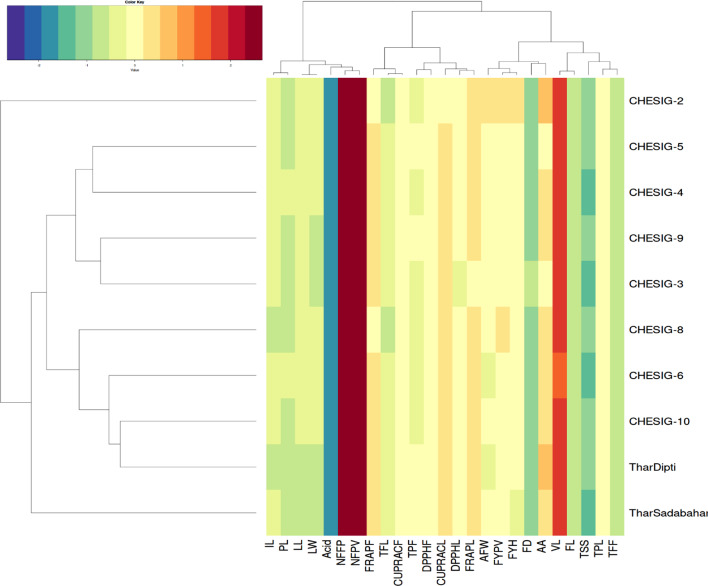
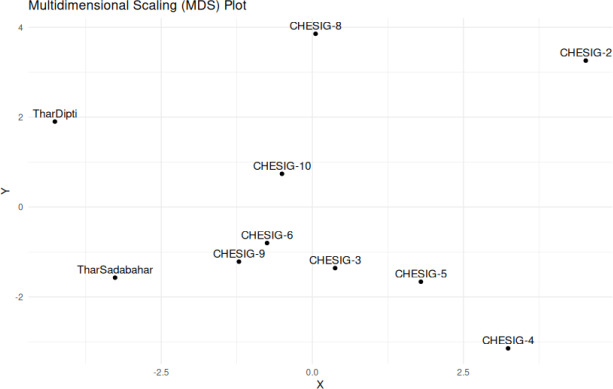
This study investigates genetic variability, morphological diversity, and biochemical traits in gynoecious Coccinia accessions using multivariate analysis. ANOVA revealed significant variation across key traits, with vine length (VL) ranging from 243.0 to 532.2 cm (CV = 10.15%), internode length (IL) from 6.15 to 9.7 cm, and leaf length (LL) from 6.52 to 8.76 cm. Fruit-related traits, including fruit diameter (FD) (1.72-4.76 cm), fruit length (FL) (3.74-8.16 cm), and average fruit weight (AFW) (11.88-30.42 g), showed significant variability (p < 0.01). Reproductive traits such as the number of female flowers per plant (NFFP) ranged from 828 to 1824 (CV = 12.08%), highlighting strong selection potential. Biochemical attributes exhibited considerable variation, with ascorbic acid (AsA) content between 18.52 and 53.68 mg/100 g and total soluble solids (TSS) from 0.9 to 3.4%. Antioxidant-related traits, including total phenolics (TPL: 13.66-24.95 mg GAE/100 g), total flavonoids (TFL: 5.42-12.16 mg CE/100 g), and ferric reducing antioxidant power (FRAPL: 20.49-46.62 µmol TE/g), indicated high bioactive potential. Strong positive correlations between yield traits (e.g., AFW and fruit yield per hectare, FYH, r > 0.9), were found by correlation analysis, and both trade-offs and synergies were seen between biochemical and morphological variables. Principal Component Analysis (PCA) highlighted genotype-specific trait relationships and explained 50.8% of the total variation. Cluster and network analyses further illustrated genetic diversity, with Thar Dipti (CHESIG-7) and Thar Sadabahar (CHESIG-2) emerging as genetically distinct accessions. These findings provide valuable insights for breeding strategies aimed at improving yield, antioxidant content, and fruit quality in Coccinia accessions.
Keywords: Coccinia grandis; Antioxidants; Biochemical traits; Correlation PCA; Genetic variability; Yield traits.
© 2025. The Author(s).
Conflict of interest statement
Declarations. Competing interests: The authors declare no competing interests.
Figures





References
-
- Saikia J, Phookan D, Talukdar P. Studies on genetic variability in Ivy gourd [Coccinia grandis (L.) Voigt]. Indian J Hortic. 2017;74(01):139–41. 10.5958/0974-0112.2017.000031.7.
-
- Bharathi LK, Naik G, Nath V. Selection indices for parthenocarpic clones of Ivy gourd (Coccinia grandis). Indian J Agric Sci. 2008;78:905–8.
-
- Khatun S, Pervin F, Karim MR, Ashraduzzaman M, Rosma A. Phytochemical screening and antimicrobial activity of Coccinia cordifolia L. plant. Pak J Pharm Sci. 2012;25(4):757–61. - PubMed
-
- Shaina TJ, Beevy SS. Morphological variation and evolutionary significance of coccinia grandis (l.) Voigt: an under-exploited cucurbitaceous vegetable crop. Plant Syst Evol. 2012;298(3):653–59. http://www.jstor.org/stable/43496775.
MeSH terms
Substances
LinkOut - more resources
Full Text Sources
Medical
