


Association between socio-demographic and injury factors, and physical activity behaviour in people with spinal cord injury: a theory-informed systematic review and meta-analysis
- PMID: 40611335
- PMCID: PMC12224392
- DOI: 10.1186/s13102-024-01021-1
Association between socio-demographic and injury factors, and physical activity behaviour in people with spinal cord injury: a theory-informed systematic review and meta-analysis
Abstract
Background: Identifying the determinants of physical (in)activity behaviour among people with spinal cord injury (PWSCI) will aid the prediction of speed and extent of recovery and inform strategies to optimise physical activity participation during physical rehabilitation. This review examined the association between socio-demographics, injury factors, and physical activity in PWSCI.
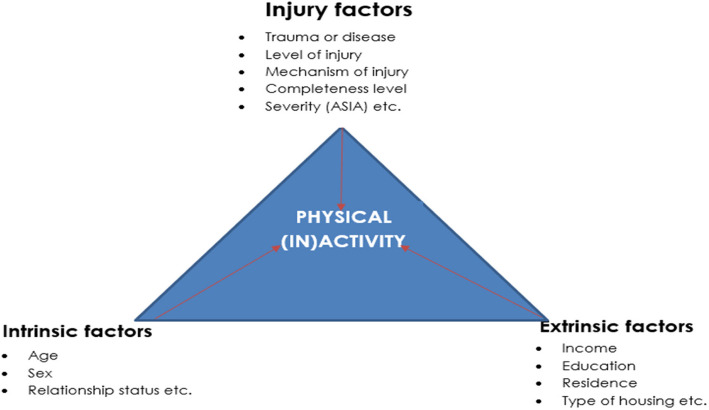
Methods: The Preferred Items for Reporting Systematic Reviews and Meta-analysis Protocols (PRISMA-P) provided the structure for this review. The epidemiological triangle and Bradford criteria further informed the review, as well as Rothman's causality model and Nweke's viewpoints. The review outcomes included injury factors and socio-demographic (intrinsic and extrinsic) factors associated with physical (in)activity in PWSCI. We searched four databases: PubMed, Medline, the Cumulative Index for Nursing and Allied Health Literature (CINHAL) and Academic Search Complete. The review used predefined eligibility criteria and a data screening and extraction template. The first author verified the extracted data. We employed narrative and quantitative syntheses and used a comprehensive Meta-analysis 4 to answer the review question.
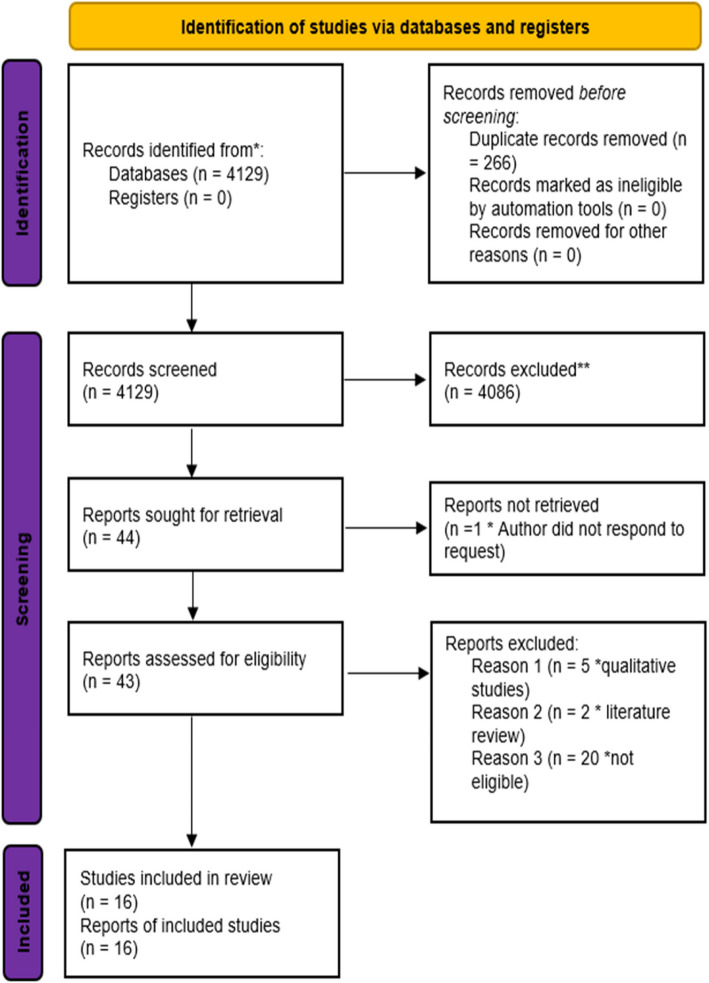
Results: We retrieved 4,129 articles, of which 16 (nine cross-sectional studies, six cohorts and one non-randomised clinical trial) with 2,716 participants were eligible. The mean age of participants in the included studies was 45 years, and about 14% were female. Physical (in) activity was statistically significantly associated with income (OR = 1.58, CI 1.23-2.04), completeness of lesion (OR = 0.86 CI 0.82-0.90), and mobility aid (3.12, CI 1.57-6.19). No statistically significant association existed between physical (in) activity and age (OR = 1.09, CI 0.46-2.58), sex (OR = 0.66, CI 0.43-1.03), education (OR = 0.66, CI 0.42-1.06), time since injury (OR = 0,971, CI 0,749-1,26), vertebral level of the lesion (OR = 0.92, CI 0.71-1.11), or mechanism of injury (OR = 1.48, CI 0.74-2.97) among PWSCI.
Conclusions: Efforts to optimise physical activity participation among PWSCI should consider the completeness of injury, income and type of mobility aid during rehabilitation programs. Factors such as employment status, residence, and type of house were less underscoring, and most studies needed more robust conceptual and theoretical underpinnings.
Trial registration: The review was registered with PROSPERO (ID: CRD42024544295).
Keywords: Injury factors; Physical activity; Socio-demographic factors; Spinal cord injury; Systematic review; Theory.
© 2025. The Author(s).
Conflict of interest statement
Declarations. Ethics approval and consent to participate: Not applicable. Consent for publication: Not applicable. Competing interests: The authors declare no competing interests.
Figures
References
-
- Hoevenaars D, Holla JFM, Postma K, van der Woude LHV, Janssen TWJ, de Groot S. Associations between meeting exercise guidelines, physical fitness, and health in people with spinal cord injury. Disabil Rehabil. 2023;45(6):1030–7. 10.1080/09638288.2022.2048910. - PubMed
-
- Martin Ginis KAM, Latimer AE, Arbour-Nicitopoulos KP, Buchholz AC, Bray SR, Craven BC, et al. Leisure time physical activity in a population-based sample of PWSCIpart I: demographic and injury-related correlates. Arch Phys Med Rehabil. 2010;91(5):722–8. 10.1016/j.apmr.2009.12.027. - PubMed
-
- Williams TL, Smith B, Papathomas A. The barriers, benefits and facilitators of leisure time physical activity among people with spinal cord injury: a meta-synthesis of qualitative findings. Health Psychol Rev. 2014;8(4):404–25. 10.1080/17437199.2014.898406. PMID: 25211208. - PubMed
-
- Hübner-Woźniak E, Morgulec-Adamowicz N, Malara M, Lewandowski P, Okęcka-Szymańska J. Effect of rugby training on blood antioxidant defenses in able-bodied and spinal cord injured players. Spinal Cord. 2012;50(3):253–6. 10.1038/sc.2011.134. - PubMed
LinkOut - more resources
Full Text Sources
