


Designs of NKG2D-based immunotherapeutics for cancer
- PMID: 40612946
- PMCID: PMC12221891
- DOI: 10.3389/fimmu.2025.1557644
Designs of NKG2D-based immunotherapeutics for cancer
Abstract
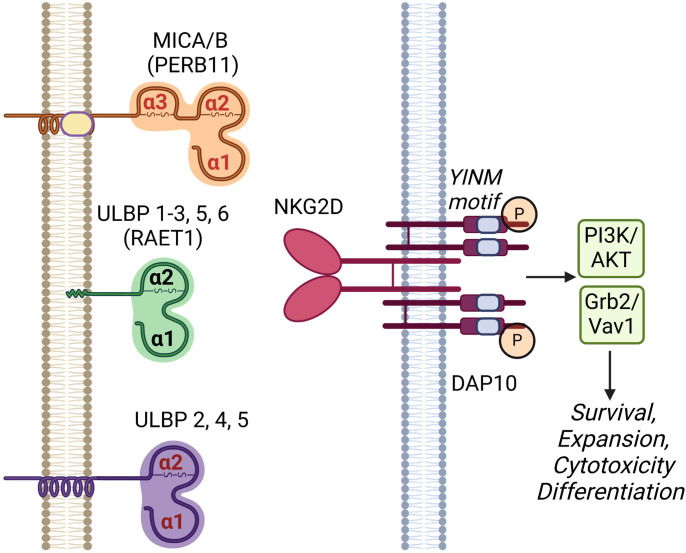
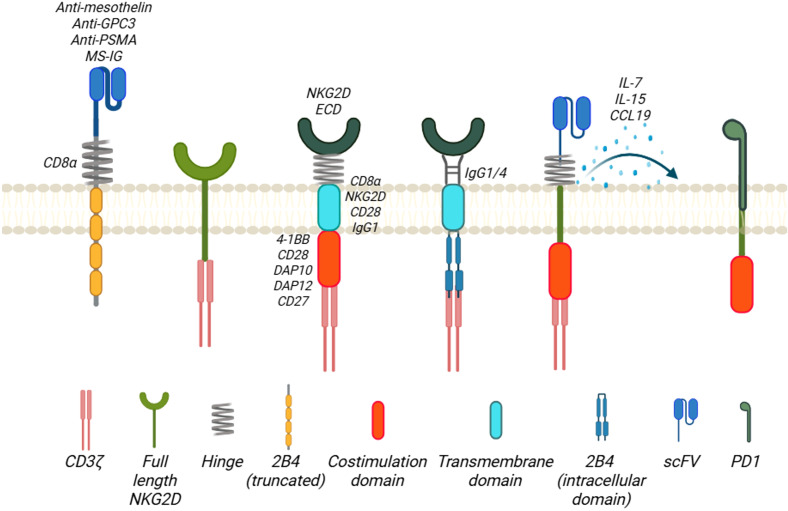
Natural killer group 2 D (NKG2D) receptor, one of the activation receptors on NK cells, has gained increasing attention in recent years because its ligands are widely expressed in most cancers. Naturally, NKG2D reacts to 8 different stress-induced ligands, MICA/B, and ULBP1-6. Despite being genomically conserved between human and mouse, NKG2D transcripts have splice variants that can differentiate the two. hNKG2D or mNKG2D (both long and short transcripts) interacts with DAP10 only in human but DAP10/12 in mouse, switching on different effector functions such as IFN-γ production and cytotoxicity. Full-length, extracellular or cytoplasmic domains have been used to construct chimeric antigen receptors (CAR) or implement into the antibody structures including bispecific antibodies. Interestingly, most of the NKG2D CARs, either on T cells or NK cells are investigated in preclinical models of solid tumors. In this article, we reviewed the majority of published NKG2D-based CAR and antibody designs, comparing their respective advantages and disadvantages. We also elaborated how these CARs and antibodies were tested in preclinical cancer models and clinical trials in this review article.
Keywords: CAR-T therapy; NK cell therapy; NKG2D; cancer; immunotherapy.
Copyright © 2025 Han, Wang, Chan and Chan.
Conflict of interest statement
The authors declare that the research was conducted in the absence of any commercial or financial relationships that could be construed as a potential conflict of interest.
Figures
References
Publication types
MeSH terms
Substances
LinkOut - more resources
Full Text Sources
Medical
