


Single-cell analysis of dup15q syndrome reveals developmental and postnatal molecular changes in autism
- PMID: 40615364
- PMCID: PMC12227528
- DOI: 10.1038/s41467-025-61184-4
Single-cell analysis of dup15q syndrome reveals developmental and postnatal molecular changes in autism
Abstract
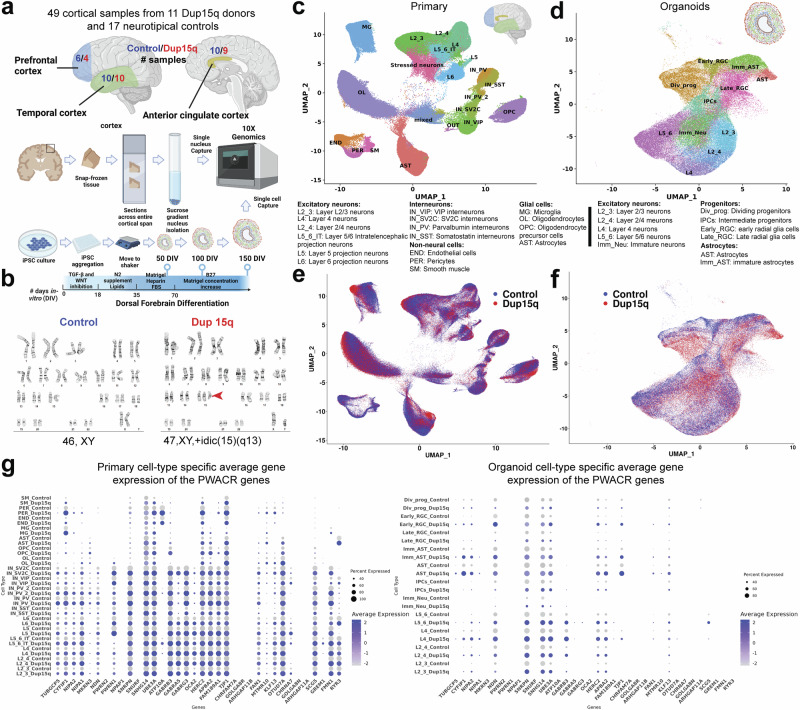
Duplication 15q (dup15q) syndrome is a leading genetic cause of autism spectrum disorder, offering a key model for studying autism-related mechanisms. Using single-cell and single-nucleus RNA sequencing of cortical organoids from dup15q patient-derived iPSCs and post-mortem brain samples, we identify increased glycolysis, disrupted layer-specific marker expression, and aberrant morphology in deep-layer neurons during fetal-stage organoid development. In adolescent-adult postmortem brains, upper-layer neurons exhibit heightened transcriptional burden related to synaptic signaling, a pattern shared with idiopathic autism. Using spatial transcriptomics, we confirm these cell-type-specific disruptions in brain tissue. By gene co-expression network analysis, we reveal disease-associated modules that are well preserved between postmortem and organoid samples, suggesting metabolic dysregulation that may lead to altered neuron projection, synaptic dysfunction, and neuron hyperexcitability in dup15q syndrome.
© 2025. The Author(s).
Conflict of interest statement
Competing interests: The authors declare no competing interests.
Figures


Update of
-
Single cell analysis of dup15q syndrome reveals developmental and postnatal molecular changes in autism.bioRxiv [Preprint]. 2023 Sep 22:2023.09.22.559056. doi: 10.1101/2023.09.22.559056. bioRxiv. 2023. Update in: Nat Commun. 2025 Jul 4;16(1):6177. doi: 10.1038/s41467-025-61184-4. PMID: 37790331 Free PMC article. Updated. Preprint.
References
MeSH terms
Supplementary concepts
Grants and funding
LinkOut - more resources
Full Text Sources
Medical
