


Enhancing smart city sustainability with explainable federated learning for vehicular energy control
- PMID: 40615475
- PMCID: PMC12227566
- DOI: 10.1038/s41598-025-07844-3
Enhancing smart city sustainability with explainable federated learning for vehicular energy control
Abstract
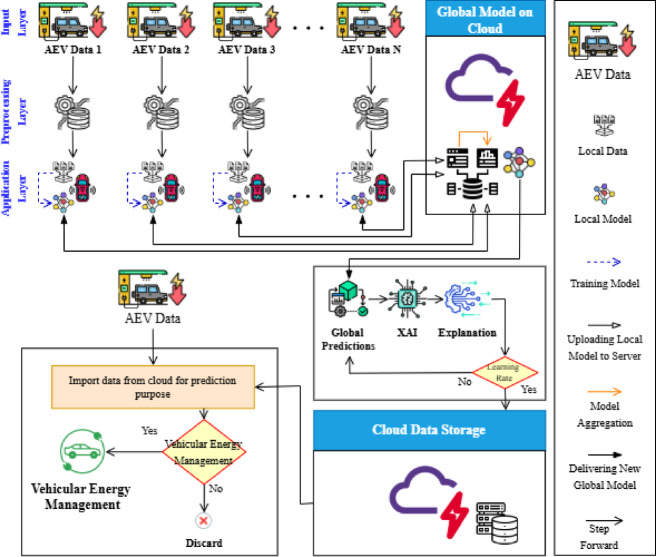
The rise of electric and autonomous vehicles in smart cities poses challenges in vehicular energy management due to un-optimized consumption, inefficient grid use, and unpredictable traffic patterns. Traditional centralized machine learning models and cloud-based Energy Management Systems (EMSs) struggle with real-time adaptability, high-dimensional data processing, and data privacy risks. These issues lead to high costs, excessive energy waste, and regulatory concerns. Federated Learning (FL) offers a decentralized approach where multiple edge devices collaboratively train models without sharing raw data. This enhances privacy, reduces communication overhead, and is well-suited for smart city applications. However, FL's black-box nature limits interpretability, reducing trust in AI-driven decisions. Explainable AI (XAI) addresses this by enhancing transparency, interpretability, and regulatory compliance. This research introduces Explainable FL (XFL) for optimizing vehicular energy management in smart cities. The proposed XFL framework integrates distributed learning with explainability techniques for interpretable and accountable decision-making. Using a real-world AEV telemetry dataset of approximately 1,219,567 records with features like speed, energy consumption, and traffic density, it employs a hierarchical FL architecture to ensure secure and decentralized learning. It efficiently analyzes real-time traffic, vehicle energy states, and grid load balancing while preserving privacy. Experimental results show that the proposed Multi-Layer Perceptron (MLP)-based global model achieves superior predictive accuracy, with R² values of 94.73% for energy consumption and 99.83% for traffic density, significantly outperforming previous methods.
Keywords: Energy management systems (EMSs); Explainable federated learning; Smart City; Vehicular energy management; XAI.
© 2025. The Author(s).
Conflict of interest statement
Declarations. Competing interests: The authors declare no competing interests.
Figures

Similar articles
-
An explainable federated blockchain framework with privacy-preserving AI optimization for securing healthcare data.Sci Rep. 2025 Jul 1;15(1):21799. doi: 10.1038/s41598-025-04083-4. Sci Rep. 2025. PMID: 40595873 Free PMC article.
-
Blockchain-enabled federated learning with edge analytics for secure and efficient electronic health records management.Sci Rep. 2025 Jul 28;15(1):27524. doi: 10.1038/s41598-025-12225-x. Sci Rep. 2025. PMID: 40721766 Free PMC article.
-
FedEmerge: An Entropy-Guided Federated Learning Method for Sensor Networks and Edge Intelligence.Sensors (Basel). 2025 Jun 14;25(12):3728. doi: 10.3390/s25123728. Sensors (Basel). 2025. PMID: 40573615 Free PMC article.
-
Designing Clinical Decision Support Systems (CDSS)-A User-Centered Lens of the Design Characteristics, Challenges, and Implications: Systematic Review.J Med Internet Res. 2025 Jun 20;27:e63733. doi: 10.2196/63733. J Med Internet Res. 2025. PMID: 40540451 Review.
-
Emerging research trends in artificial intelligence for cancer diagnostic systems: A comprehensive review.Heliyon. 2024 Aug 23;10(17):e36743. doi: 10.1016/j.heliyon.2024.e36743. eCollection 2024 Sep 15. Heliyon. 2024. Retraction in: Heliyon. 2025 Apr 15;11(9):e43335. doi: 10.1016/j.heliyon.2025.e43335. PMID: 39263113 Free PMC article. Retracted. Review.
References
-
- Aljohani, T. M., Assolami, Y. O., Alrumayh, O., Mohamed, M. A. & Almutairi, A. Sustainable energy systems in a post-pandemic world: A taxonomy-based analysis of global energy-related markets responses and strategies following COVID-19. Sustainability, 17(5), 2307. (2025).
-
- Siddiqui, S. Y., Khan, M. A., Abbas, S. & Khan, F. Smart occupancy detection for road traffic parking using deep extreme learning machine. J. King Saud Univ.-Comput. Inform. Sci.34 (3), 727–733 (2022).
-
- Atta, A., Abbas, S., Khan, M. A., Ahmed, G. & Farooq, U. An adaptive approach: Amart traffic congestion control system. J. King Saud Univ.-Comput. Inform. Sci.32 (9), 1012–1019 (2020).
-
- Etukudoh, E. A. et al. A review of sustainable transportation solutions: Innovations, challenges, and future directions. World J. Adv. Res. Rev. 21 (1), 1440–1452 (2024).
-
- Sabet, S. & Farooq, B. Exploring the combined effects of major fuel technologies, eco-routing, and eco-driving for sustainable traffic decarbonization in downtown Toronto. Transp. Res. Part A Policy Pract. 192, 104385. (2025).
LinkOut - more resources
Full Text Sources
