


The relation between passively collected data and PTSD: a systematic review and meta-analysis
- PMID: 40617877
- PMCID: PMC12228780
- DOI: 10.1038/s41746-025-01825-6
The relation between passively collected data and PTSD: a systematic review and meta-analysis
Abstract
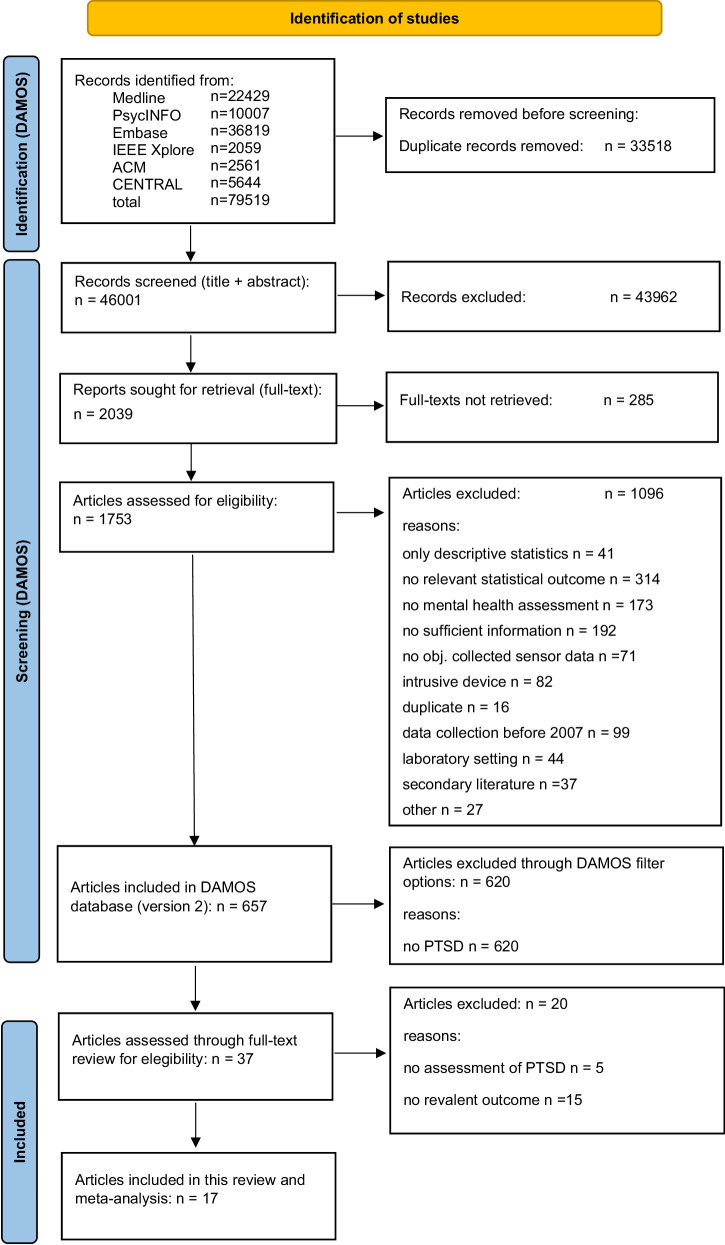
Post-traumatic stress disorder (PTSD) is a common mental disorder. This systematic review and meta-analysis examined the association between mobile sensing features and PTSD symptoms. Studies were sourced from the Database for Mobile Sensing Studies in Mental Healthcare (DAMOS), with inclusion criteria requiring correlations between mobile sensing data and PTSD symptoms assessed by validated tools. Seventeen studies encompassing 1847 participants (mean age = 38.68, 63.18% female) remained after study selection. Of 18 features across sleep, mobility, activity, and social activity, only wake after sleep onset (r = 0.14, 95% CI = [0.03, 0.25]) and relative amplitude of physical activity (r = -0.10, 95% CI = [-0.17, -0.03]) were significantly associated with PTSD symptoms. Findings were consistent across PTSD measurements, populations, demographics, and sensing durations. Although mobile sensing offers unobtrusive, objective, and ecologically valid insights into PTSD, confirmatory studies and research to optimize sensor assessment are needed before clinical practice.
© 2025. The Author(s).
Conflict of interest statement
Competing interests: The authors declare no competing interests.
Figures
References
Grants and funding
- 202406870011/China Scholarship Council
- 01EE2303A/German Center for Mental Health (Deutsches Zentrum für Psychische Gesundheit [DZPG])
- 01EE2304C/German Center for Mental Health (Deutsches Zentrum für Psychische Gesundheit [DZPG])
- 01EE2304C/German Center for Mental Health (Deutsches Zentrum für Psychische Gesundheit [DZPG])
- 01EE2303A/German Center for Mental Health (Deutsches Zentrum für Psychische Gesundheit [DZPG])
LinkOut - more resources
Full Text Sources
