


Effects of branched-chain amino acid- and vitamin D-containing high-protein food supplementation plus exercise on elderly people with decreased physical functions
- PMID: 40618056
- PMCID: PMC12229038
- DOI: 10.1186/s12877-025-06177-0
Effects of branched-chain amino acid- and vitamin D-containing high-protein food supplementation plus exercise on elderly people with decreased physical functions
Abstract
Background: The efficacy of supplementation with branched-chain amino acids (BCAAs) and vitamin D with exercise in elderly people remains unclear. This study aimed to examine whether the combination of exercise and supplementation with BCAA- and vitamin D-containing high-protein food would be effective in improving soft lean mass and physical functions in elderly people with impaired physical functions.
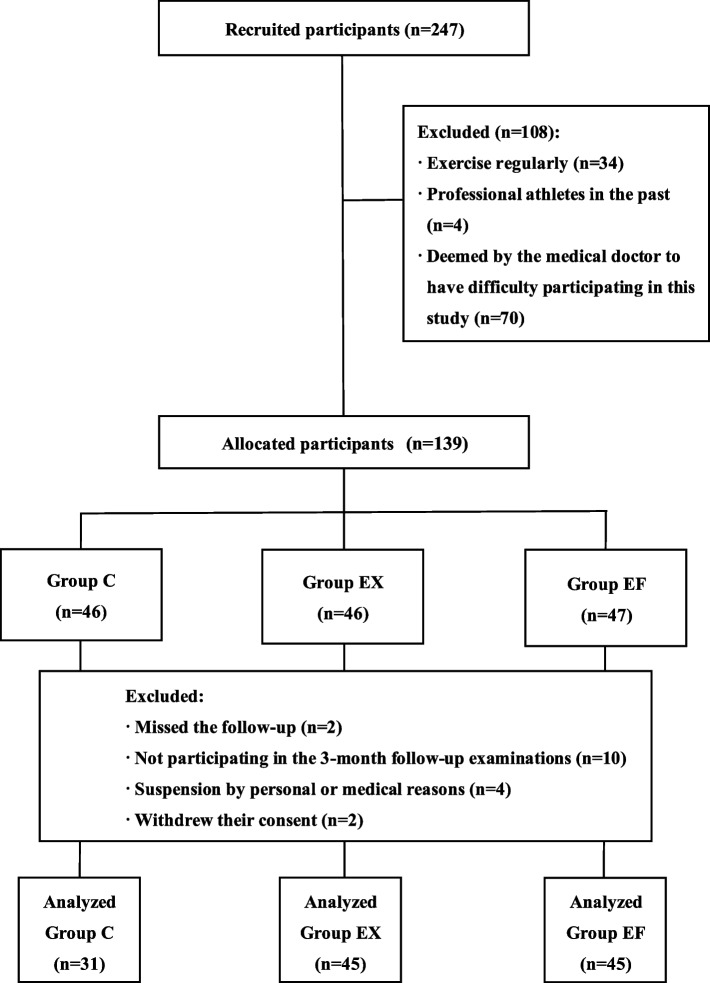
Methods: This 12-week interventional study recruited elderly people ≥ 60 years of age with impaired physical activity (locomotive syndrome, LS). The participants were assigned to one of the following three groups: exercise group (group EX, n = 46), exercise with supplementation of BCAA- and vitamin D-containing high-protein food group (group EF, n = 45), and control group (group C, n = 31). Subjects in group EX were instructed to perform locomotion training, and those in group EF were instructed to consume high-protein test food in addition to locomotion training. The soft lean mass, a self-administered questionnaire (Geriatric Locomotive Function Scale-25, GLFS-25) and physical tests (stand-up test, two-step test), and the value of 25OH vitamin D were compared among the three groups after three months of intervention.
Results: There were no significant declines in soft lean mass in group EF, while significant declines were detected in the other two groups. There were significant differences in the stand-up test scores among the three groups (p = 0.03). A post-hoc analysis showed a significant difference between groups C and EF. There was a significant difference in the two-step test scores among the three groups (p = 0.004). A post-hoc analysis showed significant differences between groups C and EX, and between groups C and EF. There were no significant differences in the GLFS-25 scores among the groups. There was a significant increase in the value of 25OH vitamin D after three months in group EF (p < 0.001).
Conclusions: This study showed that BCAA and vitamin D supplementation with exercise in elderly subjects with declining physical functions resulted in maintenance of soft lean mass, improvement in physical functions (stand-up test score and two-step test), and an increase in 25OH vitamin D.
Trial registration: This study was prospectively registered at the University Hospital Medical Information Network on 01/02/2018 (UMIN000030567).
Keywords: Branched-chain amino acid; Exercise; Physical function; Soft lean mass; Vitamin D.
© 2025. The Author(s).
Conflict of interest statement
Declarations. Ethics approval and consent to participate: This study was approved by the Miyazaki University Medical Ethics Committee (Research Project Number: I-0027). The study protocols were completed in accordance with the Declaration of Helsinki’s ethical principles for medical research involving human subjects. Competing interests: Hiroyuki Kimura and Koichiro Hamada are employees of Otsuka Pharmaceutical Co. Ltd. The remaining authors declare no conflict of interest. BODY MAINTÉ Jelly is a high-protein food containing BCAA and vitamin D from Otsuka Pharmaceutical Co., Ltd.
Figures
References
-
- Sanchís-Soler G, Sebastiá-Amat S, Parra-Rizo MA. Mental health and social integration in active older adults according to the type of sport practiced. Acta Psychol (Amst). 2025;255: 104920. - PubMed
-
- Seguin R, Nelson ME. The benefits of strength training for older adults. Am J Prev Med. 2003;25(3 Suppl 2):141–9. - PubMed
-
- Scott D, Blizzard L, Fell J, Giles G, Jones G. Associations between dietary nutrient intake and muscle mass and strength in community-dwelling older adults: the Tasmanian older adult cohort study. J Am Geriatr Soc. 2010;58(11):2129–34. - PubMed
Publication types
MeSH terms
Substances
Grants and funding
LinkOut - more resources
Full Text Sources
Medical
