


Mechanical behavior of hybrid custom implant abutments with various crown materials: a 3D finite element analysis
- PMID: 40618097
- PMCID: PMC12228271
- DOI: 10.1186/s12903-025-06445-w
Mechanical behavior of hybrid custom implant abutments with various crown materials: a 3D finite element analysis
Abstract
Background: Traditional and innovative materials are widely used in dentistry; however, the mechanical behavior of hybrid custom implant abutments, particularly stress distribution in various material combinations, is not fully understood. The study aims to evaluate the mechanical behavior of hybrid custom implant abutments made from various material combinations, including their effects on von Mises stress, maximum and minimum principal stresses, and deformation.
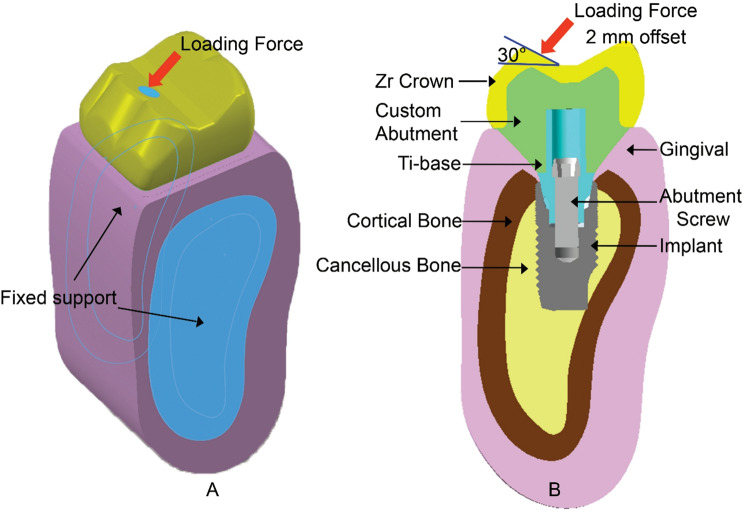
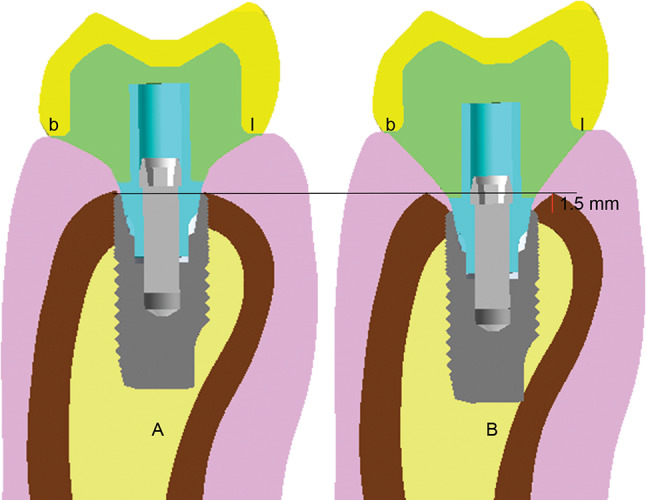
Methods: Two 3-dimensional (3D) models were constructed: a 1.5 mm subcrestal as the test and an equicrestal model as the control. The subcrestal model explored seven materials (Zirconia, Titanium, Lithium Disilicate, Polymer-Infiltrated Ceramic Networks, PEEK, PEEK reinforced with carbon fiber and reinforced with glass fiber) in various abutment and crown combinations. Each model included an implant, titanium base abutment, abutment screw, a custom abutment, a zirconia crown, and bone. A 200 N load was applied, and a Finite Element Analysis (FEA) assessed peak, volume average, and distribution of von Mises stress and principal stress.
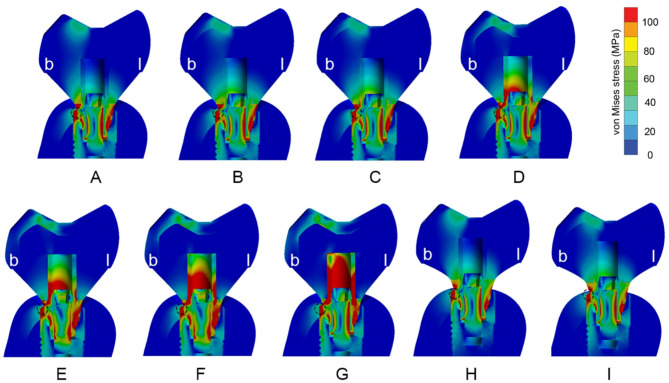
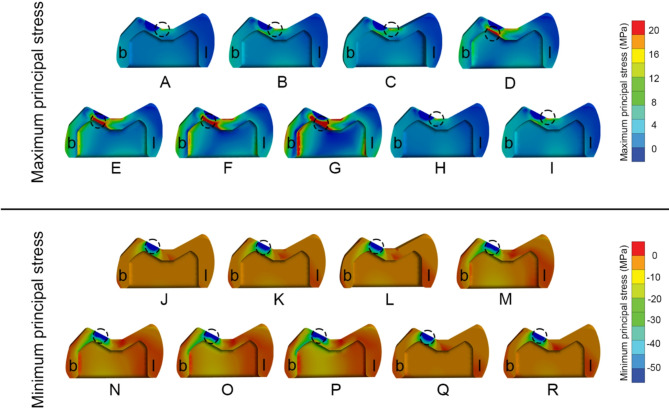
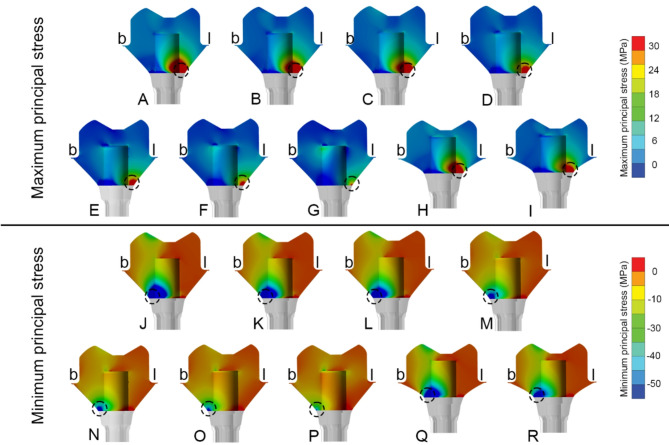
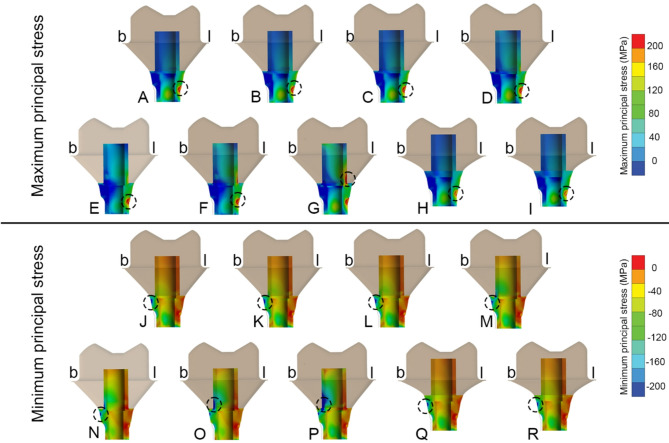
Results: The titanium base (Tibase) exhibited the highest peak and volume average von Mises stresses (306-429 MPa), followed by the custom abutment (40-95 MPa) and crown (46-81 MPa). Material changes significantly impacted stress distribution in the Tibase and customized abutments. PICN, Zirconia, Titanium, and Lithium Disilicate abutments showed peak principal stresses between 77 and 85 MPa, while PEEK variants reduced stress in the custom abutment (35-66 MPa) but increased it in the Ti-base (356-405 MPa). PEEK also increased minimum principal stresses in the Ti-base (-400 to -600 MPa).
Conclusions: Abutment materials have a greater impact on stress outcomes compared to crown materials. Abutments with high Young's modulus contribute to increased core system stiffness in hybrid custom abutment complexes. Choosing abutment materials with a high Young's modulus for hybrid custom implant abutments is essential to optimize stress distribution and enhance the stability of the implant system.
Keywords: CAD/CAM; Customized abutments; Finite element analysis; Material properties; Mechanical performance.
© 2025. The Author(s).
Conflict of interest statement
Declarations. Ethics approval and consent to participate: Not applicable. Consent for publication: Not applicable. Competing interests: The authors declare no competing interests.
Figures
References
-
- Guilherme NM, Chung K-H, Flinn BD, Zheng C, Raigrodski AJ. Assessment of reliability of CAD-CAM tooth-colored implant custom abutments. Journal of Prosthetic Dentistry.2016;116(2):206– 13. - PubMed
MeSH terms
Substances
LinkOut - more resources
Full Text Sources
Miscellaneous
