. 2025 Oct;120(5):947-974.
doi: 10.1007/s00395-025-01125-w. Epub 2025 Jul 6.

Myocardial phosphoproteomics unveils a key role of DYRK1A in aortic valve replacement-induced reverse remodelling

Affiliations

Myocardial phosphoproteomics unveils a key role of DYRK1A in aortic valve replacement-induced reverse remodelling

Fábio Trindade et al. Basic Res Cardiol. 2025 Oct.

Abstract

Aortic valve stenosis (AVS) is a growing healthcare burden. Aortic valve replacement (AVR) remains the only effective treatment to eliminate pressure overload and triggers myocardial reverse remodelling (RR), with regression of hypertrophy, fibrosis and diastolic function normalisation. However, many patients show an incomplete RR, being at higher risk of death. We aimed to uncover pathways and new therapeutic targets for incomplete RR through myocardial (phospho)proteomics. AVS patients were categorised based on left ventricle mass regression (LVM): complete RR (≥ 15%) or incomplete RR (≤ 5%). 83 myocardial proteins were dysregulated through LC-MS/MS. Gene ontology enrichment analysis identified inflammation, complement and immune system activation as priming events of an incomplete RR and a better mitochondrial function underscoring complete RR. Kinetic metabolic modelling corroborated the lower ATP production capacity of incomplete RR patients. To uncover therapeutic targets, kinases were predicted from phosphoproteome data. Casein kinase 2 and DYRK1A were among the most dysregulated kinases in RR. DYRK1A was found to be inversely correlated with LVM regression (r = - 0.62). DYRK1A functional role (passive, maximal tension and Ca2+ sensitivity) was evaluated in skinned cardiomyocytes from Dyrk1a+/- mice and from AVS patients upon incubation with this kinase. Cardiomyocytes from mutant mice showed increased myofilamentary stiffness in response to stretch. Also, the raised myofilamentary stiffness of cardiomyocytes isolated from incomplete RR was normalised upon incubation with DYRK1A. Better myocardial bioenergetics may underscore a complete LVM regression. In turn, complement and immune-inflammatory pathways activation prime an incomplete response to AVR. DYRK1A emerges as a surrogate target to treat myocardial stiffness-driven diastolic dysfunction.

Keywords: Aortic valve stenosis; DYRK1A; Myocardium; Phosphoproteomics; Proteomics; Reverse remodelling.


Figures

Fig. 1
Fig. 1
Characterisation of the myocardial proteome in AVS patients with complete (n = 4, green) or incomplete (n = 4, red) RR. Proteins are identified by their gene name. A Venn chart showing the distribution of the proteins identified in both groups. Exclusive proteins are listed. B Volcano plot representing DEPs (coloured dots), identified by t-test. Darker green and red dots depict, respectively, proteins at least 1.5-fold lower or higher in incomplete RR. C Ranking of the proteins according to the effect size (95% confidence interval). Vertical dashed lines mark the large effect size threshold (Cohen’s d > 0.8)
Fig. 2
Fig. 2
Gene ontology enrichment analysis of the DEPs. The top 20 enriched biological processes (A), molecular functions (B), and cellular components (C) are shown for complete and incomplete RR. The terms are ranked according to the gene ratio and the FDR-adjusted p-value (hypergeometric test). The dot size is proportional to gene count and its colour is scaled to the significance level
Fig. 3
Fig. 3
Network of the dysregulated biological processes between complete (green) and incomplete (red) RR, after ClueGO analysis. Proteins are identified by their gene name. Protein–protein interactions were added with CluePedia to depict functional nodules. One such nodule is a hub of four mitochondrial proteins upregulated in complete RR (vide mitochondria icons)
Fig. 4
Fig. 4
Metabolic profiling with Quantitative System Metabolism. A Prediction of substrate preference according to different energetic demands. In a resting state, fatty acids (green) are predicted as the preferred energy source for all patients. As the energetic demand rises, so does the utilisation of carbohydrates (dark blue). However, reliance on fatty acids as an energetic substrate is better preserved in patients with complete RR (77% vs 69% under high energetic stress). Ketone bodies (light blue) and branched-chain amino acids (yellow) are used in residual amounts. B Prediction of oxygen uptake and ATP production with increasing workload. Maximal oxygen consumption and ATP production rate plateau at a lower level in incomplete RR patients
Fig. 5
Fig. 5
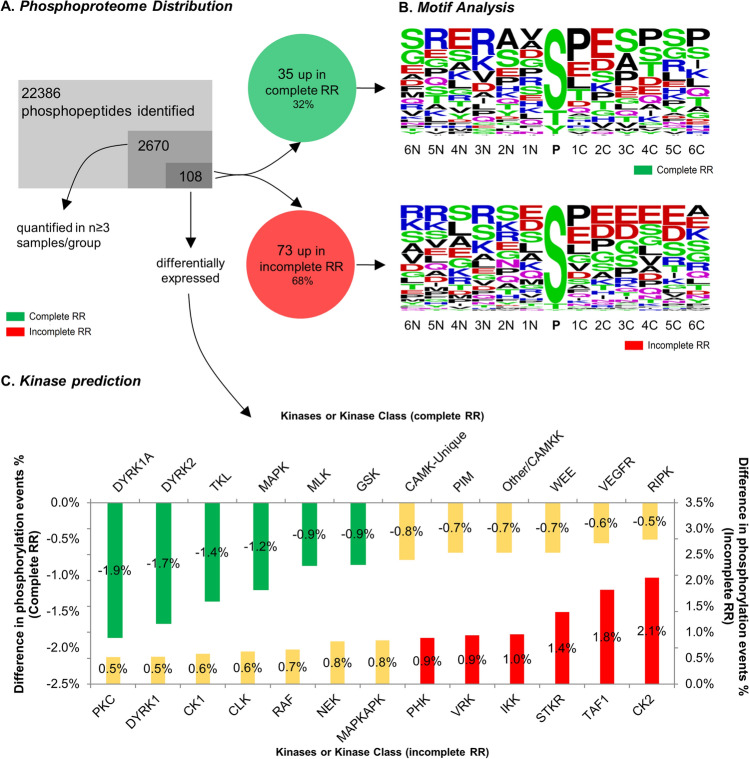
Characterisation of the myocardial phosphoproteome in AVS patients with complete (n = 4, green) or incomplete (n = 4, red) RR. A Representation of the identified and differentially expressed phosphopeptides. B Motif analysis of the phosphosites’ neighbouring sequence in complete (top) and incomplete (bottom) RR. Amino acids are depicted by the single letter code. C Kinase rank. Predicted kinases are sorted according to the percentage of associated phosphorylation events. Only kinases with a difference |cRR-iRR|> 0.5% in phosphorylation events are shown (Table S3 provides the complete list). Kinases (or their families) in the first and tenth percentiles were associated with incomplete (red) and complete RR (green), respectively
Fig. 6
Fig. 6
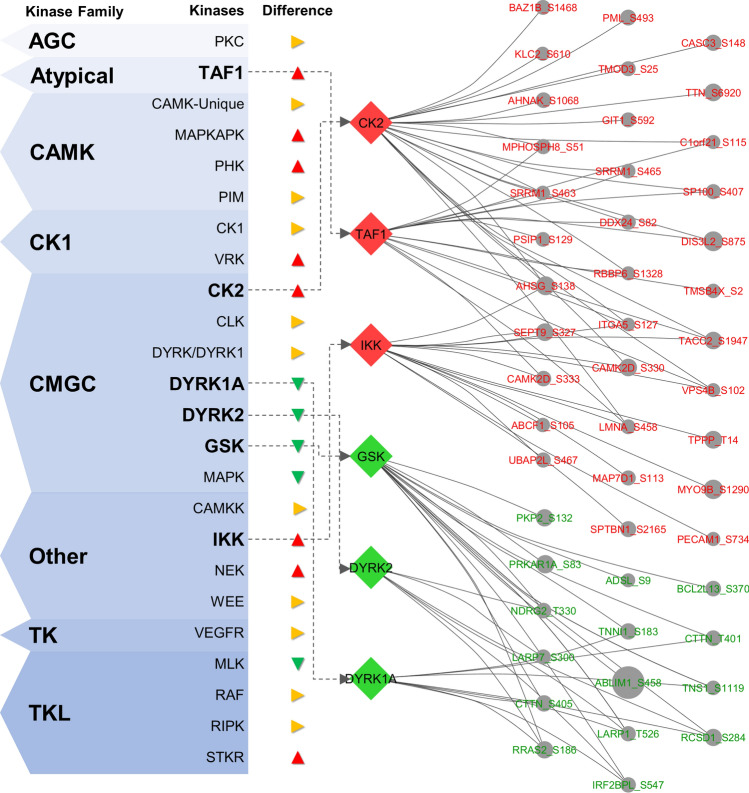
Segregation of the most important kinases, according to the respective kinase class (left panel), highlighting the three most important kinases for complete and incomplete reverse remodelling and the respective phosphosites (on the right). Note that kinase families were left out of the analysis and that IKK was represented instead of STKR family, because the latter comprise kinases phylogenetically more diverse than the former. A high degree of kinase–substrate overlap in both phenotypes could be observed through network analysis (the reader should see the interconnectivity between phosphoproteins, represented by gene name, and the central kinases), suggesting co-regulation or participation in convergent pathways
Fig. 7
Fig. 7
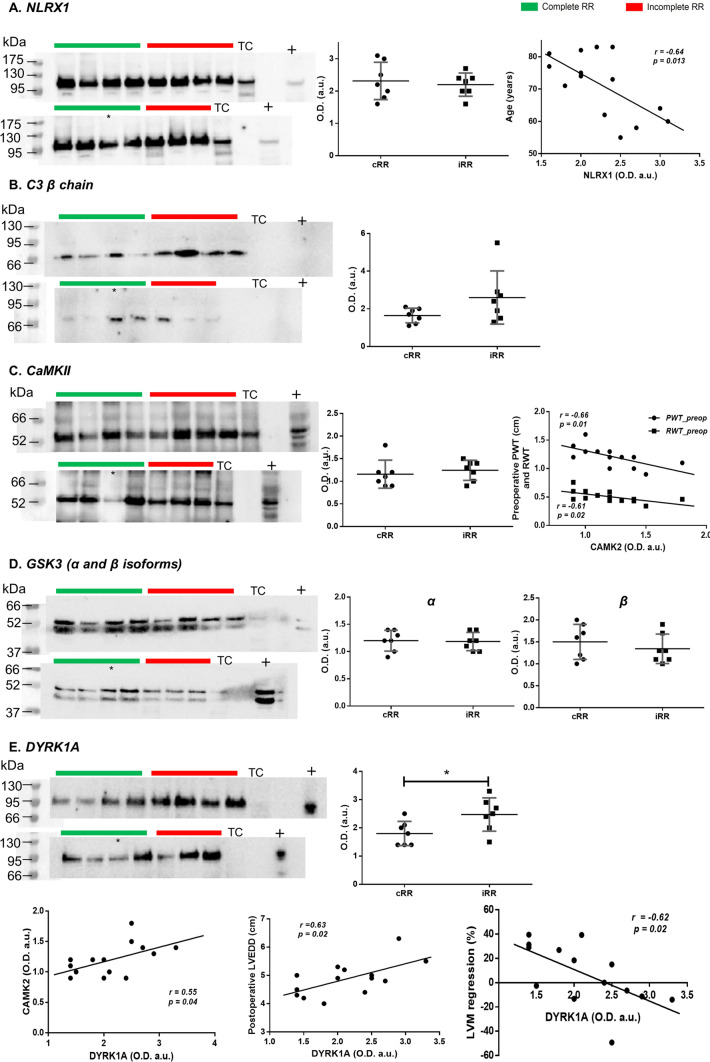
Western blot quantification of (A) NLRX1, (B) C3 β chain, (C) CAMK2, (D) GSK3α and β, and (E) DYRK1A in patients with complete (n = 7) or incomplete (n = 7) RR. TC designates a technical control and “ + ” a positive control (NLRX1, GSK3, CAMK2: HeLa cell lysate; C3, DYRK1A: HepG2 lysate for). “*” identifies an excluded sample (aortic insufficiency was found more severe than aortic stenosis). In each blot, the molecular weight of the protein ladder is shown on the left and the respective optical density quantification on the right. Differences were tested by unpaired t-test or Mann–Whitney test. Significant correlations between protein levels and clinical variables are also shown. This includes an inverse relationship between age and NLRX1 (A, right); an inverse association between CAMK2 and posterior (PWT) and relative wall thickness (RWT) (C, right); a direct association between DYRK1A and CAMK2 (E, bottom-left), a positive correlation between DYRK1A and postoperative LV end-diastolic dimension (LVEDD) (E, bottom-centre) and an inverse correlation between DYRK1A and LVM regression (E, bottom-right). In all cases, Pearson’s r is shown, as all variables shown were normal
Fig. 8
Fig. 8
DYRK1A and cardiomyocyte mechanical properties. A Snapshot of skinned cardiomyocyte obtained from wild-type and Dyrk1a+/- mice. Scale bar, 10 µm. Skinned cardiomyocytes were glued between a force transducer and a motor for the force experiments. B Western blot confirmation of Dyrk1a reduced expression in mutant mice (n = 10, p < 0.09, unpaired t-test). Dyrk1a+/+ (WT, n = 5) and Dyrk1a+/- (n = 5) mice-derived cardiomyocytes are represented by dark and light blue dots and curves, respectively. C SL-PT relationship and D calcium sensitivity on isometric (2.2 µm) force development in WT and Dyrk1a+/- cardiomyocytes. Force was normalised to that developed at saturating calcium concentration (pCa 4.5). (E, F) SL–PT relationship in cardiomyocytes from patients with complete (n = 6) and incomplete RR (n = 6) before (untreated) and after incubation with recombinant DYRK1A (+ DYRK1A). DYRK1A normalised passive tension in incomplete RR to the levels of cardiomyocytes from complete RR. In E and F, only top or bottom error bars are displayed to improve readability. The differences were inspected with two-way ANOVA with repeated measures, followed by Bonferroni’s multiple comparisons tests

References

    1. Li SX, Patel NK, Flannery LD, Selberg A, Kandanelly RR, Morrison FJ, Kim J, Tanguturi VK, Crousillat DR, Shaqdan AW, Inglessis I, Shah PB, Passeri JJ, Kaneko T, Jassar AS, Langer NB, Turchin A, Elmariah S (2022) Trends in utilization of aortic valve replacement for severe aortic stenosis. J Am Coll Cardiol 79:864–877. 10.1016/j.jacc.2021.11.060 - PubMed
    1. Kim GH, Uriel N, Burkhoff D (2017) Reverse remodelling and myocardial recovery in heart failure. Nat Rev Cardiol 15:83–96. 10.1038/nrcardio.2017.139 - PubMed
    1. Rodrigues PG, Leite-Moreira AF, Falcão-Pires I (2016) Myocardial reverse remodeling: how far can we rewind? Am J Physiol Heart Circ Physiol 310:H1402–H1422. 10.1152/ajpheart.00696.2015 - PubMed
    1. Biederman RWW, Magovern JA, Grant SB, Williams RB, Yamrozik JA, Vido DA, Rathi VK, Rayarao G, Caruppannan K, Doyle M (2011) LV reverse remodeling imparted by aortic valve replacement for severe aortic stenosis; is it durable? A cardiovascular MRI study sponsored by the American Heart Association. J Cardiothorac Surg 6:1–8. 10.1186/1749-8090-6-53 - PMC - PubMed
    1. Hatani T, Kitai T, Murai R, Kim K, Ehara N, Kobori A, Kinoshita M, Kaji S, Tani T, Sasaki Y, Yamane T, Koyama T, Nasu M, Okada Y, Furukawa Y (2016) Associations of residual left ventricular and left atrial remodeling with clinical outcomes in patients after aortic valve replacement for severe aortic stenosis. J Cardiol 68:241–247. 10.1016/j.jjcc.2015.09.017 - PubMed

MeSH terms

Substances

LinkOut - more resources