


Dioecy in a wind-pollinated herb explained by disruptive selection on sex allocation via inbreeding avoidance
- PMID: 40619945
- PMCID: PMC12371145
- DOI: 10.1111/nph.70356
Dioecy in a wind-pollinated herb explained by disruptive selection on sex allocation via inbreeding avoidance
Abstract
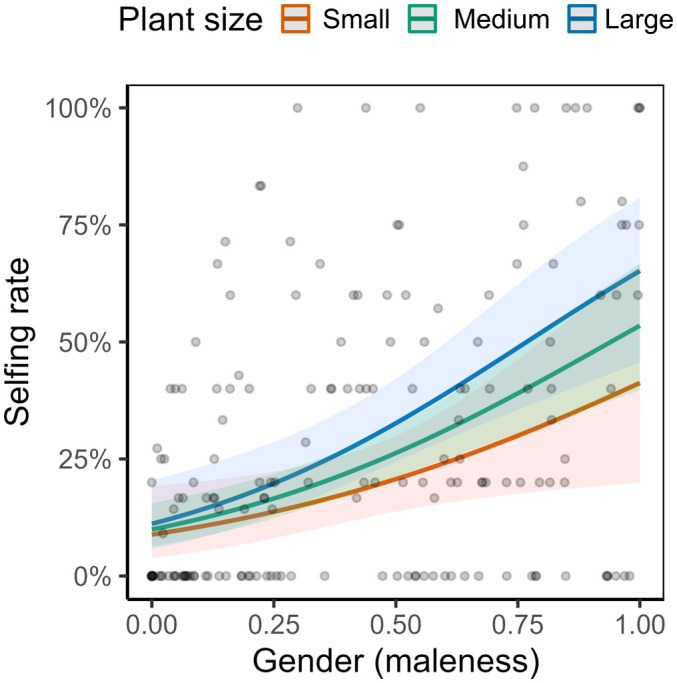
The evolution of dioecy from hermaphroditism is widely thought to be a response to disruptive selection favoring males and females, driven by advantages of inbreeding avoidance, sexual specialization, or both. It has hitherto been difficult to uncouple the importance of these two hypotheses. We use phenotypes produced by experimental evolution to test the inbreeding avoidance hypothesis in populations from which sexual specialization can be effectively ruled out. We estimate the selfing rate and the shape of fitness gain curves under scenarios with and without inbreeding depression in experimental populations of wind-pollinated Mercurialis annua with high variation in sex allocation. Our results confirm a phenotypic trade-off between male and female allocation in M. annua. Individual selfing rates increased with pollen production. This dependence led to strong disruptive selection on sex allocation due to its interaction with the mating system under the scenario of high inbreeding depression, especially for plants of medium and large sizes. Taken together, our results demonstrate that inbreeding avoidance on its own can lead to disruptive selection on sex allocation, favoring the selection and maintenance of dioecy under wind pollination without associated benefits of sexual specialization.
Keywords: anemophily; evolutionary branching; geitonogamy; monoecy; paternity; selection gradient; sexual conflict; sexual system.
© 2025 The Author(s). New Phytologist © 2025 New Phytologist Foundation.
Conflict of interest statement
None declared.
Figures



References
-
- Agren J, Schemske DW. 1995. Sex allocation in the monoecious herb Begonia semiovata . Evolution 49: 121–130. - PubMed
-
- Aljiboury AA, Friedman J. 2022. Mating and fitness consequences of variation in male allocation in a wind‐pollinated plant. Evolution 76: 1762–1775. - PubMed
-
- Ashman TL. 2003. Constraints on the evolution of males and sexual dimorphism: field estimates of genetic architecture of reproductive traits in three populations of gynodioecious Fragaria virginiana . Evolution 57: 2012–2025. - PubMed
-
- Ashman T‐L. 2006. The evolution of separate sexes: a focus on the ecological context. In: Harder LD, Barrett SCH, eds. Ecology and evolution of flowers. Oxford, UK: Oxford University Press, 204–222.
MeSH terms
Grants and funding
LinkOut - more resources
Full Text Sources
