


Serum Nox1 and Gper Levels in Patients With Generalized Anxiety Disorder: A Cross-Sectional Study in Turkiye
- PMID: 40619989
- PMCID: PMC12230344
- DOI: 10.1002/brb3.70645
Serum Nox1 and Gper Levels in Patients With Generalized Anxiety Disorder: A Cross-Sectional Study in Turkiye
Abstract
Purpose: Although the etiopathogenesis of generalized anxiety disorder (GAD) is not fully known, it is suggested that oxidative stress (OS) and estrogen play important roles. NADPH oxidase 1 (NOX1) is from the NADPH oxidase (NOX) family, which is known as a main source of reactive oxygen species (ROS). The G protein-coupled estrogen receptor (GPER) is a novel estrogen receptor that mediates the non-genomic rapid effects of estrogen. Recent work has shown GPER to be associated with OS, but it has not to our knowledge been examined in patient samples with GAD.
Method: We conducted a study comparing serum NOX1 and GPER levels of patients with GAD and healthy controls (HCs) matched for age, sex, and body mass index (BMI).
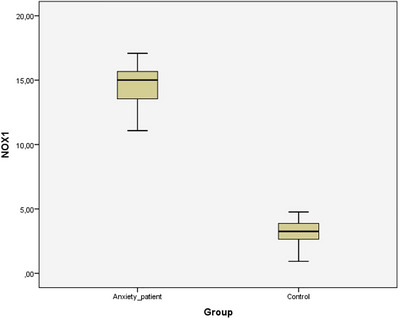
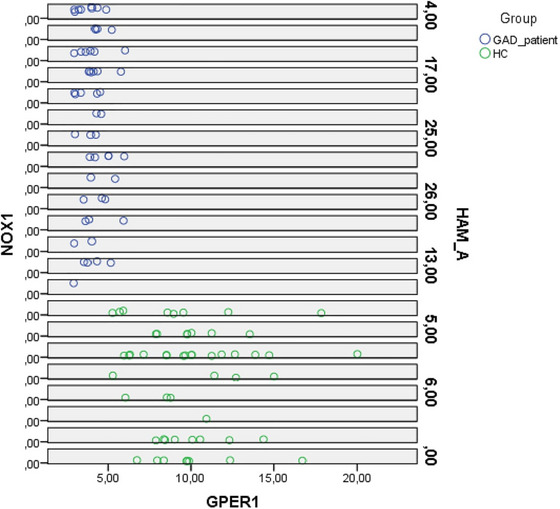
Finding: We found increased NOX1 and decreased GPER levels in patients with GAD compared with HCs. In addition, we showed that serum NOX1 levels have very good diagnostic performance for patients with GAD. We observed a weak positive correlation between serum NOX1 levels and GPER levels in the patient group.
Conclusion: Although we believe these results are important for a better understanding of the role of OS and estrogen in GAD patients, longitudinal studies should be performed in larger samples of GAD patients grouped by severity of symptoms.We investigated the levels of NOX1 and GPER in patients with GAD. We found increased NOX1 and decreased GPER levels in patients with GAD compared to healthy controls. In addition, we showed that serum NOX1 levels have very good diagnostic performance for patients with GAD.
Keywords: ERα; ERβ; biomarker; estrogen; oxidative stress; reactive oxygen species.
© 2025 The Author(s). Brain and Behavior published by Wiley Periodicals LLC.
Conflict of interest statement
The authors declare no conflicts of interest.
Figures

References
-
- Chen, J.‐R. , Shankar K., Nagarajan S., Badger T. M., and Ronis M. J.. 2008. “Protective Effects of Estradiol On Ethanol‐Induced Bone Loss Involve Inhibition of Reactive Oxygen Species Generation in Osteoblasts and Downstream Activation of the Extracellular Signal‐Regulated Kinase/Signal Transducer and Activator of Transcription 3/Receptor Activator of Nuclear Factor‐κB Ligand Signaling Cascade.” Journal of Pharmacology and Experimental Therapeutics 324, no. 1: 50–59. - PubMed
MeSH terms
Substances
LinkOut - more resources
Full Text Sources
Medical
