


Introduction, establishment, and distribution of Aedes aegypti and dengue in a temperate capital of Brazil: a retrospective surveillance-based study
- PMID: 40620879
- PMCID: PMC12226368
- DOI: 10.1016/j.lana.2025.101153
Introduction, establishment, and distribution of Aedes aegypti and dengue in a temperate capital of Brazil: a retrospective surveillance-based study
Abstract
Background: Dengue is spreading to southern latitudes in Brazil, where the temperate climate was once a barrier to the primary vector, Aedes aegypti. In this study, our objective was to reconstruct the introduction, establishment, and subsequent expansion of Ae. aegypti and dengue in Porto Alegre, the southernmost state capital of Brazil, located in Rio Grande do Sul state.
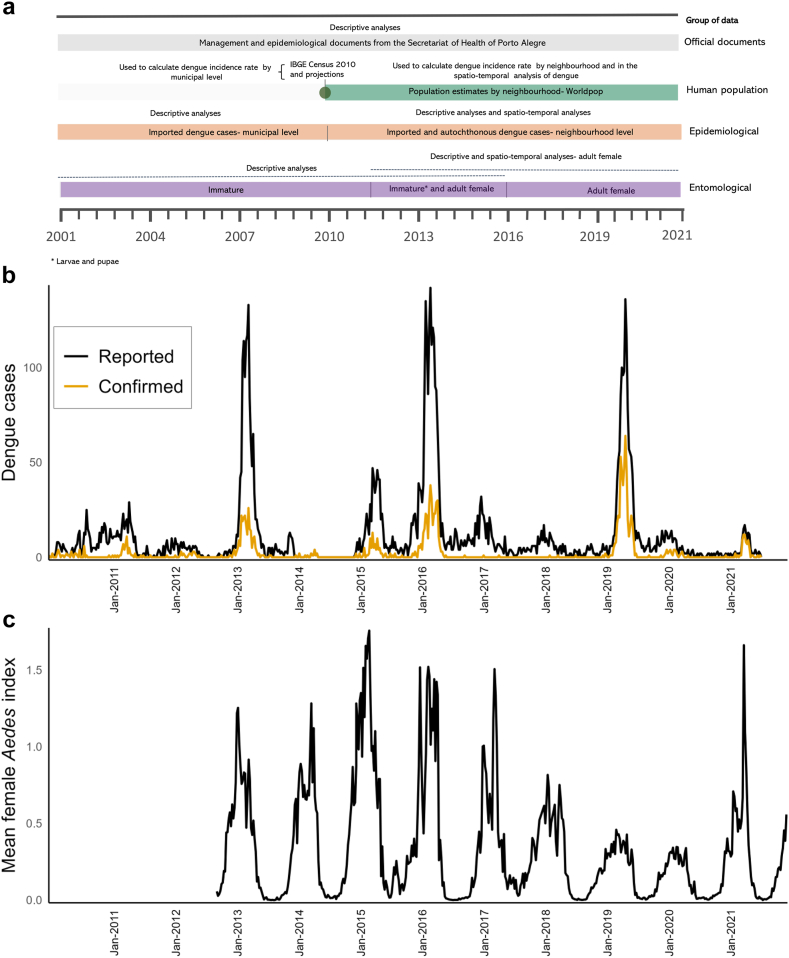
Methods: This ecological study used entomological and epidemiological surveillance data and official reports obtained from municipal health authorities of Porto Alegre, from 2001 to 2021. Descriptive analyses were employed, supplemented by space-time scan statistics to identify high-risk vector abundance and dengue case clusters.
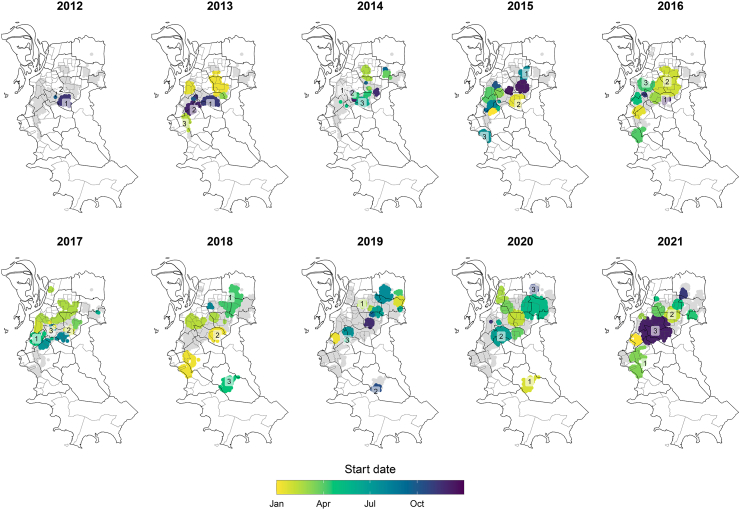
Findings: Ae. aegypti was first detected in Porto Alegre in 2001, spreading citywide by 2016. The first autochthonous dengue case was recorded in 2010, and by 2021 the disease was detected in 78% of the neighbourhoods. DENV-1 was the dominant serotype and most cases occurred among people aged 20-59. Clusters of vectors and dengue cases were more frequent during summer and autumn, but a few were also identified during winter. High-risk clusters for vectors were more frequent in the Partenon and Northwest regions and for dengue in the East, Centre, Partenon and South.
Interpretation: Ae. aegypti successfully established and spread within a temperate city in Brazil. The presence of vectors, a susceptible population and socio-environmental characteristics conducive to mosquito proliferation resulted in autochthonous transmission of dengue fever after the continuous introduction of imported cases. The climatic barrier to dengue transmission in the south of Brazil has shifted southward, coinciding with the colonisation of Ae. aegypti and the emergence of dengue in recent years in Porto Alegre.
Funding: Generalitat de Catalunya, European Commission, and Conselho Nacional de Desenvolvimento Científico e Tecnológico (CNPq).
Keywords: Aedes aegypti; Brazil; Dengue; Scan statistics; Spatiotemporal; Vector adaptation; Vector borne diseases.
© 2025 The Authors.
Conflict of interest statement
The authors declare no conflict of interest.
Figures


References
-
- WHO Dengue and severe dengue. https://www.who.int/news-room/fact-sheets/detail/dengue-and-severe-dengue
-
- Ministério da Saúde Painel de Monitoramento das Arboviroses. 2024. https://www.gov.br/saude/pt-br/assuntos/saude-de-a-a-z/a/aedes-aegypti/m...
-
- Ferreira-de-Lima V.H., Câmara D.C.P., Honório N.A., Lima-Camara T.N. The Asian tiger mosquito in Brazil: observations on biology and ecological interactions since its first detection in 1986. Acta Trop. 2020;205 - PubMed
LinkOut - more resources
Full Text Sources
