


On-chip graphene photodetectors with a nonvolatile p-i-n homojunction
- PMID: 40623980
- PMCID: PMC12234681
- DOI: 10.1038/s41377-025-01832-y
On-chip graphene photodetectors with a nonvolatile p-i-n homojunction
Abstract
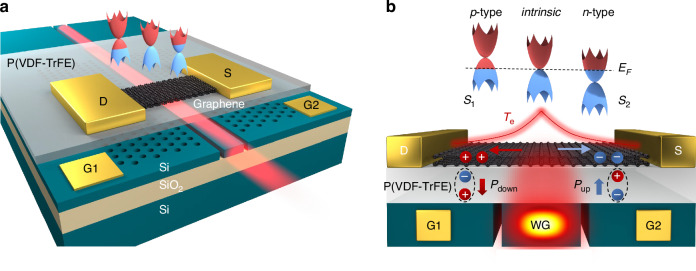
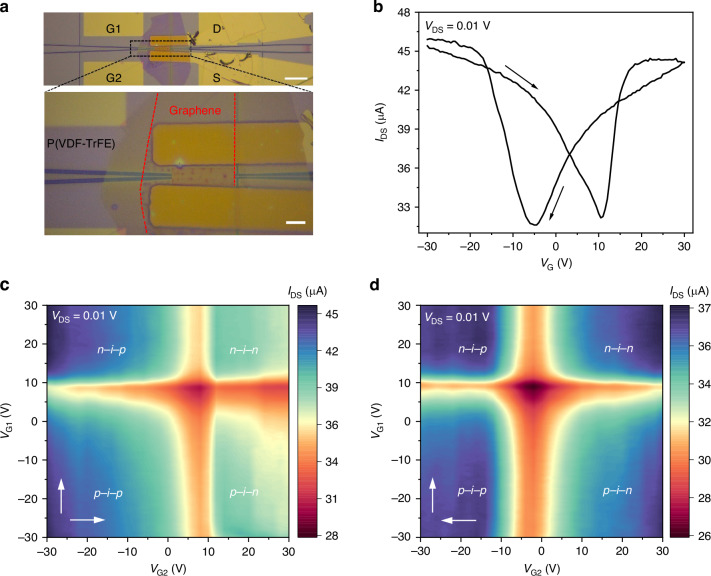
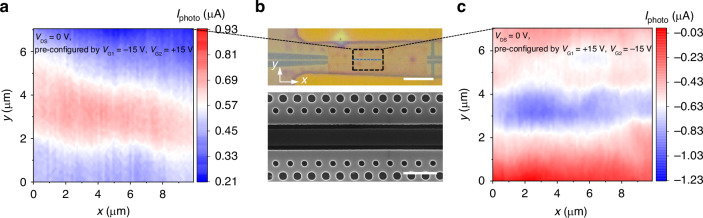
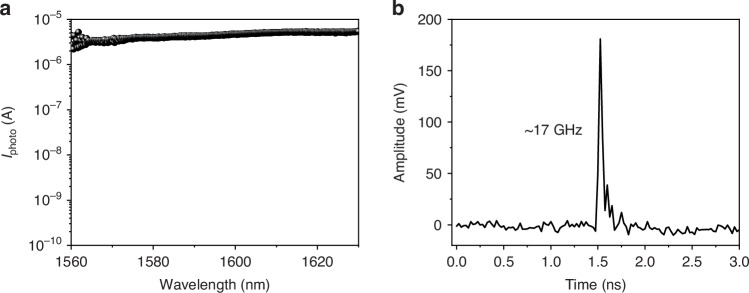
Graphene's unique photothermoelectric (PTE) effect, combined with its compatibility for on-chip fabrication, promises its development in chip-integrated photodetectors with ultralow dark-current and ultrafast speed. Previous designs of on-chip graphene photodetectors required external electrical biases or gate voltages to separate photocarriers, leading to increased power consumption and complex circuitry. Here, we demonstrate a nonvolatile graphene p-i-n homojunction constructed on a silicon photonic crystal waveguide, which facilitates PTE-based photodetection without the need for electrical bias or gate voltages. By designing an air-slotted photonic crystal waveguide as two individual silicon back gates and employing ferroelectric dielectrics with remnant polarization fields, the nonvolatile p-i-n homojunction with a clear gradient of Seebeck coefficient is electrically configured. Hot carriers in the graphene channel generated from the absorption of waveguide evanescent field are separated by the nonvolatile p-i-n homojunction effectively to yield considerable photocurrents. With zero-bias and zero-gate voltage, the nonvolatile graphene p-i-n homojunction photodetector integrated on the optical waveguide exhibits high and flat responsivity of 193 mA W-1 over the broadband wavelength range of 1560-1630 nm and an ultrafast dynamics bandwidth of 17 GHz measured in the limits of our instruments. With the high-performance on-chip photodetection, the nonvolatile graphene homojunction directly constructed on silicon photonic circuits promises the extended on-chip functions of the optoelectronic synapse, in-memory sensing and computing, and neuromorphic computing.
© 2025. The Author(s).
Conflict of interest statement
Conflict of interest: The authors declare no competing interests.
Figures

References
-
- Romagnoli, M. et al. Graphene-based integrated photonics for next-generation datacom and telecom. Nat. Rev. Mater.3, 392–414 (2018). - DOI
-
- Wu, G. J. et al. Programmable transition metal dichalcogenide homojunctions controlled by nonvolatile ferroelectric domains. Nat. Electron.3, 43–50 (2020). - DOI
-
- Shastri, B. J. et al. Photonics for artificial intelligence and neuromorphic computing. Nat. Photonics15, 102–114 (2021). - DOI
LinkOut - more resources
Full Text Sources
