


Reliability and validity of OpenPose for measuring HKA angle in dynamic walking videos in patients with knee osteoarthritis
- PMID: 40624241
- PMCID: PMC12234900
- DOI: 10.1038/s41598-025-09627-2
Reliability and validity of OpenPose for measuring HKA angle in dynamic walking videos in patients with knee osteoarthritis
Abstract
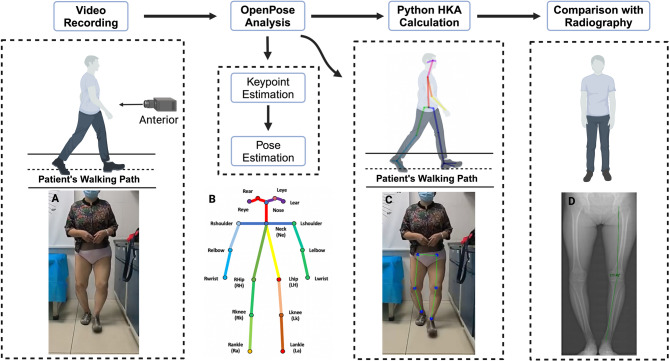
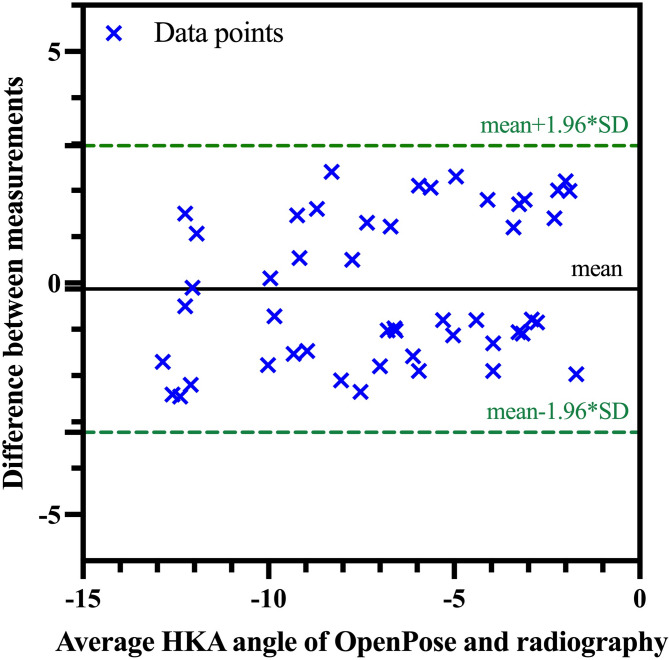
The hip-knee-ankle (HKA) angle is essential to assess surgical evaluation and disease progression in patients with knee osteoarthritis (KOA). Rapid, radiation-free assessment methods are a key area of research. This study investigates the reliability and validity of OpenPose, video-based human pose estimation method, for determining the HKA angle in KOA patients. In this study, we analyzed 50 knees affected by osteoarthritis. The HKA angle was measured using the pose estimation method and X-ray imaging before total knee arthroplasty. The pose estimation method demonstrated excellent test-retest reliability (ICC 1,1 = 1.000) and good consistency with radiography (ICC 2,1 = 0.897), with linear regression analysis showing a good correlation (R2 = 0.814). Compared with radiography, the pose estimation method exhibited a fixed error of 0.131°. This is the first study to examine the feasibility of measuring the HKA angle from frontal-view videos of patients walking normally by using the pose estimation method. Using the pose estimation method to measure the HKA angle in knee osteoarthritis patients is reliable and valid. The pose estimation method provides a safe, cost-effective, and user-friendly solution for monitoring lower limb alignment, with promising applications in remote healthcare and rehabilitation management. It eliminates radiation exposure, avoiding the health risks associated with X-ray imaging, and it does not require specialized medical equipment, enabling fully automated analysis.
Keywords: Dynamic walking videos; Hip-knee-ankle angle; Knee osteoarthritis; OpenPose.
© 2025. The Author(s).
Conflict of interest statement
Declarations. Competing interests: The authors declare no competing interests. Ethical statement: All procedures conducted in this study, involving human participants, complied with the ethical standards of the 1964 Helsinki Declaration. Approval for the study protocol was granted by the institutional ethical board of China-Japan Union Hospital of Jilin University, with the protocol assigned the identification number 2022-KYYS-075. Authorship declaration: We declare that all authors listed meet the authorship criteria according to the latest guidelines of the International Committee of Medical Journal Editors, and that all authors are in agreement with the manuscript.
Figures
References
-
- Cao, F. et al. Trends and cross-country inequalities in the global burden of osteoarthritis, 1990–2019: A population-based study. Ageing Res. Rev.99, 102382 (2024). - PubMed
-
- Cooke, D. et al. Axial lower-limb alignment: comparison of knee geometry in normal volunteers and osteoarthritis patients. Osteoarthr. Cartil.5, 39–47 (1997). - PubMed
-
- Sharma, L. Local factors in osteoarthritis. Curr. Opin. Rheumatol.13, 441–446 (2001). - PubMed
MeSH terms
Grants and funding
LinkOut - more resources
Full Text Sources
