Cancer Research Funding in Africa
- PMID: 40624332
- PMCID: PMC12234859
- DOI: 10.1038/s43856-025-00992-7
Cancer Research Funding in Africa
Abstract
Background: Africa is projected to witness the steepest rise in cancer incidence and mortality in the coming decades. Therefore, it is critical to understand the current landscape of cancer research funding to identify key gaps and inform decision-making.
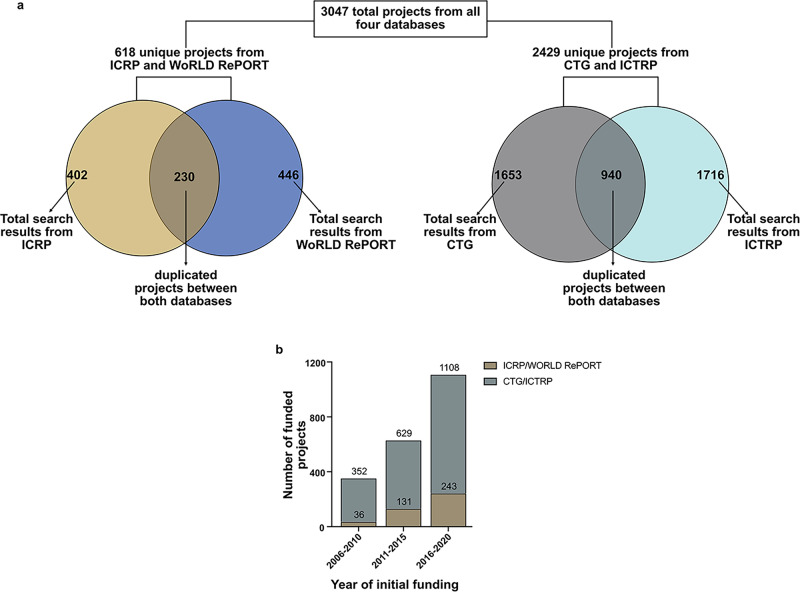
Methods: We conducted a retrospective study of funded cancer research projects involving at least one African country over the 20 years between January 2004 and December 2023. Data was collected from four publicly available databases, namely the International Cancer Research Partnership (ICRP), National Institutes of Health World Research Portfolio Online Reporting Tools (WoRLD RePORT), ClinicalTrials.gov (CTG), and International Clinical Trials Registry Platform (ICTRP). We retrieved data on country, year of funding, cancer types, study types, and funding sources. Furthermore, we used incidence, mortality, and prevalence data to compare the level of funded projects to the burden of disease.
Results: A total of 3047 unique funded projects/grants were reported from all 4 databases, with a consistent rise in the number of funded projects throughout the study period. Egypt and South Africa had the most funded cancer research projects, and 9 (16%) countries had no reported studies. Breast, lung, and cervical cancers received the highest funding allocation. We found that several cancers, notably cervical, prostate, and liver, are relatively underfunded compared to their disease burden. 70% of projects reported in ICRP/WoRLD RePORT were funded by the U.S. NIH. Notably, 40% of studies in CTG/ICTRP reported local funding, with Egypt accounting for 94% of these locally financed studies.
Conclusions: This study provides a comprehensive overview of the current state of cancer research funding in Africa, highlighting notable gaps and critical insights to guide data-driven decision-making.
Plain language summary
The burden of cancer in Africa is rising sharply; therefore, it is crucial to study the distribution of cancer research funding on the continent to identify important gaps and guide decision-making. In this study, we reviewed 20 years of data from international research databases and identified which African countries and cancer types received funding and how this compared to the actual burden of disease. We found that although there is an increasing trend in cancer research funding in Africa, the funding landscape is unevenly distributed, as very few countries account for most of the funded projects. Moreover, cancers like cervical, prostate, and liver were underfunded relative to their impact. Most funding came from external sources, except in Egypt, with significant local support. These findings highlight the need for more equitable, needs-based cancer research investment in Africa.
© 2025. The Author(s).
Conflict of interest statement
Competing interests: The authors declare no competing interests.
Figures


References
-
- Bray, F. et al. Global cancer statistics 2022: GLOBOCAN estimates of incidence and mortality worldwide for 36 cancers in 185 countries. CA Cancer J. Clin.74, 229–263 (2024). - PubMed
-
- Kingham, T. P. et al. Treatment of cancer in sub-Saharan Africa. Lancet Oncol.14, e158–e167 (2013). - PubMed
-
- GBD 2013 Risk Factors Collaborators. et al. Global, regional, and national comparative risk assessment of 79 behavioural, environmental and occupational, and metabolic risks or clusters of risks in 188 countries, 1990-2013: a systematic analysis for the Global Burden of Disease Study 2013. Lancet Lond. Engl.386, 2287–2323 (2015). - PMC - PubMed
Grants and funding
LinkOut - more resources
Full Text Sources