


Testing the cognitive-behavioral model of prolonged grief disorder (PGD): distinct and shared pathways to PTSD and depression
- PMID: 40624708
- PMCID: PMC12235822
- DOI: 10.1186/s40359-025-03078-0
Testing the cognitive-behavioral model of prolonged grief disorder (PGD): distinct and shared pathways to PTSD and depression
Abstract
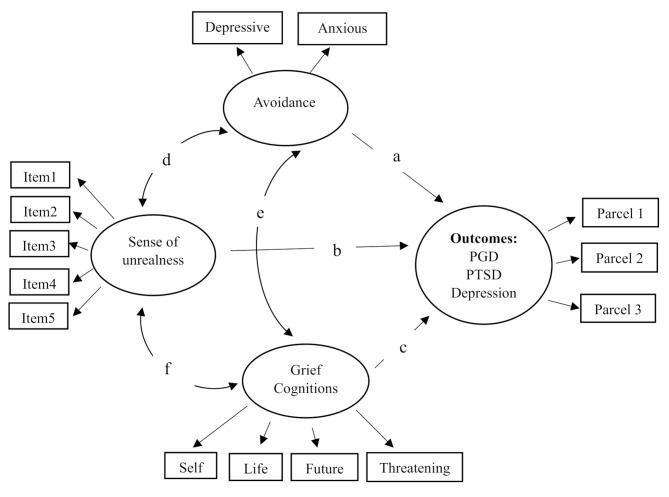
Background: The cognitive-behavioral model of prolonged grief [1] posits that the interaction between autobiographical memory deficits, negative cognitions, and avoidance contributes to the onset and persistence of prolonged grief. This study tested the model's assumptions with respect to symptoms of Prolonged Grief Disorder (PGD), Post-Traumatic Stress Disorder (PTSD), and depression in bereaved groups who experienced expected and unexpected loss, separately.
Methods: The study sample comprised 728 Turkish individuals who had lost a first-degree family member. A set of self-report measures was administered to participants, including the Prolonged Grief Disorder Scale (PG-13-Revised), the Posttraumatic Stress Disorder Checklist for DSM-5 (PCL-5), the Patient Health Questionnaire-9 (PHQ-9), the Grief Cognitions Questionnaire (GCQ-SF), the Depressive and Anxious Avoidance in Prolonged Grief Questionnaire (DAAPGQ), and the Experienced Unrealness Scale (EUS).
Results: Our findings indicate that while variables within the cognitive-behavioral model exhibit moderate to strong intercorrelations, they nonetheless represent statistically distinct constructs. These variables significantly explain the variance in symptoms of PTSD, depression, particularly PGD, in groups confronted with expected and unexpected loss. While negative cognitions and avoidance were significantly associated with all three outcomes, "a sense of unrealness" (representing autobiographical memory deficits) was significantly related only to PGD.
Conclusion: These results support the cross-cultural applicability of the cognitive-behavioral model and suggest that it can be used to explain the development of grief-related outcomes, such as PTSD and depression, beyond PGD symptoms. Although the cognitive model variables negative grief cognition and avoidance showed significant associations with grief-related outcomes, a sense of unrealness appeared to be specific to PGD only. It is considered that taking this finding into account in clinical practice may be beneficial.
Keywords: Bereavement; Cognitive-behavioral model of prolonged grief; Grief; Prolonged grief.
© 2025. The Author(s).
Conflict of interest statement
Declarations. Ethics approval and consent to participate: This study was conducted in accordance with the ethical principles outlined in the Declaration of Helsinki. Ethical approval was obtained from the TED University Human Research Ethics Committee (Approval Number: 2024-36, Date: 12/09/2024). Prior to participation, all individuals were presented with an online informed consent form outlining the study’s purpose, procedures, voluntary nature of participation, and data confidentiality. Consent for publication: Not applicable. Competing interests: The authors declare no competing interests.
Figures
References
-
- Boelen PA, van den Hout MA, van den Bout J. A cognitive-behavioral conceptualization of complicated grief. Clin Psychol Sci Pract. 2006;13(2):109–28. 10.1111/j.1468-2850.2006.00013.x - DOI
MeSH terms
LinkOut - more resources
Full Text Sources
Medical
Miscellaneous
