Review
. 2025 Jul 7;15(28):23054-23088.
doi: 10.1039/d5ra02493e. eCollection 2025 Jun 30.

A comprehensive review on magnetic manganese as catalysts in organic synthesis

Affiliations
Review

A comprehensive review on magnetic manganese as catalysts in organic synthesis

Mosstafa Kazemi et al. RSC Adv. .

Abstract

Manganese-based magnetic catalysts have gained significant attention in modern catalysis due to their unique combination of high catalytic efficiency, magnetic recoverability, and environmental sustainability. These catalysts, typically composed of manganese oxides, manganese-doped ferrites, or Mn-functionalized magnetic nanoparticles, facilitate a wide range of chemical transformations, including oxidation reactions, coupling reactions, and multicomponent reactions especially in the synthesis of heterocycles. Their ability to exhibit multiple oxidation states, strong redox activity, and high surface area makes them highly effective in selective and energy-efficient catalytic processes. Additionally, their magnetic properties enable easy separation from reaction mixtures using an external magnetic field, improving catalyst recyclability and reducing operational costs. Compared to conventional catalysts, magnetic manganese catalysts offer superior stability, cost-effectiveness, and eco-friendliness, making them promising alternatives for industrial-scale applications. This review explores recent advancements in the synthesis, mechanistic insights, and diverse applications of magnetic manganese catalysts, highlighting their role in sustainable and green chemistry. Furthermore, the challenges and future perspectives in optimizing their performance for broader catalytic applications are discussed. The insights presented in this review underscore the growing importance of magnetic manganese catalysts in developing efficient, cost-effective, and environmentally benign catalytic systems.


Conflict of interest statement

The authors declare no conflict of interest.

Figures

Fig. 1
Fig. 1. Catalysis by homogenous and heterogenous catalysts.
Fig. 2
Fig. 2. Advantages of magnetic nanocatalysts.
Fig. 3
Fig. 3. Superiority of manganese over other transition metals in catalysis.
Scheme 1
Scheme 1. General method to construct the Fe3O4@SiO2–NH2@[Mn(TPFPP)OAc] nanocomposite.
Scheme 2
Scheme 2. Epoxidation of alkenes [catalysis by Fe3O4@SiO2–NH2@[Mn(TPFPP)OAc] nanocomposite].
Scheme 3
Scheme 3. General method to construct the MNP@SiO2[4-NH-Mn-TDCPP] nanocomposite.
Scheme 4
Scheme 4. Epoxidation of alkynes [catalysis by MNP@SiO2[4-NH-Mn-TDCPP] nanocomposite].
Scheme 5
Scheme 5. General method to construct the Fe3O4@MCM-41-Im@MnPor nanocomposite.
Scheme 6
Scheme 6. Epoxidation of alkynes [catalysis by Fe3O4@MCM-41-Im@MnPor nanocomposite].
Scheme 7
Scheme 7. General method to construct the Fe3O4@SiO2–[MnL(OAc)] nanocomposite.
Scheme 8
Scheme 8. Epoxidation of alkynes [catalysis by Fe3O4@SiO2–[MnL(OAc)] nanocomposite].
Scheme 9
Scheme 9. Oxidation of sulfides to sulfoxides by H2O2 [catalysis by Fe3O4@SiO2–[MnL(OAc)] nanocomposite].
Scheme 10
Scheme 10. General method to construct the Fe3O4@SiO2–[MnL(OAc)] nanocomposite.
Scheme 11
Scheme 11. Oxidation of sulfides to sulfoxides by UHP [catalysis by Fe3O4@SiO2–[MnL(OAc)] nanocomposite].
Scheme 12
Scheme 12. Oxidation of sulfides to sulfoxides by H2O2 [catalysis by Mn2ZnO4] nanocomposite].
Scheme 13
Scheme 13. Oxidation thiols to disulfides [catalysis by Fe3O4@SiO2–NH2@Mn(iii) nanocomposite].
Scheme 14
Scheme 14. Oxidation selective of benzyl alcohols into benzaldehydes [catalysis by MnFe2O4 nanocomposite].
Scheme 15
Scheme 15. Suggested mechanism for oxidation selective oxidation of benzyl alcohols into benzaldehydes [catalysis by MnFe2O4 nanocomposite].
Scheme 16
Scheme 16. Synthesis of triaryl imidazoles [catalysis by MnFe2O4 nanocomposite].
Scheme 17
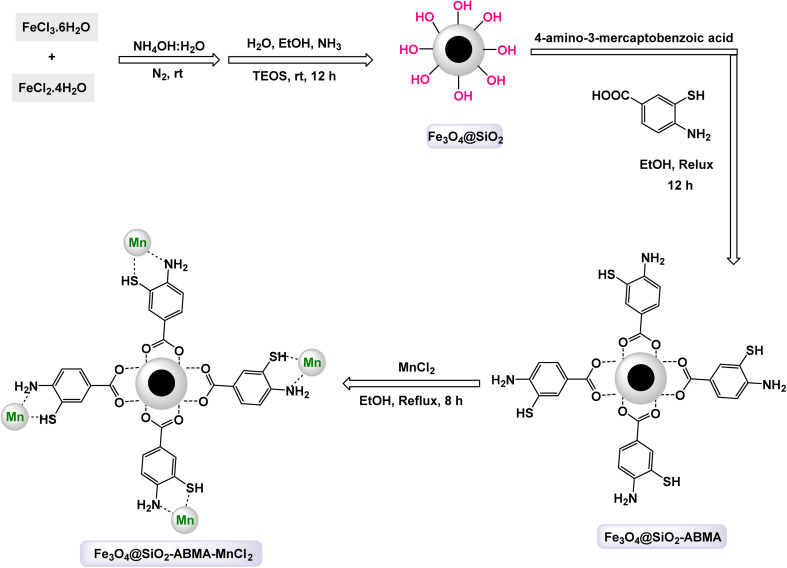
Scheme 17. General method for construction of Fe3O4@SiO2–ABMA–MnCl2 nanocomposite.
Scheme 18
Scheme 18. Synthesis of triaryl imidazoles [catalysis by Fe3O4@SiO2–ABMA–MnCl2 nanocomposite].
Scheme 19
Scheme 19. Suggested mechanism for synthesis of triaryl imidazoles [catalysis by Fe3O4@SiO2–ABMA–MnCl2 nanocomposite].
Scheme 20
Scheme 20. Synthesis of benzimidazoles [catalysis by MnFe2O4 nanocomposite].
Scheme 21
Scheme 21. Synthesis of quinoxalines [catalysis by MnFe2O4 nanocomposite].
Scheme 22
Scheme 22. Suggested mechanism for synthesis of benzimidazoles [catalysis by MnFe2O4 nanocomposite].
Scheme 23
Scheme 23. General method for construction of [Fe3O4@PAM–Schiff-base–Mn][ClO4] nanocomposite.
Scheme 24
Scheme 24. Synthesis of 1,2,3-substituted triazoles [catalysis by [Fe3O4@PAM–Schiff-base–Mn][ClO4] nanocomposite].
Scheme 25
Scheme 25. Suggested mechanism for synthesis of 1,2,3-substituted triazoles [catalysis by [Fe3O4@PAM–Schiff-base–Mn][ClO4] nanocomposite].
Scheme 26
Scheme 26. General method for construction of Fe3O4@SiO2@Mn-complex.
Scheme 27
Scheme 27. Synthesis of 7-aryl[4,3-d]pyrido[1,2-a]pyrimidin-6(7H)-ones [catalysis by Fe3O4@SiO2@Mn nanocomposite].
Scheme 28
Scheme 28. Suggested mechanism for synthesis of 7-aryl[4,3-d]pyrido[1,2-a]pyrimidin-6(7H)-ones [catalysis by Fe3O4@SiO2@Mn nanocomposite].
Scheme 29
Scheme 29. Synthesis of 1,4-dihydropyridines [catalysis by MnFe2O4 nanocomposite].
Scheme 30
Scheme 30. General method for construction of Fe3O4@CSBMn nanocomposite.
Scheme 31
Scheme 31. Synthesis of imidazo[1,2-a]pyridines [catalysis by Fe3O4@CSBMn nanocomposite].
Scheme 32
Scheme 32. Suggested mechanism for synthesis of imidazo[1,2-a]pyridines [catalysis by Fe3O4@CSBMn nanocomposite].
Scheme 33
Scheme 33. General method to construct Mn2O3-doped Fe3O4 NPs nanocomposite [MRC-1].
Scheme 34
Scheme 34. Synthesis of alpha-aminonitriles from alcohols and amines [catalysis by Mn2O3-doped Fe3O4 NPs nanocomposite].
Scheme 35
Scheme 35. Synthetic pathway for synthesis of alpha-aminonitriles from alcohols and amines [catalysis by Mn2O3-doped Fe3O4 NPs nanocomposite].
Scheme 36
Scheme 36. Synthesis of 3-benzylated indoles [catalysis by MnFe2O4 nanocomposite].
Scheme 37
Scheme 37. Suggested mechanism for synthesis of 3-benzylated indoles [catalysis by MnFe2O4 nanocomposite].
Scheme 38
Scheme 38. Synthesis of spirooxindole derivatives [catalysis by MnFe2O4 nanocomposite].
Scheme 39
Scheme 39. Suggested mechanism for synthesis of spirooxindole derivatives [catalysis by MnFe2O4 nanocomposite].

References

    1. Singh J. Juneja S. Soni R. K. Bhattacharya J. J. Colloid Interface Sci. 2021;590:60. - PubMed
    1. Moghadasi Z. Fajer N. Nanomater. Chem. 2024;1:130.
    1. Long Y. Zheng Y. Xia Y. Qu L. Yang Y. Xiang H. Zhou X. ACS Catal. 2022;12:4688.
    1. Singh J. Abraham R. Biol. Mol. Chem. 2024;2:13.
    1. Kim J. Hong S. H. ACS Catal. 2017;7:3336.

LinkOut - more resources