


Equipping community health workers in Rwanda to deliver a gender transformative parenting program to prevent violence against women and children at scale
- PMID: 40625533
- PMCID: PMC12230087
- DOI: 10.3389/frph.2025.1602136
Equipping community health workers in Rwanda to deliver a gender transformative parenting program to prevent violence against women and children at scale
Abstract
Introduction: In Rwanda, the Bandebereho program has demonstrated long-term reductions in intimate partner violence (IPV) and violence against children. Since 2019, the program has partnered with government to train community health workers (CHWs) to deliver at scale. Evidence on how to equip CHWs to deliver Bandebereho, or similar programs, with quality and fidelity is needed to support scaling. This study sought to assess the impact of training on CHWs and their capacity to deliver Bandebereho during scale up.
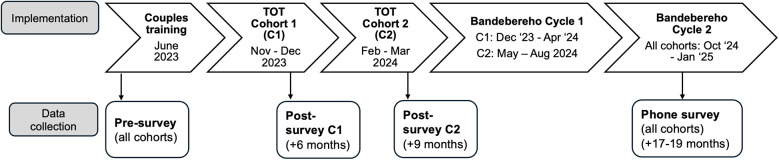
Methods: A pre/post, follow-up study was conducted with 573 CHWs in Burera district. Data were collected at three time points over 20 months using self-administered questionnaires (pre/post) and a follow-up phone survey. Questionnaires gathered data on CHW attitudes about gender roles and violence, self-reported skills, knowledge and confidence to implement Bandebereho, and training impacts on partner relations and community work. Informed consent was obtained from all study participants.
Results: The pre-survey was completed by 562 CHWs and 564 CHWs completed the post-survey after six to nine months. The phone survey was administered to 506 CHWs at follow-up (at 17-19 months). Analysis of changes between pre- and post-surveys found CHWs had more equitable gender attitudes after the training. Linear regression analysis found that CHWs with some secondary education (coefficient: -2.15, p < 0.01) and more than three years' experience (coefficient: -2.27, p < 0.001) were less likely to hold inequitable attitudes. At post-survey, CHWs reported a high level of preparedness to implement, regardless of gender. A majority reported improved partner relations, including greater partner support for their community work. At follow-up, a majority of CHWs reported a high degree of comfort and confidence implementing Bandebereho, and benefits to their work and personal relationships.
Conclusions: The findings highlight the importance of investing in high-quality facilitator training, which allows sufficient time for facilitators' own transformation, to maintain quality and fidelity at scale. The findings underscore the importance of a slow and steady approach, with sufficient time to adapt, test, and refine IPV programs for scale, which can also support a progressive handover to government. The findings may support program originators who seek to scale proven IPV prevention programs with government in other settings.
Keywords: Rwanda; community health workers (CHWs); fathers; gender transformative; health system; intimate partner violence (IPV); parenting; scale.
© 2025 Doyle, Bhatnagar, Karamage, Tuyisingize, Muhimpundu, Nyiransabimana, Cyiza, Rutayisire, Ngayaboshya and Mavhu.
Conflict of interest statement
The authors declare that the research was conducted in the absence of any commercial or financial relationships that could be construed as a potential conflict of interest.
Figures
References
-
- Kerr-Wilson A, Gibbs A, McAslan Fraser E, Ramsoomar L, Parke A, Khuwaja HMA, et al. A Rigorous Global Evidence Review of Interventions to Prevent Violence against Women and Girls. What Works to Prevent VAWG?. (2020). Available at: https://www.whatworks.co.za/resources/item/693-a-rigorous-global-evidenc.... (Accessed March 21 2025).
-
- Jewkes R, Willan S, Heise L, Washington L, Shai N, Kerr-Wilson A, et al. Elements of the design and implementation of interventions to prevent violence against women and girls associated with success: reflections from the what works to prevent violence against women and girls? Global programme. Int J Environ Res Public Health. (2021) 18:12129. 10.3390/ijerph182212129 - DOI - PMC - PubMed
-
- Leight J, Cullen C, Ranganathan M, Yakubovich A. Effectiveness of community mobilisation and group-based interventions for preventing intimate partner violence against women in low- and middle-income countries: a systematic review and meta-analysis. J Glob Health. (2023) 13:04115. 10.7189/jogh.13.04115 - DOI - PMC - PubMed
LinkOut - more resources
Full Text Sources
