


Association of childhood disadvantage with malnutrition in older ages in India
- PMID: 40629290
- PMCID: PMC12235777
- DOI: 10.1186/s12877-025-05727-w
Association of childhood disadvantage with malnutrition in older ages in India
Abstract
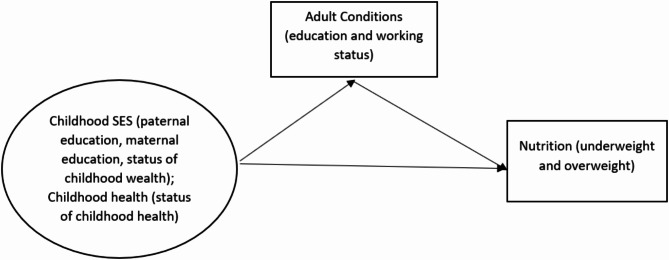
Introduction: Much research on the association between childhood status and adult health has been focussed on high income countries and, hence, these findings cannot be generalised for all developing economies. Therefore, this study is an attempt to systematically examine the impact of multiple domains of early disadvantage on nutrition status during old age in India, while testing for potential mediation by adult health, socio-economic status and lifestyle.
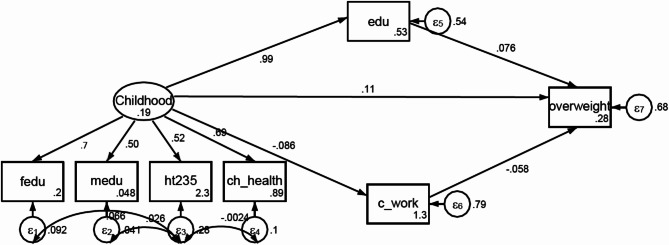
Methods: The study uses data from the first wave of the Longitudinal Ageing Study in India (LASI), 2017-18. Binary logistic regression was used to assess the adjusted association of childhood and adulthood conditions with nutrition status. Two separate models were run for underweight and overweight. We used the structural equation modelling (SEM) approach to construct latent variables and structural models to test our hypothetical model.
Results: The SEM explained 78% of the variance in underweight. The direct effect of education and childhood conditions on underweight was significant. The SEM explained 68% of the variance in overweight. Results shows that the direct effect of education and working status on overweight was significant. The indirect and total effect of childhood conditions on overweight was significant.
Conclusion: The study underscores the importance of considering both direct and indirect effects in understanding the pathways through which early life experiences influence nutritional status in old age. The unexpected finding regarding the direct effect of childhood conditions on overweight in the Indian context raises important questions about the complexities of nutrition and health in this population.
Keywords: Adulthood; BMI; Childhood; Early life; India; Mediation; Older adults.
© 2025. The Author(s).
Conflict of interest statement
Declarations. Consent for publication: Since the study was based on secondary data, consent for publication was not applicable. Competing interests: The authors declare no competing interests. Ethical approval and consent to participate: Since the study was based on secondary data, ethical approval and consent to participate was not applicable.
Figures



References
-
- World Population Prospects. 2019: Highlights| Multimedia Library - United Nations Department of Economic and Social Affairs. https://www.un.org/development/desa/publications/world-population-prospe.... Accessed 27 Oct 2022.
-
- Vinod Khole C, Soletti A. Nutritional status of Elderly in the Old Age homes: a study in Pune City. Curr Res Nutr Food Sci. 2018;6:234–40.
-
- Arnold F, Parasuraman S, Arokiasamy P, Kothari M. Nutrition in India. National Family Health Survey (NFHS-3) India 2005-06. 2009.
MeSH terms
LinkOut - more resources
Full Text Sources
Medical
