


Application of respiratory motion management technology for patients with lung cancer treated with stereotactic body radiotherapy (Review)
- PMID: 40630710
- PMCID: PMC12235356
- DOI: 10.3892/ol.2025.15161
Application of respiratory motion management technology for patients with lung cancer treated with stereotactic body radiotherapy (Review)
Abstract
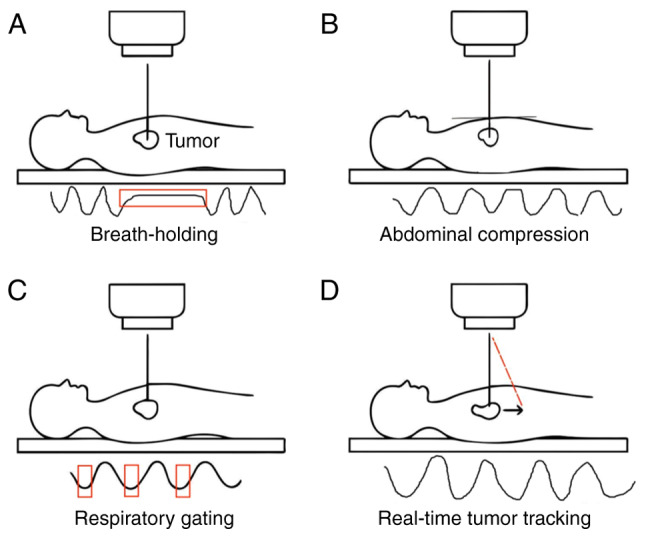
Respiratory-induced tumor motion is a major obstacle in the precise delivery of stereotactic body radiotherapy (SBRT) for lung cancer, often leading to geometric uncertainties, insufficient tumor coverage and increased radiation-induced toxicity such as pneumonitis, esophagitis and rib fractures. The present review systematically assesses motion management techniques used in lung SBRT, synthesizing evidence from 352 high-quality clinical studies published between 2000 and 2024. Selected studies included patients with non-small cell lung cancer treated exclusively with SBRT which incorporated strategies such as deep inspiration breath-hold, abdominal compression, respiratory gating and real-time tumor tracking, and often integrated with image guidance technologies such as 4DCT, cone beam CT and MRI. These techniques demonstrated notable reductions in planning target volume margins and normal tissue dose, leading to improved local control and lower toxicity rates, particularly in tumors with large motion amplitudes or proximity to critical structures. Despite these benefits, implementation remains variable due to patient-specific challenges, technical complexity and institutional resource differences. The present review highlights the clinical applications and limitations of each strategy, and proposes a decision-making framework to guide clinicians in selecting the most appropriate motion management strategy based on tumor characteristics, motion amplitude and patient-specific factors. The integration of respiratory motion management with advanced imaging is essential for optimizing therapeutic outcomes and safety in lung SBRT.
Keywords: non-small cell lung cancer; radiation pneumonitis; respiratory motion management; stereotactic body radiotherapy.
Copyright: © 2025 Shao et al.
Conflict of interest statement
The authors declare that they have no competing interests.
Figures
References
-
- Viani GA, Gouveia AG, Yan M, Matsuura FK, Moraes FY. Stereotactic body radiotherapy versus surgery for early-stage non-small cell lung cancer: An updated meta-analysis involving 29,511 patients included in comparative studies. J Bras Pneumol. 2022;48:e20210390. (In English, Portuguese) - PMC - PubMed
-
- Ni J, Wu L, Chu Q, Han C, Ai X, Dong X, Zhu Z. Sintilimab, SBRT and GM-CSF for metastatic NSCLC: A prospective, multicenter, phase II trial. Int J Radiat Oncol Biol Phys. 2023;117((Suppl)):E44. doi: 10.1016/j.ijrobp.2023.06.745. - DOI
-
- Anderson JD, Hu J, Li J, Schild SE, Fatyga M. Impact of cardiac dose on overall survival in lung stereotactic body radiotherapy (SBRT) compared to conventionally fractionated radiotherapy for locally advanced non-small cell lung cancer (LA-NSCLC) J Cancer Ther. 2021;12:409–423. doi: 10.4236/jct.2021.127036. - DOI - PMC - PubMed
Publication types
LinkOut - more resources
Full Text Sources