


Empirical evidence that glucan-interacting amino acid side chains within the transmembrane channel collectively facilitate cellulose synthase function
- PMID: 40632364
- PMCID: PMC12241271
- DOI: 10.1007/s11103-025-01615-4
Empirical evidence that glucan-interacting amino acid side chains within the transmembrane channel collectively facilitate cellulose synthase function
Abstract
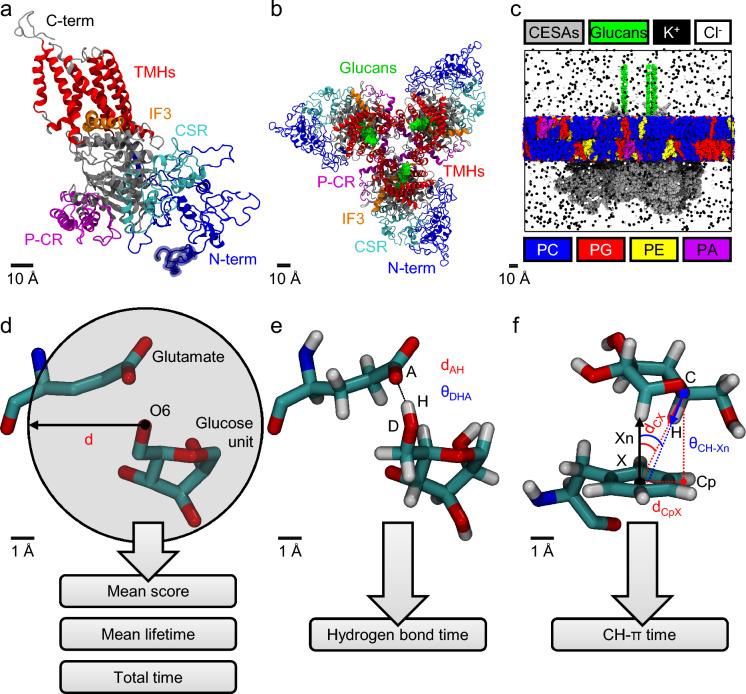
The fundamental mechanism of cellulose synthesis is widely conserved across Kingdoms and depends on cellulose synthases, which are processive, dual-function, family 2 glycosyltransferases (GT-2). These enzymes polymerize glucose on the cytoplasmic side of the plasma membrane and export the glucan chain to the cell surface through an integral transmembrane (TM) channel. Structural studies of active plant cellulose synthases (CESAs) have revealed interactions between the nascent glucan chain and the side chains of polar, charged, and aromatic amino acid residues that line the TM channel. However, the functional consequences of modifying these side chains have not been tested in vivo in CESAs or other processive GT-2s. To test this, we used an established in vivo assay based on genetic complementation of CESA5 in the moss, Physcomitrium patens. For accurate prediction of glucan-interacting amino acid residues, we generated a complete homotrimeric molecular model of PpCESA5 using a combination of homology and de novo modeling. All-atom molecular dynamics-based analyses of contact metrics and interaction energy identified 23 amino acid residues with high propensity to interact with the nascent glucan chain within the TM channel or on the apoplastic surface of PpCESA5. Mutating any one of 18 of these amino acid residues to alanine, thereby removing their side chains, abolished or impaired CESA function, with the strongest effects observed upon the loss of charged amino acid side chains. This provides direct evidence to support the hypothesis that multiple amino acid residues collectively maintain a smooth energy landscape within the TM channel to facilitate glucan translocation.
Keywords: Physcomitrium patens; Cellulose microfibril; Glycosyltransferase; Moss; Protein–carbohydrate interactions; β-d-glucose.
© 2025. The Author(s).
Conflict of interest statement
Declarations. Competing interests: The authors have no relevant financial or non-financial interests to disclose.
Figures


References
-
- Arioli T, Peng L, Betzner AS, Burn J, Wittke W, Herth W, Camilleri C, Höfte H, Plazinski J, Birch R, Cork A, Glover J, Redmond J, Williamson RE (1998) Molecular analysis of cellulose biosynthesis in Arabidopsis. Science 279:717–720 - PubMed
MeSH terms
Substances
Grants and funding
LinkOut - more resources
Full Text Sources
Miscellaneous
