


Association between high-sensitivity C-reactive protein, cystatin C and all-cause mortality in middle-aged and elderly participants with sarcopenia
- PMID: 40632368
- PMCID: PMC12241256
- DOI: 10.1007/s40520-025-03102-8
Association between high-sensitivity C-reactive protein, cystatin C and all-cause mortality in middle-aged and elderly participants with sarcopenia
Abstract
Background: High-sensitivity C-reactive protein (hs-CRP) and cystatin C (CysC), which associate with prognosis, are widely used indicators for inflammation and kidney function respectively in clinical practice.
Aims: This study aims to determine whether elevated hs-CRP and CysC concentrations are associated with all-cause mortality in middle-aged and elderly participants with sarcopenia.
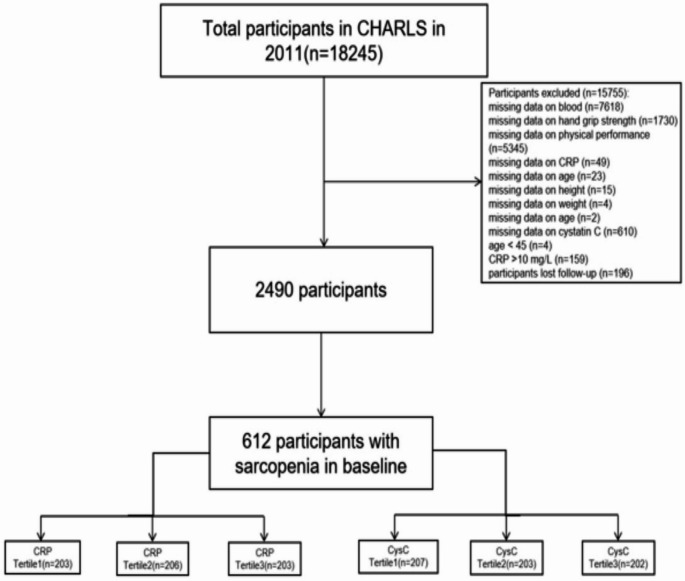
Methods: This was a retrospective study which included 612 individuals with sarcopenia from a Chinese cohort. Concentrations of hs-CRP and CysC were divided into three groups (tertiles). Cox regression models were utilized to estimate hazard ratios (HR) and 95% confidence intervals (CI) for all-cause mortality. Combined effects were calculated by dividing two indicators into four groups based on cutoffs of high risk. Subgroup analyses were performed to better stratify analyses and show the interaction of variables for associations between hs-CRP/CysC and mortality.
Results: The mean age of the participants was 70.88 (6.61) years, among which 40.03% were male. During follow-up 130 death cases occurred and mortality rate was 21.2%. Hs-CRP and CysC were prominently associated with all-cause mortality as continuous variables. Hs-CRP also manifested great capability of predicting mortality as categorical variable. When both indicators were higher than cutoffs, the combined effect was positive in Model3 (HR = 2.26, 95%CI: 1.01-5.07). Two biomarkers showed significant associations among subgroup population who were male and > 75 years old. CysC had an linear association with mortality while hs-CRP not.
Conclusion: Hs-CRP and CysC might be useful indicators for the prognosis of middle-aged and elderly participants with sarcopenia. The combined effects of two indicators predicted mortality well.
Keywords: All-cause mortality; Cystatin C; Hs-CRP; Middle-aged and elderly; Sarcopenia.
© 2025. The Author(s).
Conflict of interest statement
Declarations. Ethics approval: This study was approved by the Biomedical Ethics Committee of Peking University (IRB00001052-11015). Consent for publication: Not applicable. Competing interests: The authors declare no competing interests. Clinical trial number: Not applicable.
Figures

References
-
- Pepys MB, Baltz ML (1983) Acute phase proteins with special reference to C-reactive protein and related proteins (pentaxins) and serum amyloid A protein. Adv Immunol 34:141–212 - PubMed
-
- Simon L, Gauvin F, Amre DK, Saint-Louis P, Lacroix J (2004) Serum procalcitonin and C-reactive protein levels as markers of bacterial infection: a systematic review and meta-analysis. Clin Infect Dis 39(2):206–217. 10.1086/421997 - PubMed
-
- Willems JM, Trompet S, Blauw GJ, Westendorp RGJ, de Craen AJM (2010) White blood cell count and C-reactive protein are independent predictors of mortality in the oldest old. J Gerontol Biol Sci Med Sci 65(7):764–768. 10.1093/gerona/glq004 - PubMed
MeSH terms
Substances
Grants and funding
- 2023ZYC-Z29/Zhejiang Medical Association clinical medicine special fund project
- 2023ZYC-Z29/Zhejiang Medical Association clinical medicine special fund project
- 2023ZYC-Z29/Zhejiang Medical Association clinical medicine special fund project
- 2023ZYC-Z29/Zhejiang Medical Association clinical medicine special fund project
- 2023ZYC-Z29/Zhejiang Medical Association clinical medicine special fund project
LinkOut - more resources
Full Text Sources
Research Materials
Miscellaneous
