Benefits of public awareness in mitigating cystic echinococcosis risk in Western China: A climate and socio-economic perspective
- PMID: 40632802
- PMCID: PMC12240338
- DOI: 10.1371/journal.pntd.0013182
Benefits of public awareness in mitigating cystic echinococcosis risk in Western China: A climate and socio-economic perspective
Abstract
Background: The prevalence of cystic echinococcosis (CE), a widespread zoonotic disease, imposes a significant public health burden, especially in western China. However, under the background of global change, how to meet the challenge of the future risk of CE remains unclear. As global climate change, land use changes, and socio-economic factors continue to progress, the spread and intensity of CE may potentially worsen, making it crucial to assess and mitigate future risks.
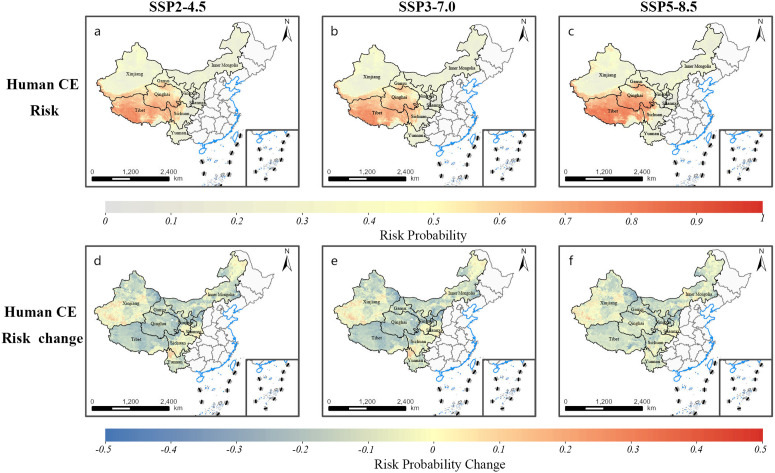
Methods: By employing Bayesian additive regression trees model to develop risk models for CE in animal hosts (cattle, sheep and dogs) and humans, this study mapped the current distribution of infection risk for CE and projected future risks under the SSP2-4.5, SSP3-7.0, and SSP5-8.5 scenarios. The projections considered both constant and increased rates of public awareness rates regarding CE prevention in the future.
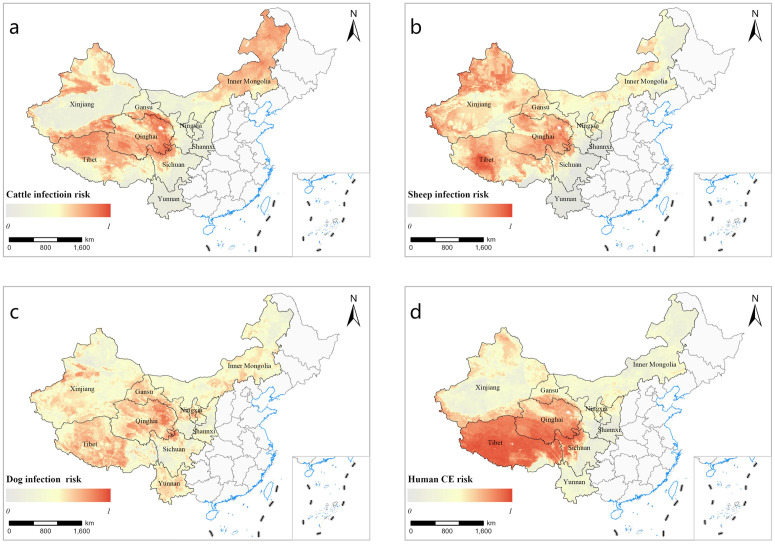
Results: Current simulations indicate that the regions with a high risk of CE infection are primarily concentrated in Tibet, Qinghai, Gansu, and Xinjiang. Future projections suggest that heightened CE risks will be experienced in regions such as Yunnan, Gansu, and Sichuan will experience heightened CE risks. Notably, predictions suggest that increased public awareness is estimated to be linked to accompanied by a reduction of the population at risk by 2.72% to 3.35% in western China by 2030.
Conclusion: This research offers a comprehensive understanding of the future distribution of epidemic risk for CE under climate and socio-economic changes. It highlights that enhancing public awareness regions with high-risk is a critical factor associated with reduced infection rates. Furthermore, the study offers a valuable framework for assessing the risk associated with other zoonotic diseases.
Copyright: © 2025 Yin et al. This is an open access article distributed under the terms of the Creative Commons Attribution License, which permits unrestricted use, distribution, and reproduction in any medium, provided the original author and source are credited.
Conflict of interest statement
The authors have declared that no competing interests exist.
Figures
References
-
- Eckert J, Gemmell MA, Meslin FX, Pawlowski ZS. WHO/OIE manual on echinococcosis in humans and animals: a public health problem of global concern. Paris: World Organ Anim Health. 2002.
-
- Degefu H, Damet T. Hydatidosis of cattle and sheep, its economic importance and Echinococcus granulosus among stray dogs in South Wollo, Ethiopia. Ethiop Vet J. 2014;17(2):101. doi: 10.4314/evj.v17i2.8 - DOI
MeSH terms
LinkOut - more resources
Full Text Sources
Research Materials