


COVID-19 vaccine acceptance and associated factors among parents of children between 6 and 12 years: a multicenter mixed method study in India
- PMID: 40636879
- PMCID: PMC12237963
- DOI: 10.3389/fpubh.2025.1513419
COVID-19 vaccine acceptance and associated factors among parents of children between 6 and 12 years: a multicenter mixed method study in India
Abstract
Background: It is well recognized that parents play a central role in making decisions for their children. Understanding willingness of parents to vaccinate their children against COVID-19 is important as it helps to develop effective strategies for maximizing vaccination coverage. We aimed to evaluate parental acceptance regarding COVID-19 vaccination for children between 6 and 12 years of age in India.
Methods: A mixed-method study (March-September 2023) employed a structured questionnaire and in-depth interviews with parents of school-going and non-school-going children across five purposively selected Indian states. Multistage random sampling was used for districts, schools, and students, while convenience sampling was applied for qualitative data. Multivariable logistic regression assessed factors influencing parental acceptance of COVID-19 vaccination, and qualitative analysis identified barriers and facilitators.
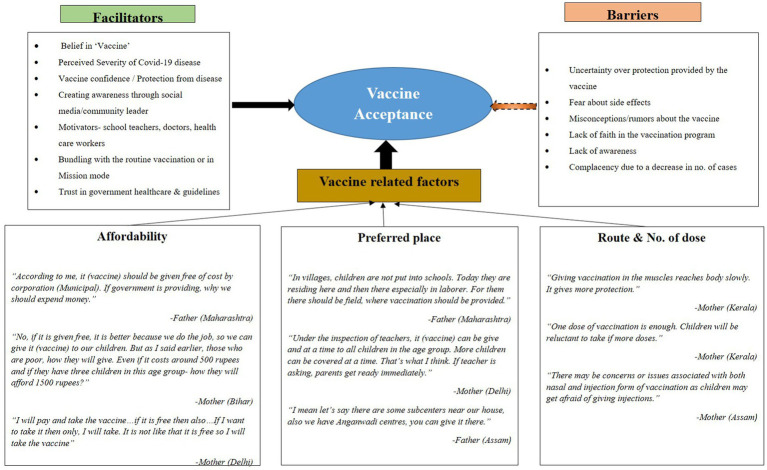
Results: A total of 2017 parents participated in the study. The overall parental acceptance to vaccinate their children against COVID-19 was 76.4%. Multivariate logistic regression analysis showed that parents who were literate (p = 0.004), not vaccinated against COVID-19 (p = 0.012), had less than or equal to four family members (p < 0.001) and a history of COVID-19 infection in the family (p = 0.036) were less likely to accept the COVID-19 vaccine for their children. Key barriers to vaccination included uncertainty over the protection provided by the vaccine, fear about side effects, and misconceptions about the vaccine whereas belief in the vaccine, perceived severity of COVID-19 disease, and bundling with routine vaccination were the key facilitators.
Conclusion: These findings highlight the importance of increasing adult COVID-19 vaccination. Developing policies focusing on parents with higher literacy, staying in smaller families, and previous COVID-19 infection among family members will help to increase the vaccine uptake among children. Interventions for the integration of these vaccines with routine immunization or availability at schools may help in increasing COVID-19 vaccine acceptance.
Keywords: COVID-19 vaccine; India; mixed methods; parents; vaccine acceptance.
Copyright © 2025 Ghate, Rekhadevi, Sen, Sharma, Shidhaye, Nair, Kumar, Jayesh, Patil, Gurav and Aggarwal.
Conflict of interest statement
The authors declare that the research was conducted in the absence of any commercial or financial relationships that could be construed as a potential conflict of interest.
Figures
References
-
- WHO . (2023). Available online at: https://www.who.int/director-general/speeches/detail/who-director-genera... (Accessed December 6, 2023).
-
- WHO . COVID-19 disease in children and adolescents. Geneva; (2021). Available online at: https://www.who.int/publications/i/item/WHO-2019-nCoV-Sci_Brief-Children... (Accessed August 13, 2024).
Publication types
MeSH terms
Substances
LinkOut - more resources
Full Text Sources
Medical
