


Pulse Pressure Impairs Cognition via White Matter Disruption
- PMID: 40636963
- PMCID: PMC12366739
- DOI: 10.1161/HYPERTENSIONAHA.124.24543
Pulse Pressure Impairs Cognition via White Matter Disruption
Abstract
Background: In older adults, elevated pulse pressure predicts cognitive decline, independent of overall blood pressure. It is proposed to compromise cerebrovascular integrity, potentially leading to brain damage, though the underlying mechanisms remain unclear. We hypothesized that pulse pressure affects cognition by disrupting white matter microstructure, and that it does so independently of other cardiovascular risk factors.
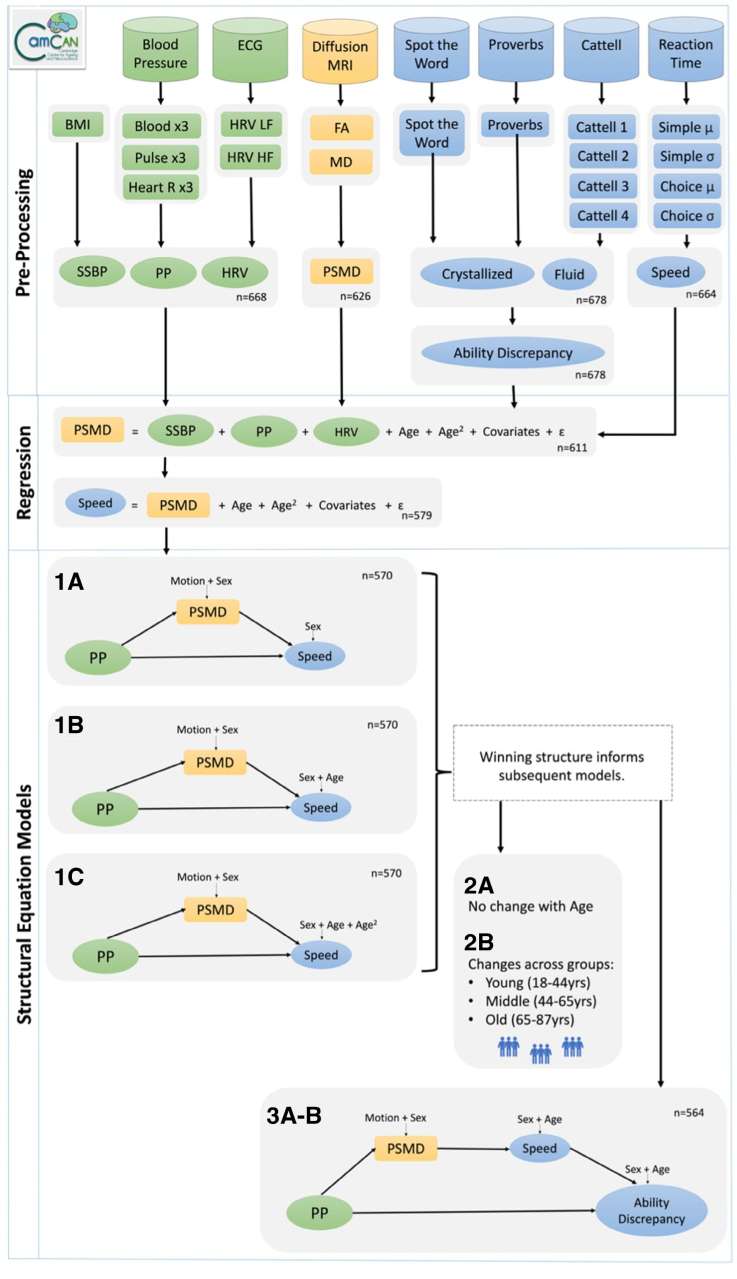
Methods: Latent indices of pulse pressure, overall blood pressure, and heart rate variability were estimated in a cross-sectional, population-based cohort (n=708, aged 18-88 years). An indicator of white matter microstructure was derived from diffusion-weighted imaging, termed the peak width of skeletonized mean diffusivity (PSMD). Cognitive function was assessed using measures of processing speed.
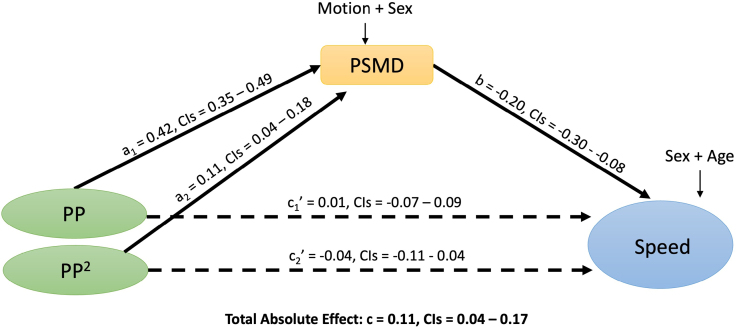
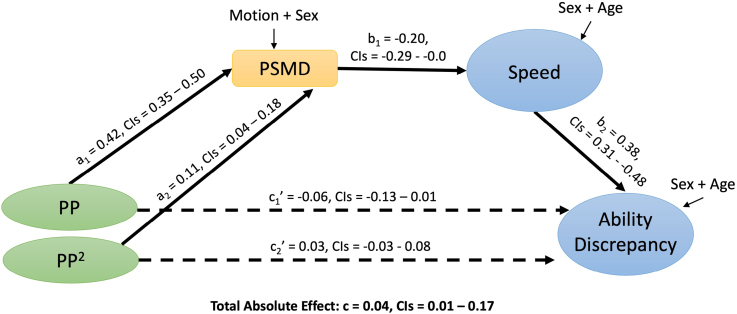
Results: In robust regression, pulse pressure was significantly associated with PSMD, with PSMD also being associated with processing speed. Thus, higher pulse pressure was associated with greater white matter disruption, which in turn was associated with slower processing. This motivated testing whether PSMD mediates the effects of pulse pressure on processing speed using structural equation models. PSMD mediated this effect, accounting for 72% of the effect after adjusting for age, and remained significant after adjusting for other cardiovascular factors. We then expanded the model to show that vascular-related changes in processing speed also drive changes in higher cognitive functions.
Conclusions: High pulse pressure disrupts the microstructural integrity of white matter in the brain, leading to slower processing speed. We propose that better management of pulse pressure could help to preserve white matter integrity and reduce cognitive decline in later life.
Keywords: aged; blood pressure; cognition; heart rate; risk factors.
Conflict of interest statement
J.B. Rowe is a nonremunerated trustee of the Guarantors of Brain, Darwin College, and the PSP Association; he provides consultancy to Alzheimer Research UK, Astronautx, Asceneuron, Alector, Astex, Booster Therapeutics, ClinicalInk, CuraSen, CumulusNeuro, Eisai, Ferrer, SV Health, and Wave, and has research grants from AZ-Medimmune, Janssen, Lilly as industry partners in the Dementias Platform UK. The other authors report no conflicts.
Figures
References
-
- Boudoulas H, Stefanadis C. The Aorta: Structure, Function, Dysfunction, and Diseases. Informa Healthcare; 2009.
-
- Black S, Gao F, Bilbao J. Understanding white matter disease: imaging-pathological correlations in vascular cognitive impairment. Stroke. 2009;40:S48. doi: 10.1161/strokeaha.108.537704 - PubMed
-
- Rowbotham GF, Little E. Circulations of the cerebral hemispheres. Br J Surg. 2005;52:8–21. doi: 10.1002/bjs.1800520104 - PubMed
MeSH terms
LinkOut - more resources
Full Text Sources
Medical
