


Correlation of Preoperative Inflammation/Immunity Markers With Postoperative Urinary Tract Infections in Elderly Hip Fracture Patients
- PMID: 40637046
- PMCID: PMC12318684
- DOI: 10.1111/os.70107
Correlation of Preoperative Inflammation/Immunity Markers With Postoperative Urinary Tract Infections in Elderly Hip Fracture Patients
Abstract
Objective: Given the rising incidence of postoperative urinary tract infections (UTIs) in elderly patients with hip fractures and their substantial impact on mortality and functional recovery, identifying accessible predictors for early risk stratification is critical to improving perioperative management. This study aimed to investigate the association between preoperative inflammation/immune markers and the occurrence of postoperative UTIs in the vulnerable population.
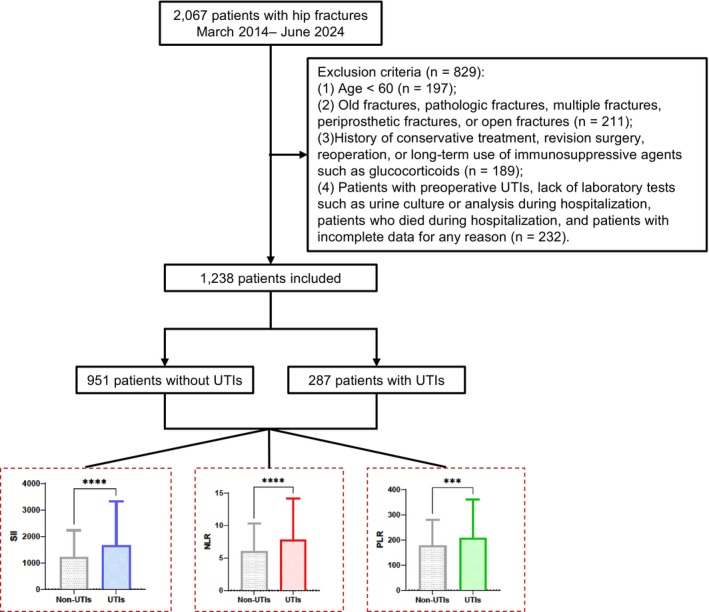
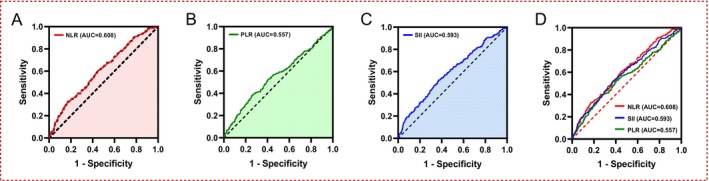
Methods: This study examined elderly patients who underwent hip surgery for hip fractures at our institution from March 2014 to June 2024. Preoperative inflammation/immune markers such as the neutrophil-to-lymphocyte ratio (NLR), platelet-to-lymphocyte ratio (PLR), and systemic immune inflammation index (SII) were measured. Receiver operating characteristic (ROC) curves were used to identify optimal cutoff values for each marker. To control the potential confounding factors, multivariate logistic regression analysis and propensity score matching analysis were conducted, resulting in adjusted odds ratios (ORs) and 95% confidence intervals (CIs) to assess the strength of the association between each marker and UTIs.
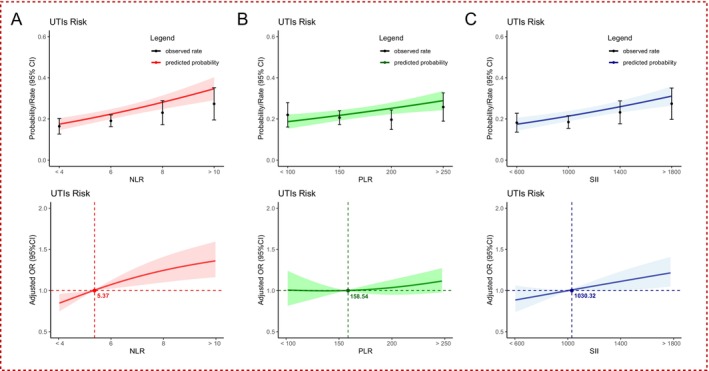
Results: A total of 1238 patients were included in this study, of whom 287 (23.18%) developed postoperative UTIs. Among elderly hip fracture patients, NLR demonstrated the highest predictive value for postoperative UTIs compared to PLR and SII (area under the curve [AUC] = 0.608, 95% CI: 0.571-0.645). High NLR (OR = 1.57, 95% CI: 1.16-2.13), high PLR (OR = 1.59, 95% CI: 1.16-2.19), and high SII (OR = 1.75, 95% CI: 1.29-2.37) were significantly associated with the incidence of postoperative UTIs using the best cutoff values. Additionally, a dose-effect relationship was observed for this association (p for trend < 0.05). These results remained significant even after propensity score matching.
Conclusions: Preoperative inflammatory/immune markers NLR, PLR, and SII exhibited independent associations with the development of postoperative UTIs in elderly hip fracture patients undergoing surgery. Furthermore, a dose-effect relationship was observed for this association.
Keywords: NLR; PLR; SII; elderly; hip fracture; urinary tract infections.
© 2025 The Author(s). Orthopaedic Surgery published by Tianjin Hospital and John Wiley & Sons Australia, Ltd.
Conflict of interest statement
The authors declare no conflicts of interest.
Figures
References
-
- Nazrun A. S., Tzar M. N., Mokhtar S. A., and Mohamed I. N., “A Systematic Review of the Outcomes of Osteoporotic Fracture Patients After Hospital Discharge: Morbidity, Subsequent Fractures, and Mortality,” Therapeutics and Clinical Risk Management 10 (2014): 937–948, 10.2147/tcrm.S72456. - DOI - PMC - PubMed
MeSH terms
Substances
Grants and funding
LinkOut - more resources
Full Text Sources
Medical
