. 2025 Apr 22:36:100726.
doi: 10.1016/j.ynstr.2025.100726. eCollection 2025 May.

Early-life adversities compromise behavioral development in male and female mice heterozygous for CNTNAP2

Affiliations

Early-life adversities compromise behavioral development in male and female mice heterozygous for CNTNAP2

Gabriele Chelini et al. Neurobiol Stress. .

Abstract

The etiological complexity of psychiatric disorders arises from the dynamic interplay between genetic and environmental vulnerabilities. Among the environmental components, early-life adversities are a major risk factor for developing a psychiatric condition. Yet, the interaction between adversities early in life and genetic vulnerability contributing to psychopathology is poorly understood. To fill this gap, we took advantage of the ideally controlled conditions of a pre-clinical approach. We raised a mouse model with genetic predisposition for multiple psychiatric disorders (autism spectrum, schizophrenia, bipolar disorder), the Cntnap2 +/- mouse, with limited bedding and nesting (LBN), a well-established paradigm to induce early-life stress in rodents. These mice were compared to LBN-raised Cntnap2 +/+ littermates, as well as parallel groups of Cntnap2 +/+ and Cntnap2 +/- raised in standard conditions. Using a battery for behavioral phenotyping we show that early-life adverse experience shapes non-overlapping phenotypic landscapes based on genetic predisposition. Specifically, LBN-raised Cntnap2 +/- mice displayed a perseverative risk-taking behavior in the elevated plus maze. Interestingly, this trait was highly predictive of their success in social interaction, suggesting that the intrusion of anxiety into the social behavioral domain may contribute to extreme gain- or loss-of function in sociability. Finally, we show that LBN promotes hypertrophy of post-synaptic densities in the basolateral nucleus of the amygdala (BLA), but only in Cntnap2 +/- raised in LBN this is associated with microglia abnormalities. We conclude that the interplay between early-life adversities and Cntnap2 haploinsufficiency alters emotion regulation in mice, putatively as a consequence of deficient synaptic scaling in the BLA.


Conflict of interest statement

The authors declare no competing interests.

Figures

Fig. 1
Fig. 1
Generation and assessment of the four of experimental groups revealed a main effect of gene-environment interplay in shaping the behavioral domain (A) Schematic representation of the breeding strategy for the generation of the experimental groups. (B) Outline of the behavioral battery used for the assessment of stress and anxiety and autistic-like behaviors. (C) MANOVA, using the output measure of the whole behavioral assessment, unraveled a significant effect of the Gene-environment interaction, followed by ELE and sex. (D) Centroid plot resulting from MANOVA analysis displaying the behavioral discrepancies between groups. (E) A discriminant algorithm predicts, with nearly perfect accuracy, the group identity of all subjects as testified by the ROC curve, confirming that the behavioral assessment successfully harnesses the phenotypic differences between the four experimental conditions. ∗p < 0.05/∗∗p < 0.001/∗∗∗p < 0.0001.
Fig. 2
Fig. 2
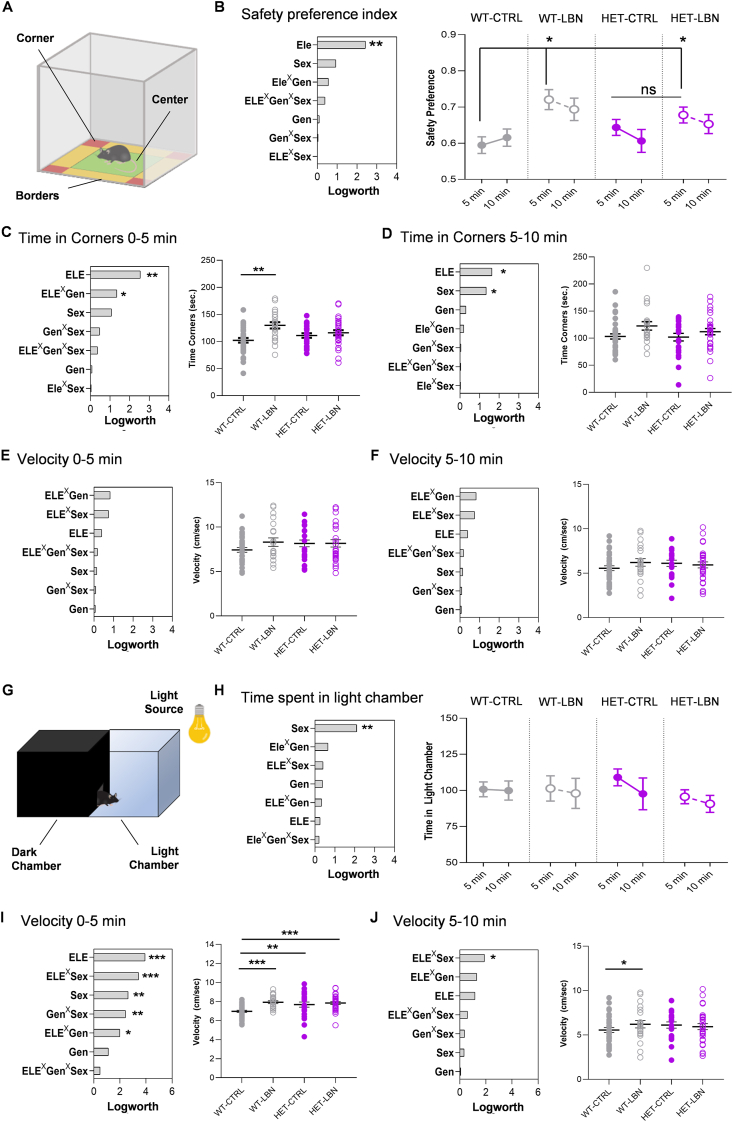
LBN induces anxiogenic behaviors that are mitigated by Cntnap2 haploinsufficiency (A) Graphical depiction of the Open Field arena and its partitions. (BF) Left panels: charts summarizing the quantification of the main effect of the covariates included in the model; Right charts: depict the results of multiple comparisons for the given outcome measure. (B) A main effect of ELE determines a preference for the safe areas of the OF arena (corners) in both WT and HET-LBN groups, specifically during the first 5 min of the test. (C) During the first 5 min of the test, WT-LBN spend significantly more time in the corners compared to WT-CTRL, highlighting a main effect of both early-life experience (ELE) and the interaction between ELE and genotype (ELExGen). (D) A main effect of the ELE persists during the 5–10 min interval, but group differences are abolished. (E, F) No differences in the velocity indicates that neither ELS nor CNTNAP2 mutation have an impact on the locomotor activity. (G) Graphical depiction of the L/D arena and its partitions. (H) A remarkable effect of sex was found in the time spent in the light chamber, but no impact of either ELE or Genotype. (I) Both ELE and Genotype, as well as sex have a significant impact on the mice velocity in the light chamber during the first 5 min of the L/D test, resulting in a significant increase in all groups compared to WT-CTRL. (J) Only WT-LBN group maintain significantly higher speed in the second half of the test. See Fig. S2 for further details on sex differences. ELE = early-life experience; Gen = genotype; X indicates interaction. ∗p < 0.05/∗∗p < 0.001/∗∗∗p < 0.0001.
Fig. 3
Fig. 3
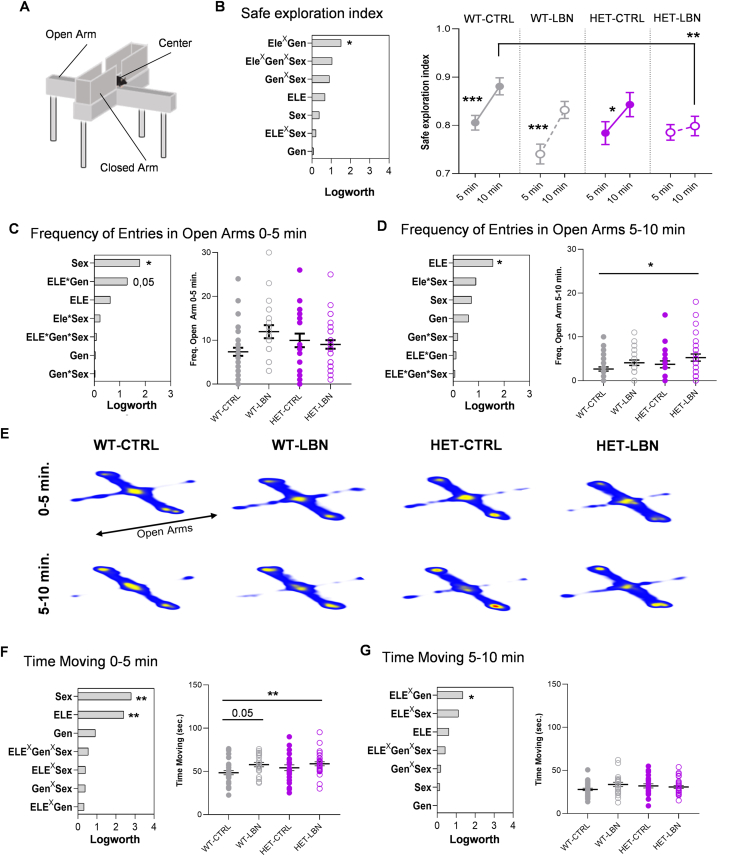
HET-LBN mice display a perseverative risk-taking behavior in the EPM. (A) Graphical depiction of the elevated plus maze and its partitions. (B-D, F, G) Left panels summarize the quantification of the main effect of the covariates included in the model. Right charts depict the results of multiple comparisons for the given outcome measure. (B) A main effect of the interaction ELEXGen affects the mice preference for a safe area (center) versus a dangerous one (open arms); during the second half of the test, the safe exploration index increases in WT-CTRL, WT-LBN and HET-CTRL, but not in HET-LBN, resulting in a significant difference with WT-CTRL. (C) During the first 5 min, the frequency of entries into the open arm does not change in neither of the groups and only a shared effect of Sex is significantly explaining the model. (D) During the 5–10 min interval, a main effect of the variable ELE is explained by a significant increase in the frequency of entries in the open arm specific for the HET-LBN group compared to WT-CTRL. (E) Representative heatmaps depicting mice activity at both the time-points of the test; note how LBN exposure to the open arm persists beyond the first 5 min. (F) A main effect of LBN was found in the time moving in the maze for the 0–5 min interval, due to a slight increase in motility in WT-LBN and a large increase in HET-LBN. (G) Group differences in the motility state are abolished in the second half of the test, while a small effect of the interaction ELEXGen emerge. ELE = early-life experience; Gen = genotype; X indicates interaction. ∗p < 0.05.
Fig. 4
Fig. 4
Successful social interaction correlates with increased risk-taking in Cntnap2+/− raised in LBN. (A) Graphical depiction of the 3-chamber arena configuration. B-D, G, H) Left panels: charts summarizing the quantification of the main effect of the covariates included in the model; Right charts: depict the results of multiple comparisons for the given outcome measure. (B) Neither of the four groups display deficient social preference, at neither time-point. (CD) Neither the time sniffing the co-specific (C) nor the social preference (D) are impacted by experimental conditions. (E) Correlation matrix between the time spent sniffing the social target and the outcome measures obtained in the stress and anxiety assessment. (F) Regression plot showing the linear relationship between the time spent sniffing the social target and the frequency of entries into the open arm. The regression coefficients were only significant in the HET-LBN group (WT-CTRL p = 0.618, WT-LBN p = 0.679, HET-CTRL p = 0.665, HET-LBN p = 0.004). (G, H) Results of the 3-chamber test after correcting the data for the effect of risk-taking behavior: (G) A main effect of the variable ELE results in HET-LBN mice spending less time sniffing the social target compared to both WT- and HET-CTRLs; (H) By consequence, HET-LBN display a lack of social preference due to a main effect of the ELE∗Gen interaction. ELE = early-life experience; Gen = genotype; X indicates interaction. ∗p < 0.05/∗∗p < 0.001/∗∗∗p < 0.0001/# indicates social preference significantly different than chance: 0.5.
Fig. 5
Fig. 5
Stratification of social-behavioral strategies suggests that HET-LBN mice are more likely to express deficits in social preference (A) Iterative k-mean clustering using the elbow method determined the presence of four distinct sociophenotypes (SPs); the pie chart shows the relative weight of each PC in explaining the variance. (B) 3D scatter plot showing the separation of the four SPs. (C) Radar plot displaying the differences in the social-behavioral strategies across the four SPs. (for each measure, data are normalized as the % change from the wholesome group mean). (D) SP2 is the only subcategory lacking a social preference. (E) Graphical depiction of the frequency distribution (%) of the SPs within each of the four experimental groups; note that SP2 is over-represented in the HET-LBN group, making it significantly divergent from WT-CTRL. (F) Multiple correspondence analysis confirms the overlap between SP2 and HET-LBN group. (G) SPs do not show any difference in the safety preference during the EPM. (H, I) By splitting the HET-LBN group based on their success in social interaction we found that: (H) mice belonging to the socially impaired SP2 do not show any alteration in their exploratory preference compared to other groups. (I) Conversely, mice from the socially successful SP1/3/4 display reduced preference for the safe option. ∗p < 0.05/# indicates social preference significantly different than chance: 0.5.
Fig. 6
Fig. 6
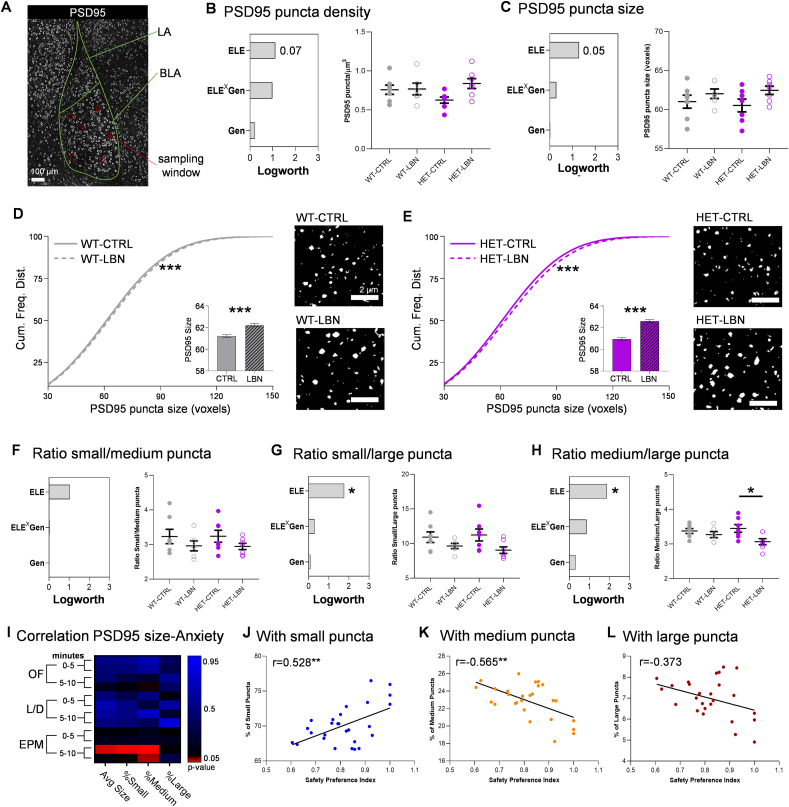
LBN promotes synaptic hypertrophy in BLA: (A) Confocal photomicrograph of the basolateral amygdala (BLA) showing the location of sampling windows used for the analysis of PSD95 puncta. (B, C, F-H) Left panels summarize the quantification of the main effect of the covariates included in the model. Right charts depict the results of multiple comparisons for the given outcome measure. (B, C) A close-to-significant effect of ELE was found in both the density (B) and size (C) of PSD95 puncta. (D, E) Analysis of the relative frequency distribution of the puncta size revealed a significant shift in favor of larger puncta in both WT-LBN and HET-LBN groups compared to their respective WT-CTRL and HET-CTRL. (F) Ratio between small and medium puncta size is unaffected by the experimental conditions. (G) The ratio between small and large puncta is significantly affected by ELE, but does not result in group differences. (H) The ratio between medium and large puncta is significantly affected by ELE, with a stronger effect displayed in HET-LBN, significantly diverging from HET-CTRL. (I) The size of PSD95-puncta selectively correlates with the safety preference index during the 5–10 min interval of the EPM. (J) The percentage of smaller-sized puncta positively correlates with the safety preference while (K) the percentage of medium-sized puncta is negatively correlated. (L) Weak negative correlation between the percentage of larger spines and safety preference (p = 0.05). ELE = early-life experience; Gen = genotype; X indicates interaction. ∗p < 0.05/∗∗p < 0.001/∗∗∗p < 0.0001.
Fig. 7
Fig. 7
Altered microglia phenotype in Cntnap2+/− mice is worsened by LBN. (A) Confocal photomicrographs showing an overview of IBA1-positive microglia cells in BLA. (B) Confocal photomicrographs capturing a detailed view of a typical microglia appearance in each of the four experimental groups (top) and paired with its relative 3D reconstruction (bottom). (C) Frequency plots showing the distribution of microglia size in the four experimental conditions as revealed by rank analysis; HET-LBN presents with a greater proportion of larger cells (between 4000 and 6000 μm3) compared to WT-CTRL and HET-CTRL (for visualization purpose, cells were categorized according to size-bins of 1000 μm3). (D, E) Left panels: charts summarizing the quantification of the main effect of the covariates included in the model; Right charts: depict the results of multiple comparisons for the given outcome measure. (D) A main effect of both ELE and ELExGen is driven by significant increase in the microglia size selective for HET-LBN (as forecast in panel C). (E) The number of CD68+ phagolysosomes per cell is selectively increased in HET-LBN, determining significant effect of both ELE and Gen and their interaction. (F) Conversely, the average volume of CD68-positive phagolysosomes per cell surface area is exclusively affected by CNTNAP2 haploinsufficiency, with significant differences observed between HET-CTRL and both WT groups. Black dots indicate values for single animal. Colored dots indicate values of single cells. ELE = early-life experience; Gen = genotype; X indicates interaction. ∗p < 0.05/∗∗p < 0.001/∗∗∗p < 0.0001.

References

    1. American Psychiatric Association . Diagnostic and Statistical Manual of Mental Disorders. Fifth Edition. American Psychiatric Publishing; Washington, DC, USA: 2022. Text Revision (DSM-5-TR), ISBN 978-0-89042-575-6.
    1. Angoa-Pérez M., Kane M.J., Briggs D.I., Francescutti D.M., Kuhn D.M. Marble burying and nestlet shredding as tests of repetitive, compulsive-like behaviors in mice. JoVE J. 2013;50978 doi: 10.3791/50978. - DOI - PMC - PubMed
    1. Arat H.E., Chouinard V.-A., Cohen B.M., Lewandowski K.E., Öngür D. Diffusion tensor imaging in first degree relatives of schizophrenia and bipolar disorder patients. Schizophr. Res. 2015;161:329–339. doi: 10.1016/j.schres.2014.12.008. - DOI - PMC - PubMed
    1. Bagheri F., Goudarzi I., Lashkarbolouki T., Elahdadi Salmani M., Goudarzi A., Morley-Fletcher S. The combined effects of perinatal ethanol and early-life stress on cognition and risk-taking behavior through oxidative stress in rats. Neurotox. Res. 2022;40:925–940. doi: 10.1007/s12640-022-00506-6. - DOI - PubMed
    1. Bora E., Özerdem A. Social cognition in first-degree relatives of patients with bipolar disorder: a meta-analysis. Eur. Neuropsychopharmacol. 2017;27:293–300. doi: 10.1016/j.euroneuro.2017.02.009. - DOI - PubMed

LinkOut - more resources