


Functions and mechanisms of long non-coding RNA in esophageal squamous cell carcinoma (Review)
- PMID: 40642605
- PMCID: PMC12242912
- DOI: 10.3892/ol.2025.15164
Functions and mechanisms of long non-coding RNA in esophageal squamous cell carcinoma (Review)
Abstract
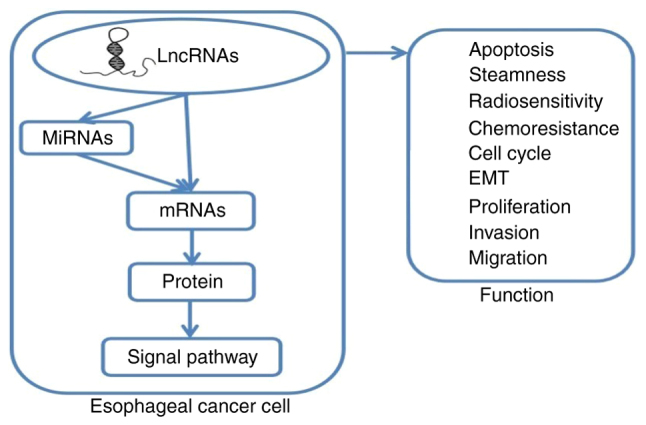
Esophageal cancer (EC) is a highly prevalent and lethal malignancy of the digestive system, characterized by a complex pathogenesis involving multigene abnormalities and epigenetic regulation. Long non-coding RNAs (lncRNAs) are key regulatory elements in esophageal squamous cell carcinoma (ESCC). lncRNAs, defined as ncRNA molecules >200 nucleotides in length, modulate gene expression through diverse mechanisms, including epigenetic modification, competing endogenous RNA networks and RNA-protein interactions. lncRNAs participate in regulating key biological processes in ESCC, such as tumor cell proliferation, invasion, metastasis, apoptosis, drug resistance, radioresistance, stem cell properties and epithelial-mesenchymal transition. The present review summarizes the regulatory roles of lncRNAs in ESCC pathophysiology and their potential clinical application, emphasizing specific regulatory axes and mechanistic pathways implicated in esophageal carcinogenesis. Future studies should explore the molecular mechanisms of lncRNAs and their translational application to improve prognostic outcomes for patients with ESCC and identify novel therapeutic targets. These efforts may provide innovative strategies and directions for advancing precision oncology in ESCC management.
Keywords: esophageal squamous cell carcinoma; function; long non-coding RNA; mechanism; prognostic.
Copyright: © 2025 Lin et al.
Conflict of interest statement
The authors declare that they have no competing interests.
Figures
References
Publication types
LinkOut - more resources
Full Text Sources